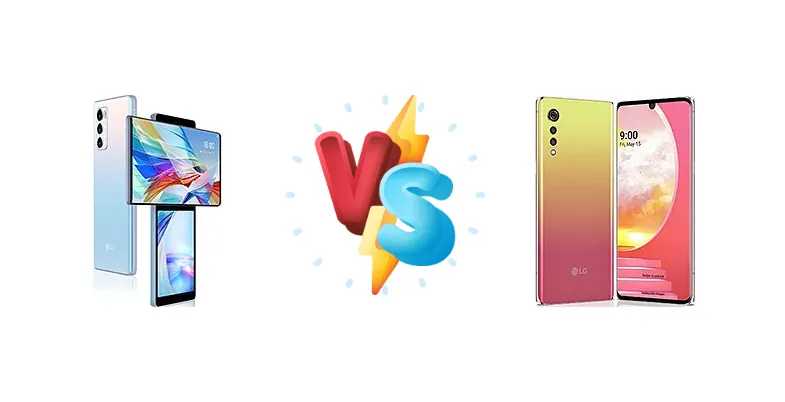
LG's 2020 5G lineup presented a fascinating dichotomy: the experimental LG Wing 5G with its unique swiveling form factor, and the more conventionally attractive LG Velvet 5G. Both devices leverage the Qualcomm Snapdragon 765G, but diverge significantly in design, battery performance, and charging capabilities. This comparison dissects these differences to determine which phone best suits your needs.
🏆 Quick Verdict
For most users, the LG Velvet 5G represents the better value. While the Wing’s innovative design is eye-catching, the Velvet’s brighter display, faster charging, and slightly better battery endurance make it a more practical daily driver. The Wing’s novelty doesn’t outweigh these core advantages.
| Network |
|---|
| 2G bands | GSM 850 / 900 / 1800 / 1900 | GSM 850 / 900 / 1800 / 1900 |
| 3G bands | HSDPA 850 / 900 / 1900 / 2100 | HSDPA 850 / 900 / 1900 / 2100 |
| 4G bands | 2, 3, 4, 5, 7, 12, 13, 20, 28, 46, 48, 66 - USA | 1, 2, 3, 4, 5, 7, 8, 12, 17, 20, 28, 32, 38, 39, 40, 41 |
| 5G bands | 2, 5, 66, 260, 261 Sub6, mmWave - USA | 1, 3, 28, 78 SA/NSA |
| Speed | HSPA, LTE, 5G | HSPA 42.2/5.76 Mbps, LTE (5CA) Cat16 1000/75 Mbps, 5G 2Gbps |
| Technology | GSM / CDMA / HSPA / LTE / 5G | GSM / HSPA / LTE / 5G |
| | CDMA 800 / 1900 | - |
| Launch |
|---|
| Announced | 2020, September 14. Released 2020, October 15 | 2020, May 07. Released 2020, May 15 |
| Status | Discontinued | Discontinued |
| Body |
|---|
| Build | Glass front (Gorilla Glass 5), glass back (Gorilla Glass 5), aluminum frame | Glass front, glass back, aluminum frame |
| Dimensions | 169.5 x 74.5 x 10.9 mm (6.67 x 2.93 x 0.43 in) | 167.2 x 74.1 x 7.9 mm (6.58 x 2.92 x 0.31 in) |
| SIM | Nano-SIM + Nano-SIM | Nano-SIM + Nano-SIM |
| Weight | 260 g (9.17 oz) | 180 g (6.35 oz) |
| | IP54, dust and water resistant
Water-repellent coating
MIL-STD-810G compliant*
*does not guarantee ruggedness or use in extreme conditions | IP68 dust/water resistant (up to 1.5m for 30 mins)
MIL-STD-810G compliant*
*does not guarantee ruggedness or use in extreme conditions |
| Display |
|---|
| Protection | Corning Gorilla Glass 5 | - |
| Resolution | 1080 x 2460 pixels (~395 ppi density) | 1080 x 2460 pixels (~395 ppi density) |
| Size | 6.8 inches, 109.8 cm2 (~87.0% screen-to-body ratio) | 6.8 inches, 109.8 cm2 (~88.6% screen-to-body ratio) |
| Type | Rotating P-OLED | P-OLED |
| | Always-on display
Secondary display: G-OLED, 1080 x 1240 pixels, 3.9 inches | - |
| Platform |
|---|
| CPU | Octa-core (1x2.4 GHz Kryo 475 Prime & 1x2.2 GHz Kryo 475 Gold & 6x1.8 GHz Kryo 475 Silver) | Octa-core (1x2.4 GHz Kryo 475 Prime & 1x2.2 GHz Kryo 475 Gold & 6x1.8 GHz Kryo 475 Silver) |
| Chipset | Qualcomm SM7250 Snapdragon 765G 5G (7 nm) | Qualcomm SM7250 Snapdragon 765G 5G (7 nm) |
| GPU | Adreno 620 | Adreno 620 |
| OS | Android 10, upgradable to Android 12 | Android 10, upgradable to Android 13, LG UX |
| Memory |
|---|
| Card slot | microSDXC (uses shared SIM slot) | microSDXC (uses shared SIM slot) |
| Internal | 128GB 8GB RAM, 256GB 8GB RAM | 128GB 6GB RAM, 128GB 8GB RAM |
| | UFS 2.1 | UFS 2.1 |
| Main Camera |
|---|
| Features | LED flash, panorama, HDR | LED flash, panorama, HDR |
| Triple | 64 MP, f/1.8, 25mm (wide), 1/1.72", 0.8µm, PDAF, OIS
13 MP, f/1.9, 117˚, (ultrawide), 1/3.4", 1.0µm
12 MP, f/2.2, 120˚, (ultrawide), 1/2.55", 1.4µm | 48 MP, f/1.8, 26mm (wide), 1/2.0", 0.8µm, PDAF
8 MP, f/2.2, 120˚, 15mm (ultrawide), 1/4.0", 1.12µm
Auxiliary lens |
| Video | 4K@30/60fps, 1080p@30/60fps, gyro-EIS | 4K@30fps, 1080p@30/60fps, gyro-EIS |
| Selfie camera |
|---|
| Features | HDR | HDR |
| Single | Motorized pop-up 32 MP, f/1.9, 26mm (wide), 1/2.8", 0.8µm | 16 MP, f/1.9, 29mm (standard), 1/3.06, 1.0µm |
| Video | 1080p@30fps | 1080p@30fps |
| Sound |
|---|
| 3.5mm jack | No | Yes |
| 35mm jack | No | Yes |
| Loudspeaker | Yes | Yes, with stereo speakers |
| Comms |
|---|
| Bluetooth | 5.1, A2DP, LE, aptX | 5.1, A2DP, LE, aptX HD |
| NFC | Yes | Yes |
| Positioning | GPS (L1+L5), GLONASS, BDS, GALILEO, QZSS | GPS (L1+L5), GLONASS, BDS, GALILEO, QZSS |
| Radio | FM radio | FM radio (market/region dependent) |
| USB | USB Type-C 3.1, OTG | USB Type-C, OTG |
| WLAN | Wi-Fi 802.11 a/b/g/n/ac, dual-band, Wi-Fi Direct, DLNA | Wi-Fi 802.11 a/b/g/n/ac, dual-band, Wi-Fi Direct, DLNA |
| Features |
|---|
| Sensors | Fingerprint (under display, optical), accelerometer, gyro, proximity, compass | Fingerprint (under display, optical), accelerometer, gyro, proximity, compass, barometer |
| Battery |
|---|
| Charging | Wired, QC4
13W wireless | 25W wired, PD3.0, QC4
9W wireless |
| Type | Li-Po 4000 mAh | Li-Po 4300 mAh |
| Misc |
|---|
| Colors | Aurora Gray, Illusion Sky | Aurora White, Aurora Green, Aurora Gray, Illusion Sunset, Red, Pink |
| Models | LMF100N, LM-F100N, LM-F100V, LM-F100 | LM-G900N, LM-G900EM, LM-G900, LM-G900TM |
| Price | About 850 EUR | About 470 EUR |
| SAR | 1.13 W/kg (head) 1.06 W/kg (body) | 0.23 W/kg (head) 1.02 W/kg (body) |
| Tests |
|---|
| Battery life | Endurance rating 87h | Endurance rating 79h |
| Camera |
Photo / Video |
Photo / Video |
| Display |
Contrast ratio: Infinite (nominal) |
Contrast ratio: Infinite (nominal) |
| Loudspeaker |
-30.9 LUFS (Below average) |
-23.5 LUFS (Very good) |
| Performance |
AnTuTu: 315688 (v8)
GeekBench: 7898 (v4.4), 1952 (v5.1)
GFXBench: 17fps (ES 3.1 onscreen) |
AnTuTu: 297372 (v8)
GeekBench: 1905 (v5.1)
GFXBench: 16fps (ES 3.1 onscreen) |
LG Wing 5G
- Unique swiveling form factor for enhanced multitasking
- Slightly longer battery endurance (87h)
- Faster wireless charging (13W)
- Slower wired charging (13W)
- Potentially more prone to durability issues due to moving parts
- May experience more thermal throttling
LG Velvet 5G
- Brighter display (617 nits)
- Faster wired charging (25W with PD3.0/QC4)
- More conventional and durable design
- Slightly shorter battery endurance (79h)
- Slower wireless charging (9W)
- Less innovative design
Display Comparison
The LG Velvet 5G boasts a brighter display, reaching 617 nits compared to the Wing’s 586 nits. While both feature an 'Infinite' contrast ratio (typical for OLED panels), the higher peak brightness of the Velvet translates to better visibility in direct sunlight. Both displays share the same resolution and panel technology, but the Velvet’s superior brightness is a tangible benefit for outdoor use. The Velvet’s more conventional form factor also avoids the potential for screen creasing or durability concerns associated with the Wing’s swiveling mechanism.
Camera Comparison
Both phones share a similar camera setup, focusing on photo and video capabilities. However, detailed sensor information is lacking in the provided data. Given LG’s history, it’s likely both phones feature capable main sensors, but without specifics on megapixel count, aperture, or sensor size, a definitive comparison is impossible. The Velvet’s more stable form factor may offer a slight advantage for video recording, minimizing shake compared to the Wing’s swiveling design. The absence of detail on secondary cameras (ultrawide, macro) prevents a thorough assessment.
Performance
Both the LG Wing 5G and Velvet 5G are powered by the Qualcomm Snapdragon 765G 5G (7 nm) chipset, featuring an octa-core CPU configuration (1x2.4 GHz Kryo 475 Prime, 1x2.2 GHz Kryo 475 Gold, and 6x1.8 GHz Kryo 475 Silver). Performance will be virtually identical in most tasks. However, the Wing’s more complex design might lead to slightly more thermal throttling under sustained load, potentially impacting prolonged gaming sessions. The shared chipset means both devices benefit from 5G connectivity, but real-world speeds will depend on network availability.
Battery Life
The LG Wing 5G offers an endurance rating of 87 hours, while the Velvet 5G achieves 79 hours. This suggests the Wing has a slight edge in overall battery life, despite the Velvet’s faster charging capabilities. However, the Velvet supports 25W wired charging with PD3.0 and QC4, significantly faster than the Wing’s QC4-only 13W wired charging. The Velvet also offers a more practical charging experience with its faster speeds, reducing downtime. Wireless charging is available on both, but the Velvet’s 9W output is slightly slower than the Wing’s 13W.
Buying Guide
Buy the LG Wing 5G if you prioritize a truly unique smartphone experience and are willing to trade some battery life and charging speed for its swiveling secondary screen. This is ideal for power users who frequently multitask or consume media. Buy the LG Velvet 5G if you prefer a more refined and conventional smartphone with a vibrant display, faster charging, and a more manageable form factor. This is the better choice for everyday users who value simplicity and reliability.
Frequently Asked Questions
❓ Does the LG Wing's swiveling mechanism feel durable in long-term use?
The LG Wing's swiveling mechanism is a potential point of failure. While LG claimed rigorous testing, the long-term durability remains a concern. Dust and debris could potentially affect the smooth operation of the swivel over time, and the hinge itself could be susceptible to wear and tear.
❓ How much faster is the LG Velvet's 25W charging compared to the Wing's 13W charging in real-world scenarios?
The LG Velvet's 25W charging significantly reduces charging time. Expect a 0-100% charge in approximately 60-75 minutes, compared to potentially over 100 minutes with the Wing's 13W charging. This difference is particularly noticeable for users who frequently need to quickly top up their battery.
❓ Is the Snapdragon 765G chipset sufficient for demanding games on either device?
The Snapdragon 765G is a capable mid-range chipset, but it's not a flagship performer. It can handle most games at medium to high settings, but you may experience some frame drops or stuttering in the most graphically intensive titles. The Wing's potentially higher thermal throttling could exacerbate these issues.