
LG Wing 5G vs. Google Pixel 6a: A Clash of Innovation and AI
| Phones Images | |||||
|---|---|---|---|---|---|
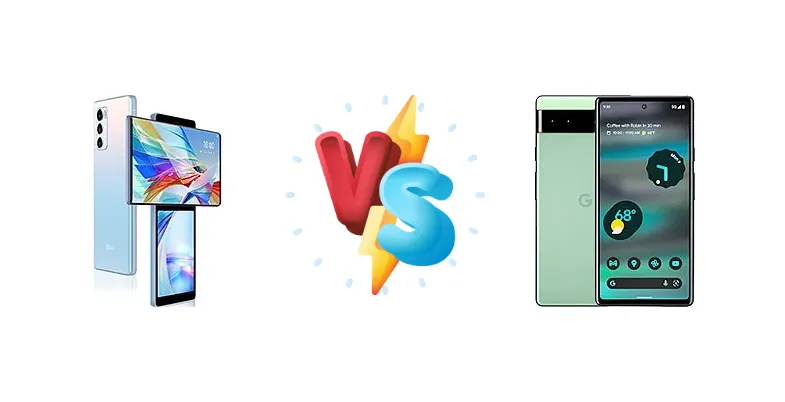
|
🏆 Quick Verdict
For most users, the Google Pixel 6a emerges as the stronger choice. Its Google Tensor chipset provides a significant performance advantage, coupled with superior software support and a brighter, more modern display. While the LG Wing 5G’s unique form factor is intriguing, its older chipset and limited software updates diminish its long-term appeal.
| PHONES | ||
|---|---|---|
| Phone Names | LG Wing 5G | Google Pixel 6a |
| Network | ||
|---|---|---|
| 2G bands | GSM 850 / 900 / 1800 / 1900 | GSM 850 / 900 / 1800 / 1900 |
| 3G bands | HSDPA 850 / 900 / 1900 / 2100 | HSDPA 800 / 850 / 900 / 1700(AWS) / 1900 / 2100 |
| 4G bands | 2, 3, 4, 5, 7, 12, 13, 20, 28, 46, 48, 66 - USA | 1, 2, 3, 4, 5, 7, 8, 12, 13, 14, 17, 18, 19, 20, 25, 26, 28, 29, 30, 38, 39, 40, 41, 42, 48, 66, 71 - GX7AS, GB62Z (USA/Canada) |
| 5G bands | 2, 5, 66, 260, 261 Sub6, mmWave - USA | 1, 2, 3, 5, 7, 8, 12, 20, 25, 28, 30, 38, 40, 41, 48, 66, 71, 77, 78 SA/NSA/Sub6 - GX7AS (USA/Canada) |
| Speed | HSPA, LTE, 5G | HSPA, LTE, 5G |
| Technology | GSM / CDMA / HSPA / LTE / 5G | GSM / HSPA / LTE / 5G |
| CDMA 800 / 1900 | 1, 2, 3, 5, 7, 8, 12, 20, 25, 28, 30, 40, 48, 66, 71, 77, 78 SA/NSA/Sub6 - G1AZG (International) | |
| Launch | ||
|---|---|---|
| Announced | 2020, September 14. Released 2020, October 15 | 2022, May 11 |
| Status | Discontinued | Available. Released 2022, July 21 |
| Body | ||
|---|---|---|
| Build | Glass front (Gorilla Glass 5), glass back (Gorilla Glass 5), aluminum frame | Glass front (Gorilla Glass 3), aluminum frame, plastic back |
| Dimensions | 169.5 x 74.5 x 10.9 mm (6.67 x 2.93 x 0.43 in) | 152.2 x 71.8 x 8.9 mm (5.99 x 2.83 x 0.35 in) |
| SIM | Nano-SIM + Nano-SIM | Nano-SIM + eSIM |
| Weight | 260 g (9.17 oz) | 178 g (6.28 oz) |
| IP54, dust and water resistant Water-repellent coating MIL-STD-810G compliant* *does not guarantee ruggedness or use in extreme conditions | IP67 dust/water resistant (up to 1m for 30 min) | |
| Display | ||
|---|---|---|
| Protection | Corning Gorilla Glass 5 | Corning Gorilla Glass 3 |
| Resolution | 1080 x 2460 pixels (~395 ppi density) | 1080 x 2400 pixels, 20:9 ratio (~429 ppi density) |
| Size | 6.8 inches, 109.8 cm2 (~87.0% screen-to-body ratio) | 6.1 inches, 90.7 cm2 (~83.0% screen-to-body ratio) |
| Type | Rotating P-OLED | OLED, HDR |
| Always-on display Secondary display: G-OLED, 1080 x 1240 pixels, 3.9 inches | Always-on display | |
| Platform | ||
|---|---|---|
| CPU | Octa-core (1x2.4 GHz Kryo 475 Prime & 1x2.2 GHz Kryo 475 Gold & 6x1.8 GHz Kryo 475 Silver) | Octa-core (2x2.80 GHz Cortex-X1 & 2x2.25 GHz Cortex-A76 & 4x1.80 GHz Cortex-A55) |
| Chipset | Qualcomm SM7250 Snapdragon 765G 5G (7 nm) | Google Tensor (5 nm) |
| GPU | Adreno 620 | Mali-G78 MP20 |
| OS | Android 10, upgradable to Android 12 | Android 12, upgradable to Android 15, up to 5 major Android upgrades |
| Memory | ||
|---|---|---|
| Card slot | microSDXC (uses shared SIM slot) | No |
| Internal | 128GB 8GB RAM, 256GB 8GB RAM | 128GB 6GB RAM |
| UFS 2.1 | UFS 3.1 | |
| Main Camera | ||
|---|---|---|
| Dual | - | 12.2 MP, f/1.7, 27mm, (wide), 1/2.55", 1.4µm, dual pixel PDAF, OIS 12 MP, f/2.2, 17mm, 114˚ (ultrawide), 1.25µm |
| Features | LED flash, panorama, HDR | Dual-LED flash, Pixel Shift, Auto-HDR, panorama |
| Single | - | 8 MP, f/2.0, 24mm (wide), 1.12µm |
| Triple | 64 MP, f/1.8, 25mm (wide), 1/1.72", 0.8µm, PDAF, OIS 13 MP, f/1.9, 117˚, (ultrawide), 1/3.4", 1.0µm 12 MP, f/2.2, 120˚, (ultrawide), 1/2.55", 1.4µm | - |
| Video | 4K@30/60fps, 1080p@30/60fps, gyro-EIS | 4K@30/60fps, 1080p@30/60/120/240fps; gyro-EIS, OIS |
| Selfie camera | ||
|---|---|---|
| Features | HDR | HDR, panorama |
| Single | Motorized pop-up 32 MP, f/1.9, 26mm (wide), 1/2.8", 0.8µm | 8 MP, f/2.0, 24mm (wide), 1.12µm |
| Video | 1080p@30fps | 1080p@30fps |
| Sound | ||
|---|---|---|
| 3.5mm jack | No | No |
| 35mm jack | No | No |
| Loudspeaker | Yes | Yes, with stereo speakers |
| Comms | ||
|---|---|---|
| Bluetooth | 5.1, A2DP, LE, aptX | 5.2, A2DP, LE |
| NFC | Yes | Yes |
| Positioning | GPS (L1+L5), GLONASS, BDS, GALILEO, QZSS | GPS, GLONASS, GALILEO, QZSS |
| Radio | FM radio | No |
| USB | USB Type-C 3.1, OTG | USB Type-C 3.1 |
| WLAN | Wi-Fi 802.11 a/b/g/n/ac, dual-band, Wi-Fi Direct, DLNA | Wi-Fi 802.11 a/b/g/n/ac/6e, dual-band, Wi-Fi Direct |
| Features | ||
|---|---|---|
| Sensors | Fingerprint (under display, optical), accelerometer, gyro, proximity, compass | Fingerprint (under display, optical), accelerometer, gyro, proximity, compass, barometer |
| Battery | ||
|---|---|---|
| Charging | Wired, QC4 13W wireless | 18W wired, PD3.0 |
| Type | Li-Po 4000 mAh | Li-Po 4410 mAh |
| Misc | ||
|---|---|---|
| Colors | Aurora Gray, Illusion Sky | Chalk, Charcoal, Sage |
| Models | LMF100N, LM-F100N, LM-F100V, LM-F100 | GX7AS, GB62Z, G1AZG, GB17L |
| Price | About 850 EUR | $ 138.99 / C$ 228.74 / ₹ 23,999 |
| SAR | 1.13 W/kg (head) 1.06 W/kg (body) | - |
| Tests | ||
|---|---|---|
| Battery life | Endurance rating 87h | Endurance rating 94h |
| Camera | Photo / Video | - |
| Display | Contrast ratio: Infinite (nominal) | Contrast ratio: Infinite (nominal) |
| Loudspeaker | -30.9 LUFS (Below average) | - |
| Performance | AnTuTu: 315688 (v8) GeekBench: 7898 (v4.4), 1952 (v5.1) GFXBench: 17fps (ES 3.1 onscreen) | - |
LG Wing 5G
- Unique swiveling dual-screen form factor
- Wireless charging support
- Solid battery endurance (87h)
- Older Snapdragon 765G chipset
- Limited software update support
- Dimmer display compared to Pixel 6a
Google Pixel 6a
- Powerful Google Tensor chipset
- Excellent camera with Google’s AI processing
- Guaranteed software updates
- Brighter display for outdoor visibility
- No wireless charging
- More conventional design
- Slightly lower battery endurance rating (94h)
Display Comparison
The Pixel 6a boasts a significantly brighter display, reaching 876 nits compared to the Wing 5G’s 586 nits. This translates to vastly improved visibility outdoors under direct sunlight. Both displays share an 'Infinite' (nominal) contrast ratio, suggesting deep blacks, but the Pixel 6a’s higher brightness provides a more vibrant and engaging viewing experience. The Wing 5G’s dual-screen setup offers expanded screen real estate, but the secondary screen’s quality is likely lower than the Pixel 6a’s primary panel.
Camera Comparison
While both phones offer photo and video capabilities, the Pixel 6a benefits from Google’s renowned computational photography expertise. Although sensor sizes aren't specified, the Pixel 6a’s image processing algorithms excel in dynamic range, low-light performance, and overall image quality. The LG Wing 5G’s camera system is likely competent, but lacks the software optimizations that elevate the Pixel 6a’s camera to a class-leading level. The absence of detailed camera specs for the Wing 5G makes a precise comparison difficult, but Google’s track record suggests a clear advantage for the Pixel.
Performance
Google’s Tensor chip in the Pixel 6a represents a substantial leap in processing power over the Qualcomm Snapdragon 765G found in the LG Wing 5G. The Tensor’s octa-core configuration, featuring 2x2.80 GHz Cortex-X1 cores, delivers faster application loading, smoother multitasking, and improved AI processing for features like voice recognition and image processing. The Snapdragon 765G, while capable, is a generation behind and built on a larger 7nm process compared to the Tensor’s 5nm node, resulting in lower efficiency and potential for thermal throttling under sustained load.
Battery Life
Both devices achieve similar endurance ratings, with the Pixel 6a at 94 hours and the LG Wing 5G at 87 hours. However, the Pixel 6a achieves this with a more power-efficient chipset. The Pixel 6a supports 18W wired charging with PD3.0, while the Wing 5G offers QC4 wired charging and 13W wireless charging. The Pixel 6a’s faster wired charging provides a quicker top-up, while the Wing 5G offers the convenience of wireless charging, a feature absent on the Pixel 6a.
Buying Guide
Buy the LG Wing 5G if you prioritize a genuinely unique smartphone experience and are willing to accept compromises in performance and software support. The swiveling form factor offers multitasking possibilities not found elsewhere. Buy the Google Pixel 6a if you value a smooth, responsive user experience, excellent camera capabilities powered by Google’s AI, and guaranteed software updates for years to come. It’s the pragmatic choice for everyday use.