
LG Wing 5G vs. Google Pixel 6: A Deep Dive into Innovation and AI
| Phones Images | |||||
|---|---|---|---|---|---|
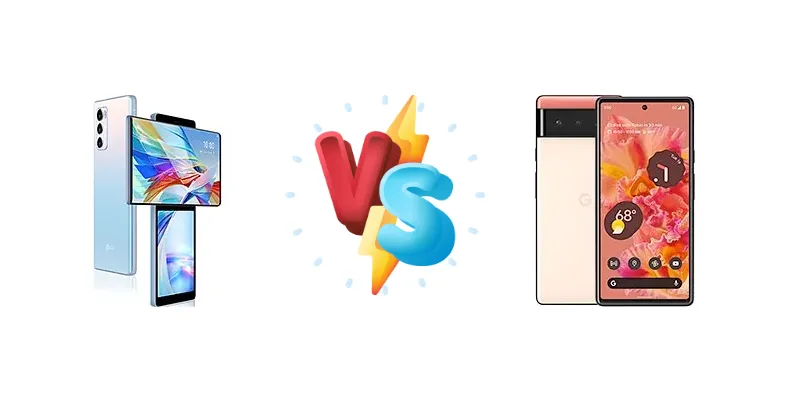
|
🏆 Quick Verdict
For most users, the Google Pixel 6 emerges as the superior choice. While the LG Wing 5G’s dual-screen is a unique feature, the Pixel 6’s significantly more powerful Google Tensor chipset, superior software support, and comparable battery life deliver a more polished and future-proof experience. The Wing's age and potential software support issues further solidify the Pixel 6's advantage.
| PHONES | ||
|---|---|---|
| Phone Names | LG Wing 5G | Google Pixel 6 |
| Network | ||
|---|---|---|
| 2G bands | GSM 850 / 900 / 1800 / 1900 | GSM 850 / 900 / 1800 / 1900 |
| 3G bands | HSDPA 850 / 900 / 1900 / 2100 | HSDPA 800 / 850 / 900 / 1700(AWS) / 1900 / 2100 |
| 4G bands | 2, 3, 4, 5, 7, 12, 13, 20, 28, 46, 48, 66 - USA | 1, 2, 3, 4, 5, 7, 8, 12, 13, 14, 17, 18, 19, 20, 25, 26, 28, 29, 30, 32, 38, 39, 40, 41, 42, 46, 48, 66, 71 - GB7N6, G9S9B16 |
| 5G bands | 2, 5, 66, 260, 261 Sub6, mmWave - USA | 1, 2, 3, 5, 7, 8, 12, 14, 20, 25, 28, 30, 38, 40, 41, 48, 66, 71, 77, 78, 257, 258, 260, 261 SA/NSA/Sub6/mmWave - G9S9B |
| Speed | HSPA, LTE, 5G | HSPA, LTE, 5G |
| Technology | GSM / CDMA / HSPA / LTE / 5G | GSM / CDMA / HSPA / EVDO / LTE / 5G |
| CDMA 800 / 1900 | 1, 2, 3, 5, 7, 8, 12, 14, 20, 25, 28, 30, 38, 40, 41, 48, 66, 71, 77, 78 SA/NSA/Sub6 - GB7N6 | |
| Launch | ||
|---|---|---|
| Announced | 2020, September 14. Released 2020, October 15 | 2021, October 19 |
| Status | Discontinued | Available. Released 2021, October 28 |
| Body | ||
|---|---|---|
| Build | Glass front (Gorilla Glass 5), glass back (Gorilla Glass 5), aluminum frame | Glass front (Gorilla Glass Victus), glass back (Gorilla Glass 6), aluminum frame |
| Dimensions | 169.5 x 74.5 x 10.9 mm (6.67 x 2.93 x 0.43 in) | 158.6 x 74.8 x 8.9 mm (6.24 x 2.94 x 0.35 in) |
| SIM | Nano-SIM + Nano-SIM | Nano-SIM + eSIM |
| Weight | 260 g (9.17 oz) | 207 g (7.30 oz) |
| IP54, dust and water resistant Water-repellent coating MIL-STD-810G compliant* *does not guarantee ruggedness or use in extreme conditions | IP68 dust/water resistant (up to 1.5m for 30 min) | |
| Display | ||
|---|---|---|
| Protection | Corning Gorilla Glass 5 | Corning Gorilla Glass Victus |
| Resolution | 1080 x 2460 pixels (~395 ppi density) | 1080 x 2400 pixels, 20:9 ratio (~411 ppi density) |
| Size | 6.8 inches, 109.8 cm2 (~87.0% screen-to-body ratio) | 6.4 inches, 98.9 cm2 (~83.4% screen-to-body ratio) |
| Type | Rotating P-OLED | AMOLED, 90Hz, HDR10+ |
| Always-on display Secondary display: G-OLED, 1080 x 1240 pixels, 3.9 inches | Always-on display | |
| Platform | ||
|---|---|---|
| CPU | Octa-core (1x2.4 GHz Kryo 475 Prime & 1x2.2 GHz Kryo 475 Gold & 6x1.8 GHz Kryo 475 Silver) | Octa-core (2x2.80 GHz Cortex-X1 & 2x2.25 GHz Cortex-A76 & 4x1.80 GHz Cortex-A55) |
| Chipset | Qualcomm SM7250 Snapdragon 765G 5G (7 nm) | Google Tensor (5 nm) |
| GPU | Adreno 620 | Mali-G78 MP20 |
| OS | Android 10, upgradable to Android 12 | Android 12, upgradable to Android 15, up to 5 major Android upgrades |
| Memory | ||
|---|---|---|
| Card slot | microSDXC (uses shared SIM slot) | No |
| Internal | 128GB 8GB RAM, 256GB 8GB RAM | 128GB 8GB RAM, 256GB 8GB RAM |
| UFS 2.1 | UFS 3.1 | |
| Main Camera | ||
|---|---|---|
| Dual | - | 50 MP, f/1.9, 25mm (wide), 1/1.31", 1.2µm, dual pixel PDAF, OIS 12 MP, f/2.2, 17mm, 114˚ (ultrawide), 1.25µm |
| Features | LED flash, panorama, HDR | Laser AF, Dual-LED flash, Pixel Shift, Auto-HDR, panorama |
| Single | - | 8 MP, f/2.0, 24mm (wide), 1.12µm |
| Triple | 64 MP, f/1.8, 25mm (wide), 1/1.72", 0.8µm, PDAF, OIS 13 MP, f/1.9, 117˚, (ultrawide), 1/3.4", 1.0µm 12 MP, f/2.2, 120˚, (ultrawide), 1/2.55", 1.4µm | - |
| Video | 4K@30/60fps, 1080p@30/60fps, gyro-EIS | 4K@30/60fps, 1080p@30/60/120/240fps; gyro-EIS, OIS |
| Selfie camera | ||
|---|---|---|
| Features | HDR | HDR, panorama |
| Single | Motorized pop-up 32 MP, f/1.9, 26mm (wide), 1/2.8", 0.8µm | 8 MP, f/2.0, 24mm (wide), 1.12µm |
| Video | 1080p@30fps | 1080p@30fps |
| Sound | ||
|---|---|---|
| 3.5mm jack | No | No |
| 35mm jack | No | No |
| Loudspeaker | Yes | Yes, with stereo speakers |
| Comms | ||
|---|---|---|
| Bluetooth | 5.1, A2DP, LE, aptX | 5.2, A2DP, LE, aptX HD |
| NFC | Yes | Yes |
| Positioning | GPS (L1+L5), GLONASS, BDS, GALILEO, QZSS | GPS (L1+L5), GLONASS (G1), BDS (B1I+B1c+B2a), GALILEO (E1+E5a), QZSS (L1+L5) |
| Radio | FM radio | No |
| USB | USB Type-C 3.1, OTG | USB Type-C 3.1 |
| WLAN | Wi-Fi 802.11 a/b/g/n/ac, dual-band, Wi-Fi Direct, DLNA | Wi-Fi 802.11 a/b/g/n/ac/6e, dual-band, Wi-Fi Direct |
| Features | ||
|---|---|---|
| Sensors | Fingerprint (under display, optical), accelerometer, gyro, proximity, compass | Fingerprint (under display, optical), accelerometer, gyro, proximity, compass, barometer |
| Battery | ||
|---|---|---|
| Charging | Wired, QC4 13W wireless | Wired (based on 30W charger), PD3.0, 50% in 30 min 21W wireless Reverse wireless |
| Type | Li-Po 4000 mAh | Li-Ion 4614 mAh |
| Misc | ||
|---|---|---|
| Colors | Aurora Gray, Illusion Sky | Sorta Seafoam, Kinda Coral, Stormy Black |
| Models | LMF100N, LM-F100N, LM-F100V, LM-F100 | GB7N6, G9S9B16, G9S9B, GR1YH |
| Price | About 850 EUR | $ 172.48 / C$ 238.84 / £ 169.99 / € 191.89 / ₹ 23,719 |
| SAR | 1.13 W/kg (head) 1.06 W/kg (body) | - |
| Tests | ||
|---|---|---|
| Battery life | Endurance rating 87h | Endurance rating 86h |
| Camera | Photo / Video | Photo / Video |
| Display | Contrast ratio: Infinite (nominal) | Contrast ratio: Infinite (nominal) |
| Loudspeaker | -30.9 LUFS (Below average) | -26.9 LUFS (Good) |
| Performance | AnTuTu: 315688 (v8) GeekBench: 7898 (v4.4), 1952 (v5.1) GFXBench: 17fps (ES 3.1 onscreen) | AnTuTu: 676831 (v9) GeekBench: 2899 (v5.1) GFXBench: 57fps (ES 3.1 onscreen) |
LG Wing 5G
- Unique dual-screen form factor for enhanced multitasking.
- Relatively affordable price point (due to age).
- Decent battery endurance.
- Older chipset (Snapdragon 765G) offers limited performance.
- Potential software update concerns.
- Bulky and less ergonomic design.
Google Pixel 6
- Powerful Google Tensor chip for smooth performance.
- Exceptional camera quality with AI enhancements.
- Guaranteed software updates and long-term support.
- May be more expensive than the LG Wing 5G.
- Larger size may not appeal to all users.
- Potential for software bugs at launch (common with new chips).
Display Comparison
Both the LG Wing 5G and Google Pixel 6 feature displays with an infinite (nominal) contrast ratio, indicating excellent black levels. However, the LG Wing 5G boasts a measured peak brightness of 586 nits, which, while respectable, is likely surpassed by the Pixel 6, though specific data is unavailable. The Wing’s secondary screen adds a layer of complexity, potentially impacting overall viewing experience due to differing panel characteristics. The Pixel 6’s display benefits from Google’s color calibration expertise, likely resulting in more accurate color reproduction. The Wing's dual-screen setup is its defining visual feature, but the Pixel 6 likely offers a more consistent and refined single-screen experience.
Camera Comparison
Both phones offer photo and video capabilities, but the Pixel 6 leverages Google’s renowned computational photography expertise. While specific sensor details are missing, the Pixel 6’s Tensor chip includes a dedicated TPU (Tensor Processing Unit) specifically designed for accelerating AI tasks, including image processing. This results in superior image quality, particularly in challenging lighting conditions. The Wing 5G’s camera system, while capable, lacks the advanced AI algorithms that define the Pixel 6’s photographic prowess. The Pixel 6’s image processing excels in dynamic range, noise reduction, and detail preservation, making it the clear winner for photography enthusiasts. The Wing's swiveling form factor *could* offer unique shooting angles, but the software and processing power of the Pixel 6 are more impactful.
Performance
The core difference lies in the chipsets. The LG Wing 5G utilizes the Qualcomm Snapdragon 765G (7nm), an upper-midrange processor. The Google Pixel 6, however, is powered by Google’s custom Tensor chip (5nm). The 5nm fabrication process of the Tensor chip provides a significant advantage in power efficiency and transistor density compared to the 7nm Snapdragon 765G. This translates to better sustained performance and reduced thermal throttling. The Pixel 6’s CPU configuration – 2x2.80 GHz Cortex-X1, 2x2.25 GHz Cortex-A76, and 4x1.80 GHz Cortex-A55 – is architecturally superior to the Wing’s Octa-core (1x2.4 GHz Kryo 475 Prime & 1x2.2 GHz Kryo 475 Gold & 6x1.8 GHz Kryo 475 Silver), offering faster processing speeds and improved multi-tasking capabilities. Users demanding intensive tasks like gaming or video editing will find the Pixel 6 significantly more capable.
Battery Life
Both devices achieve an endurance rating of approximately 86-87 hours, suggesting comparable battery life under similar usage scenarios. However, the Pixel 6 offers significantly faster charging capabilities: wired charging based on a 30W charger (50% in 30 minutes) and 21W wireless charging with reverse wireless charging. The LG Wing 5G supports QC4 wired charging and 13W wireless charging. The Pixel 6’s faster charging speeds provide a more convenient user experience, allowing for quicker top-ups. While the overall endurance is similar, the Pixel 6’s charging ecosystem is more advanced and efficient.
Buying Guide
Buy the LG Wing 5G if you absolutely require a dual-screen experience for enhanced multitasking and are comfortable with the potential limitations of an older device, including potentially limited software updates and a less refined user experience. Buy the Google Pixel 6 if you prioritize a smooth, responsive user experience, exceptional camera performance powered by AI, and guaranteed software updates for years to come. The Pixel 6 is the better all-around smartphone for the vast majority of users.