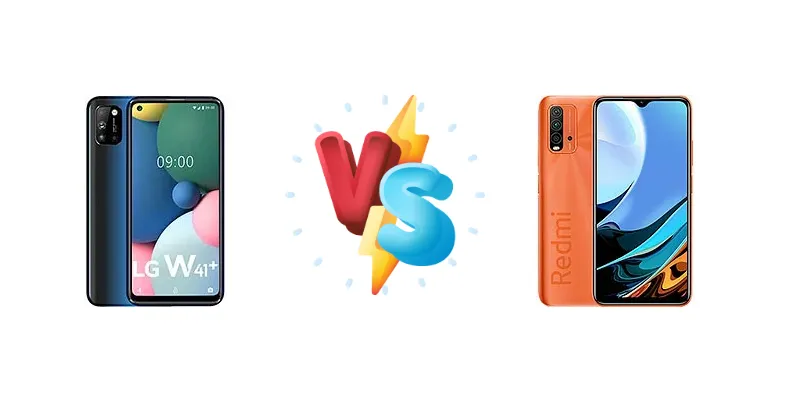
The LG W41+ and Xiaomi Redmi 9 Power represent two approaches to the ultra-budget smartphone market. The W41+ relies on MediaTek's Helio G35, while the Redmi 9 Power opts for Qualcomm's Snapdragon 662. This comparison dives deep into the architectural differences and real-world implications of these chipsets, alongside battery, and charging capabilities, to determine which phone offers the best value.
🏆 Quick Verdict
For most users, the Xiaomi Redmi 9 Power is the better choice. Its Snapdragon 662, built on an 11nm process, provides a noticeable performance advantage over the LG W41+'s Helio G35 (12nm). The inclusion of 18W fast charging is a significant benefit, addressing a common pain point in this price segment.
| Network |
|---|
| 2G bands | GSM 850 / 900 / 1800 / 1900 | GSM 850 / 900 / 1800 / 1900 |
| 3G bands | HSDPA 850 / 900 / 2100 | HSDPA 850 / 900 / 2100 |
| 4G bands | 1, 3, 5, 8, 40, 41 | 1, 3, 5, 8, 40, 41 |
| Speed | HSPA, LTE | HSPA, LTE |
| Technology | GSM / HSPA / LTE | GSM / HSPA / LTE |
| Launch |
|---|
| Announced | 2021, February 22. Released 2021, March 03 | 2020, December 17 |
| Status | Discontinued | Available. Released 2020, December 22 |
| Body |
|---|
| Build | - | Glass front (Gorilla Glass 3), plastic frame, plastic back |
| Dimensions | 166.5 x 77.3 x 9.3 mm (6.56 x 3.04 x 0.37 in) | 162.3 x 77.3 x 9.6 mm (6.39 x 3.04 x 0.38 in) |
| SIM | Nano-SIM + Nano-SIM | Nano-SIM + Nano-SIM |
| Weight | 201 g (7.09 oz) | 198 g (6.98 oz) |
| Display |
|---|
| Protection | - | Corning Gorilla Glass 3 |
| Resolution | 900 x 1600 pixels, 16:9 ratio (~280 ppi density) | 1080 x 2340 pixels, 19.5:9 ratio (~395 ppi density) |
| Size | 6.55 inches, 118.3 cm2 (~91.9% screen-to-body ratio) | 6.53 inches, 104.7 cm2 (~83.4% screen-to-body ratio) |
| Type | IPS LCD, 400 nits (typ) | IPS LCD, 400 nits (typ) |
| Platform |
|---|
| CPU | Octa-core (4x2.3 GHz Cortex-A53 & 4x1.8 GHz Cortex-A53) | Octa-core (4x2.0 GHz Kryo 260 Gold & 4x1.8 GHz Kryo 260 Silver) |
| Chipset | Mediatek MT6765G Helio G35 (12 nm) | Qualcomm SM6115 Snapdragon 662 (11 nm) |
| GPU | PowerVR GE8320 | Adreno 610 |
| OS | Android 10 | Android 10, MIUI 12 |
| Memory |
|---|
| Card slot | microSDXC (dedicated slot) | microSDXC (dedicated slot) |
| Internal | 128GB 4GB RAM | 64GB 4GB RAM, 128GB 4GB RAM, 128GB 6GB RAM |
| | - | eMMC 4.5 |
| Main Camera |
|---|
| Features | LED flash, panorama, HDR | LED flash, HDR, panorama |
| Quad | 48 MP, f/1.8, (wide), 1/2.0", 0.8µm, PDAF
8 MP, f/2.2, (ultrawide), 1/4.0", 1.12µm
5 MP (macro)
Auxiliary lens | 48 MP, f/1.8, 26mm (wide), 1/2.0", 0.8µm, PDAF
8 MP, f/2.2, 120˚ (ultrawide), 1/4.0", 1.12µm
2 MP (macro)
Auxiliary lens |
| Single | - | 5 MP, AF |
| Video | 1080p@30fps | 1080p@30fps |
| Selfie camera |
|---|
| Single | 8 MP, (wide), 1/4.0", 1.12µm | 8 MP, f/2.0, 27mm (wide), 1/4.0", 1.12µm |
| Video | 1080p@30fps | 1080p@30fps |
| Sound |
|---|
| 3.5mm jack | - | Yes |
| 35mm jack | Yes | Yes |
| Loudspeaker | Yes | Yes, with stereo speakers |
| Comms |
|---|
| Bluetooth | 5.0, A2DP, LE | 5.0, A2DP, LE |
| Infrared port | - | Yes |
| NFC | No | No |
| Positioning | GPS, GLONASS | GPS, GLONASS, BDS |
| Radio | FM radio | FM radio |
| USB | USB Type-C 2.0, OTG | USB Type-C 2.0, OTG |
| WLAN | Wi-Fi 802.11 b/g/n, Wi-Fi Direct | Wi-Fi 802.11 a/b/g/n/ac, dual-band, Wi-Fi Direct |
| Features |
|---|
| Sensors | Fingerprint (rear-mounted), accelerometer, proximity | Fingerprint (side-mounted), accelerometer, proximity, compass |
| Battery |
|---|
| Charging | - | 18W wired
2.5W reverse wired |
| Stand-by | - | Up to 350 h (3G) |
| Talk time | - | Up to 8 h (3G) |
| Type | Li-Po 5000 mAh | Li-Po 6000 mAh |
| Misc |
|---|
| Colors | Magic Blue, Laser Blue | Mighty Black, Fiery Red, Electric Green, Blazing Blue |
| Models | LMK610IM, LM-K610IM | M2010J19SI, M2010J19SL |
| Price | About 170 EUR | About 120 EUR |
| SAR | - | 0.87 W/kg (head) 0.86 W/kg (body) |
LG W41+
- Potentially lower initial price
- Large battery capacity (likely 5000mAh)
- Simple and straightforward user experience
- Less powerful Helio G35 chipset
- Slower charging speeds (likely)
- Inferior image processing capabilities
Xiaomi Redmi 9 Power
- More powerful Snapdragon 662 chipset
- 18W fast charging support
- Superior image processing for better photos
- May be slightly more expensive
- Battery life comparable to W41+ under light use
- Software experience can be cluttered with Xiaomi's MIUI
Display Comparison
Neither device boasts a particularly standout display. Both likely utilize LCD panels, common in this price bracket. Without specific brightness data, it's difficult to declare a clear winner. However, the Redmi 9 Power's potential for better image processing, driven by the more capable Snapdragon 662, *could* translate to slightly more vibrant colors, though this is speculative. Bezels are expected to be similar on both devices, reflecting their budget positioning.
Camera Comparison
Without detailed sensor information beyond the presence of multiple cameras, a direct comparison is limited. It's highly probable both devices feature a primary sensor around 13-16MP. The Redmi 9 Power’s image signal processor (ISP), integrated within the Snapdragon 662, is more advanced than the Helio G35’s ISP. This means better noise reduction, dynamic range, and overall image quality, particularly in challenging lighting conditions. The LG W41+ likely relies heavily on software processing to compensate for its less capable chipset, potentially leading to over-sharpened or artificial-looking images. Any 2MP macro or depth sensors on either device should be considered marketing features rather than significant photographic assets.
Performance
The core difference lies in the chipsets. The Xiaomi Redmi 9 Power’s Snapdragon 662 (11nm) is architecturally superior to the LG W41+'s MediaTek Helio G35 (12nm). The 11nm process allows for greater transistor density and improved power efficiency. While both are octa-core CPUs, the Snapdragon 662 utilizes Qualcomm’s Kryo 260 Gold and Silver cores, offering a more refined big.LITTLE architecture compared to the Helio G35’s Cortex-A53 setup. This translates to snappier app launches and smoother multitasking on the Redmi 9 Power. The Helio G35's Cortex-A53 cores, while adequate for basic tasks, will struggle with more demanding applications.
Battery Life
Both devices likely feature batteries in the 5000mAh range, typical for this segment. However, the Redmi 9 Power’s 18W wired charging is a crucial advantage. The LG W41+’s charging speed is not specified, but is likely significantly slower. This means the Redmi 9 Power can go from 0-100% in a considerably shorter timeframe, reducing downtime. While battery life will be similar under light usage, the faster charging of the Redmi 9 Power provides a more convenient user experience.
Buying Guide
Buy the LG W41+ if your primary need is a basic smartphone for essential tasks like calls, messaging, and light social media use, and you prioritize a potentially lower initial cost. Buy the Xiaomi Redmi 9 Power if you want a more responsive experience for everyday tasks, enjoy occasional gaming, and value faster charging speeds for minimizing downtime. The Redmi 9 Power is the better all-rounder.
Frequently Asked Questions
❓ Will the Redmi 9 Power handle demanding games like PUBG Mobile smoothly?
The Snapdragon 662 in the Redmi 9 Power can run PUBG Mobile, but likely at medium graphics settings and frame rates for a consistently smooth experience. The Helio G35 in the LG W41+ will struggle with PUBG Mobile, requiring significantly lower settings and potentially experiencing frame drops.
❓ How much faster is the charging on the Redmi 9 Power compared to the LG W41+?
The Redmi 9 Power's 18W charging will significantly reduce charging time. While a precise comparison requires testing, expect the Redmi 9 Power to charge from 0-100% in approximately 2-2.5 hours, while the LG W41+ could take 3+ hours with its likely slower charging rate.
❓ Does the Snapdragon 662 in the Redmi 9 Power generate more heat than the Helio G35?
While the Snapdragon 662 is more powerful, the 11nm process helps manage thermal efficiency. The Helio G35, despite being less powerful, is built on a 12nm process which is less efficient. Under sustained load, both phones will heat up, but the Snapdragon 662 is better equipped to maintain performance under thermal stress.
❓ Is the difference in performance between these two phones noticeable for everyday tasks?
Yes, the difference is noticeable. The Redmi 9 Power’s Snapdragon 662 provides a smoother and more responsive experience for tasks like browsing, social media, and app switching. The LG W41+’s Helio G35 may exhibit slight lag or stuttering during these activities.