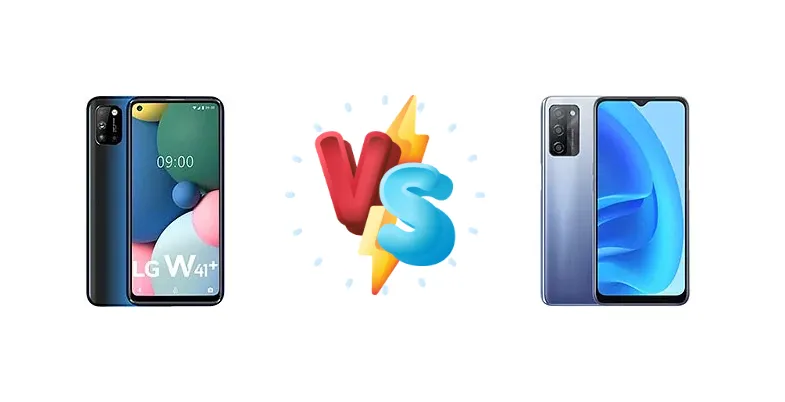
Both the LG W41+ and Oppo A55s target the entry-level smartphone market, but they approach it with vastly different silicon. The LG W41+ relies on the older Mediatek Helio G35, while the Oppo A55s boasts the more modern and powerful Dimensity 700. This comparison dissects the implications of this core difference, alongside other key features, to determine which device offers the best value.
🏆 Quick Verdict
For the average user, the Oppo A55s is the clear winner. Its Dimensity 700 chipset delivers significantly better performance, making it more suitable for multitasking, gaming, and future-proofing. While the LG W41+ may offer a slightly longer battery life due to its less powerful processor, the performance gains of the A55s outweigh this benefit.
| Network |
|---|
| 2G bands | GSM 850 / 900 / 1800 / 1900 | GSM 850 / 900 / 1800 / 1900 |
| 3G bands | HSDPA 850 / 900 / 2100 | HSDPA 800 / 850 / 900 / 1700(AWS) / 1900 / 2100 |
| 4G bands | 1, 3, 5, 8, 40, 41 | 1, 3, 5, 8, 34, 38, 39, 40, 41 |
| 5G bands | - | 1, 28, 41, 77, 78 |
| Speed | HSPA, LTE | HSPA, LTE |
| Technology | GSM / HSPA / LTE | GSM / CDMA / HSPA / LTE / 5G |
| | - | CDMA 800 |
| Launch |
|---|
| Announced | 2021, February 22. Released 2021, March 03 | 2022, April 18 |
| Status | Discontinued | Available. Released 2022, April 18 |
| Body |
|---|
| Dimensions | 166.5 x 77.3 x 9.3 mm (6.56 x 3.04 x 0.37 in) | 163.9 x 75.7 x 8.4 mm (6.45 x 2.98 x 0.33 in) |
| SIM | Nano-SIM + Nano-SIM | Nano-SIM + Nano-SIM |
| Weight | 201 g (7.09 oz) | 186 g (6.56 oz) |
| Display |
|---|
| Resolution | 900 x 1600 pixels, 16:9 ratio (~280 ppi density) | 720 x 1600 pixels, 20:9 ratio (~270 ppi density) |
| Size | 6.55 inches, 118.3 cm2 (~91.9% screen-to-body ratio) | 6.5 inches, 102.0 cm2 (~82.2% screen-to-body ratio) |
| Type | IPS LCD, 400 nits (typ) | IPS LCD, 480 nits (peak) |
| Platform |
|---|
| CPU | Octa-core (4x2.3 GHz Cortex-A53 & 4x1.8 GHz Cortex-A53) | Octa-core (2x2.2 GHz Cortex-A76 & 6x2.0 GHz Cortex-A55) |
| Chipset | Mediatek MT6765G Helio G35 (12 nm) | Mediatek Dimensity 700 (7 nm) |
| GPU | PowerVR GE8320 | Mali-G57 MC2 |
| OS | Android 10 | Android 11, ColorOS 11.1 |
| Memory |
|---|
| Card slot | microSDXC (dedicated slot) | microSDXC |
| Internal | 128GB 4GB RAM | 128GB 6GB RAM, 128GB 8GB RAM |
| Main Camera |
|---|
| Features | LED flash, panorama, HDR | LED flash, HDR, panorama |
| Quad | 48 MP, f/1.8, (wide), 1/2.0", 0.8µm, PDAF
8 MP, f/2.2, (ultrawide), 1/4.0", 1.12µm
5 MP (macro)
Auxiliary lens | - |
| Single | - | 8 MP, f/2.0, (wide) |
| Triple | - | 13 MP, f/2.2, 25mm (wide), 1/3.06", 1.12µm, PDAF
2 MP (macro)
Auxiliary lens |
| Video | 1080p@30fps | 1080p@30fps |
| Selfie camera |
|---|
| Features | - | HDR |
| Single | 8 MP, (wide), 1/4.0", 1.12µm | 8 MP, f/2.0, (wide) |
| Video | 1080p@30fps | 1080p@30fps |
| Sound |
|---|
| 3.5mm jack | - | Yes |
| 35mm jack | Yes | Yes |
| Loudspeaker | Yes | Yes |
| Comms |
|---|
| Bluetooth | 5.0, A2DP, LE | 5.1, A2DP, LE, aptX HD |
| NFC | No | No |
| Positioning | GPS, GLONASS | GPS, GLONASS, GALILEO, BDS, QZSS |
| Radio | FM radio | No |
| USB | USB Type-C 2.0, OTG | USB Type-C 2.0, OTG |
| WLAN | Wi-Fi 802.11 b/g/n, Wi-Fi Direct | Wi-Fi 802.11 a/b/g/n/ac, dual-band, Wi-Fi Direct |
| Features |
|---|
| Sensors | Fingerprint (rear-mounted), accelerometer, proximity | Fingerprint (side-mounted), accelerometer, gyro, proximity, compass |
| Battery |
|---|
| Charging | - | 10W wired |
| Type | Li-Po 5000 mAh | Li-Po 5000 mAh |
| Misc |
|---|
| Colors | Magic Blue, Laser Blue | Black, Blue, Gold |
| Models | LMK610IM, LM-K610IM | CPH2309 |
| Price | About 170 EUR | About 160 EUR |
LG W41+
- Potentially longer battery life due to less powerful chipset
- May be available at a lower price point (depending on market)
- Simpler user experience for basic tasks
- Significantly slower performance compared to the Oppo A55s
- Limited gaming capabilities
- Older chipset architecture
Oppo A55s
- Much faster performance thanks to the Dimensity 700
- More responsive user experience
- Better suited for multitasking and gaming
- More future-proof chipset
- Potentially shorter battery life compared to the LG W41+
- Slower 10W charging
- May be slightly more expensive
Display Comparison
Neither device's display specifications are provided, so a direct comparison is limited. However, given their price points, both likely utilize LCD panels. The Oppo A55s, being a newer device, may benefit from improved color calibration and viewing angles. The absence of information regarding refresh rates suggests both are likely capped at the standard 60Hz.
Camera Comparison
Without detailed camera specifications, a comprehensive comparison is impossible. However, it’s reasonable to assume both phones feature basic camera setups geared towards casual photography. The Oppo A55s, being a newer model, likely benefits from improved image processing algorithms, potentially resulting in better dynamic range and low-light performance. The presence of a larger sensor (if any) on the A55s would further enhance image quality. The LG W41+ likely relies on older, less refined image processing techniques.
Performance
The core difference lies in the chipsets. The Oppo A55s’ Mediatek Dimensity 700, built on a 7nm process, represents a substantial upgrade over the LG W41+'s 12nm Mediatek Helio G35. The Dimensity 700’s CPU configuration – 2x2.2 GHz Cortex-A76 and 6x2.0 GHz Cortex-A55 – is architecturally superior to the Helio G35’s 4x2.3 GHz Cortex-A53 & 4x1.8 GHz Cortex-A53. The Cortex-A76 cores in the A55s offer significantly higher single-core performance, crucial for responsive app launches and smoother multitasking. The 7nm process also contributes to better power efficiency, despite the higher performance. This translates to less thermal throttling during sustained workloads, benefiting gamers and power users.
Battery Life
Battery capacity isn't specified for either device. However, the Helio G35 in the LG W41+ is less power-hungry than the Dimensity 700 in the Oppo A55s. This suggests the W41+ *could* offer slightly longer battery life under identical usage conditions. However, the A55s’ 10W wired charging is significantly slower than what is commonly found in modern smartphones, potentially offsetting any battery life advantage the W41+ might have. The A55s’ more efficient chipset may also mitigate the battery drain from its higher performance.
Buying Guide
Buy the LG W41+ if your primary need is basic smartphone functionality – calls, texts, and light social media – and you prioritize maximizing battery life above all else. You're willing to accept slower app loading times and limited gaming capabilities. Buy the Oppo A55s if you want a smoother, more responsive experience, enjoy mobile gaming occasionally, and value a phone that will remain usable for longer without feeling sluggish. The A55s is the better choice for users who want a phone that can handle more than just the basics.
Frequently Asked Questions
❓ Will the Oppo A55s handle popular games like PUBG Mobile smoothly?
The Mediatek Dimensity 700 in the Oppo A55s is capable of running PUBG Mobile at medium settings with a stable frame rate. While it won't deliver the highest graphical fidelity, it provides a significantly better gaming experience than the LG W41+’s Helio G35, which would struggle with consistent performance.
❓ Is the 10W charging on the Oppo A55s a significant drawback?
Yes, 10W charging is relatively slow by today's standards. Expect a full charge to take over 3 hours. While the Dimensity 700 is more power-efficient, the slow charging speed means you'll need to plan ahead and charge the phone overnight or during extended periods of inactivity.
❓ How much of a performance difference will I notice between the Helio G35 and the Dimensity 700 in everyday tasks?
The difference will be very noticeable. The Dimensity 700's more powerful CPU cores and modern architecture will result in faster app loading times, smoother scrolling, and a more responsive overall experience. The LG W41+ will feel sluggish in comparison, especially when multitasking.