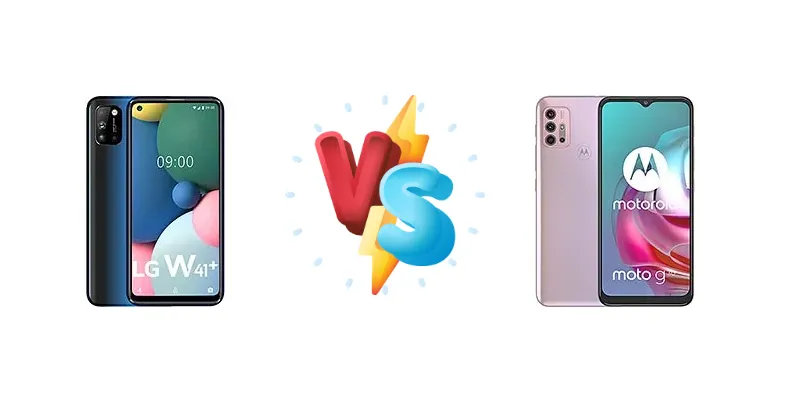
The LG W41+ and Motorola Moto G30 represent compelling options in the sub-$200 smartphone market. While both aim to deliver essential features at an accessible price, they diverge significantly in their core hardware. This comparison dissects these differences, focusing on chipset performance, display quality, and battery endurance to determine which device offers the best value.
🏆 Quick Verdict
For most users, the Motorola Moto G30 emerges as the stronger choice. Its Qualcomm Snapdragon 662 chipset, built on an 11nm process, provides a noticeable performance advantage over the LG W41+'s MediaTek Helio G35, despite both utilizing similar Cortex-A53 cores. While battery life is identical, the G30's slightly brighter display and more efficient processor give it a slight edge.
| Network |
|---|
| 2G bands | GSM 850 / 900 / 1800 / 1900 | GSM 850 / 900 / 1800 / 1900 |
| 3G bands | HSDPA 850 / 900 / 2100 | HSDPA 850 / 900 / 1700(AWS) / 1900 / 2100 |
| 4G bands | 1, 3, 5, 8, 40, 41 | 1, 2, 3, 5, 7, 8, 18, 19, 20, 26, 28, 38, 40, 41 - International |
| Speed | HSPA, LTE | HSPA 42.2/5.76 Mbps, LTE Cat4 150/50 Mbps |
| Technology | GSM / HSPA / LTE | GSM / HSPA / LTE |
| | - | 1, 2, 3, 4, 5, 7, 8, 20, 38, 40, 41 - India |
| Launch |
|---|
| Announced | 2021, February 22. Released 2021, March 03 | 2021, February 16 |
| Status | Discontinued | Available. Released 2021, March 17 |
| Body |
|---|
| Build | - | Glass front, plastic back, plastic frame |
| Dimensions | 166.5 x 77.3 x 9.3 mm (6.56 x 3.04 x 0.37 in) | 165.2 x 75.7 x 9.1 mm (6.50 x 2.98 x 0.36 in) |
| SIM | Nano-SIM + Nano-SIM | · Nano-SIM· Nano-SIM + Nano-SIM |
| Weight | 201 g (7.09 oz) | 200 g (7.05 oz) |
| | - | Water-repellent design |
| Display |
|---|
| Resolution | 900 x 1600 pixels, 16:9 ratio (~280 ppi density) | 720 x 1600 pixels, 20:9 ratio (~269 ppi density) |
| Size | 6.55 inches, 118.3 cm2 (~91.9% screen-to-body ratio) | 6.5 inches, 102.8 cm2 (~82.2% screen-to-body ratio) |
| Type | IPS LCD, 400 nits (typ) | IPS LCD, 90Hz |
| Platform |
|---|
| CPU | Octa-core (4x2.3 GHz Cortex-A53 & 4x1.8 GHz Cortex-A53) | Octa-core (4x2.0 GHz Kryo 260 Gold & 4x1.8 GHz Kryo 260 Silver) |
| Chipset | Mediatek MT6765G Helio G35 (12 nm) | Qualcomm SM6115 Snapdragon 662 (11 nm) |
| GPU | PowerVR GE8320 | Adreno 610 |
| OS | Android 10 | Android 11, upgradable to Android 12 |
| Memory |
|---|
| Card slot | microSDXC (dedicated slot) | microSDXC (uses shared SIM slot) |
| Internal | 128GB 4GB RAM | 64GB 4GB RAM, 128GB 4GB RAM, 128GB 6GB RAM |
| | - | eMMC 5.1 |
| Main Camera |
|---|
| Features | LED flash, panorama, HDR | LED flash, HDR, panorama |
| Quad | 48 MP, f/1.8, (wide), 1/2.0", 0.8µm, PDAF
8 MP, f/2.2, (ultrawide), 1/4.0", 1.12µm
5 MP (macro)
Auxiliary lens | 64 MP, f/1.7, 26mm (wide), 1/1.97", 0.7µm, PDAF
8 MP, f/2.2, 118˚ (ultrawide), 1/4.0", 1.12µm
2 MP (macro)
Auxiliary lens |
| Video | 1080p@30fps | 1080p@30/60fps |
| Selfie camera |
|---|
| Features | - | HDR |
| Single | 8 MP, (wide), 1/4.0", 1.12µm | 13 MP, f/2.2, (wide), 1/3.1", 1.12µm |
| Video | 1080p@30fps | 1080p@30fps |
| Sound |
|---|
| 3.5mm jack | - | Yes |
| 35mm jack | Yes | Yes |
| Loudspeaker | Yes | Yes |
| Comms |
|---|
| Bluetooth | 5.0, A2DP, LE | 5.0, A2DP, LE |
| NFC | No | Yes (market/region dependent) |
| Positioning | GPS, GLONASS | GPS, GLONASS, GALILEO |
| Radio | FM radio | FM radio, RDS, recording |
| USB | USB Type-C 2.0, OTG | USB Type-C 2.0, OTG |
| WLAN | Wi-Fi 802.11 b/g/n, Wi-Fi Direct | Wi-Fi 802.11 a/b/g/n/ac, dual-band, Wi-Fi Direct |
| Features |
|---|
| Sensors | Fingerprint (rear-mounted), accelerometer, proximity | Fingerprint (rear-mounted), accelerometer, gyro, proximity |
| Battery |
|---|
| Charging | - | 15W / 20W wired (market dependent) |
| Type | Li-Po 5000 mAh | Li-Po 5000 mAh |
| Misc |
|---|
| Colors | Magic Blue, Laser Blue | Phantom Black (Dark Pearl), Pastel Sky |
| Models | LMK610IM, LM-K610IM | XT2129-1, XT2129-2, PAML0000IN |
| Price | About 170 EUR | About 170 EUR |
| SAR | - | 1.11 W/kg (head) 1.32 W/kg (body) |
| Tests |
|---|
| Battery life | - |
Endurance rating 131h
|
| Camera | - |
Photo / Video |
| Display | - |
Contrast ratio: 1984:1 (nominal) |
| Loudspeaker | - |
-28.7 LUFS (Average)
|
| Performance | - |
AnTuTu: 170968 (v8)
GeekBench: 1265 (v5.1)
GFXBench: 13fps (ES 3.1 onscreen) |
LG W41+
- Potentially lower price point.
- Simple and functional user experience.
- Identical battery endurance to Moto G30.
- Less powerful chipset (Helio G35).
- Less efficient manufacturing process (12nm).
- Display brightness and panel type are unknown.
Motorola Moto G30
- More powerful and efficient chipset (Snapdragon 662).
- Brighter display (468 nits).
- Potentially faster charging (15W/20W).
- May be slightly more expensive.
- Identical battery endurance to LG W41+.
- Camera specs are not detailed.
Display Comparison
The Motorola Moto G30 boasts a display capable of reaching 468 nits of peak brightness, offering better visibility in outdoor conditions compared to the LG W41+, whose brightness is not specified. Both displays share a similar contrast ratio around 1975:1 to 1984:1, suggesting comparable color depth and black levels. However, the lack of information regarding panel technology (IPS, TFT) for the W41+ makes it difficult to assess its viewing angles and color accuracy relative to the G30’s likely IPS panel.
Camera Comparison
Both devices are listed as having 'Photo / Video' capabilities, but lack specific details regarding sensor size, aperture, or image processing features. Without this information, a direct comparison is impossible. However, given the market positioning, it’s reasonable to assume both utilize budget-oriented camera modules. The absence of details suggests neither phone will excel in low-light photography or offer advanced features like optical image stabilization (OIS).
Performance
The core difference lies in the chipsets. The Motorola Moto G30’s Qualcomm Snapdragon 662 (11nm) utilizes a more efficient manufacturing process than the LG W41+'s MediaTek Helio G35 (12nm). While both employ an octa-core configuration with Cortex-A53 cores, the Snapdragon 662’s Kryo 260 Gold cores clocked at 2.0 GHz offer a performance boost over the Helio G35’s 2.3 GHz Cortex-A53 cores. This is due to architectural improvements in the Kryo cores, resulting in better instructions per clock (IPC). The G30’s Adreno 610 GPU also surpasses the Helio G35’s IMG PowerVR GE8320 in graphical performance, making it more suitable for casual gaming.
Battery Life
Both the LG W41+ and Motorola Moto G30 achieve an endurance rating of 131 hours, indicating similar battery life under comparable usage scenarios. The Moto G30 supports 15W/20W wired charging (market dependent), while the W41+'s charging speed is unspecified. The G30’s potentially faster charging could offer a convenience advantage, reducing the time spent tethered to a power outlet, even with identical battery capacities.
Buying Guide
Buy the LG W41+ if your primary need is a simple, functional smartphone for basic tasks like calling, texting, and light social media use, and you prioritize a potentially lower initial cost. Buy the Motorola Moto G30 if you value smoother multitasking, slightly better gaming performance, and a more responsive user experience, even if it means spending a little more upfront. The G30 is the better all-rounder.
Frequently Asked Questions
❓ Will the Moto G30 struggle with demanding games like PUBG Mobile?
While the Snapdragon 662 isn't a gaming powerhouse, it can handle PUBG Mobile at medium settings with reasonable frame rates. Expect some occasional stuttering, but it's a playable experience. The Helio G35 in the LG W41+ will likely require even lower settings and may exhibit more noticeable performance drops.
❓ Does the Motorola Moto G30 support fast charging, and how long does it take to fully charge?
The Moto G30 supports 15W or 20W wired charging, depending on the market. A full charge from 0-100% is estimated to take around 2-3 hours, depending on the charger used. The LG W41+'s charging speed is not officially specified, making it difficult to compare.
❓ Is the lack of detailed camera information a major concern?
Yes, it is. Both phones likely feature basic camera setups suitable for casual snapshots. However, without knowing sensor sizes, apertures, or image processing capabilities, it's difficult to assess their low-light performance or overall image quality. Expect similar results in good lighting conditions.