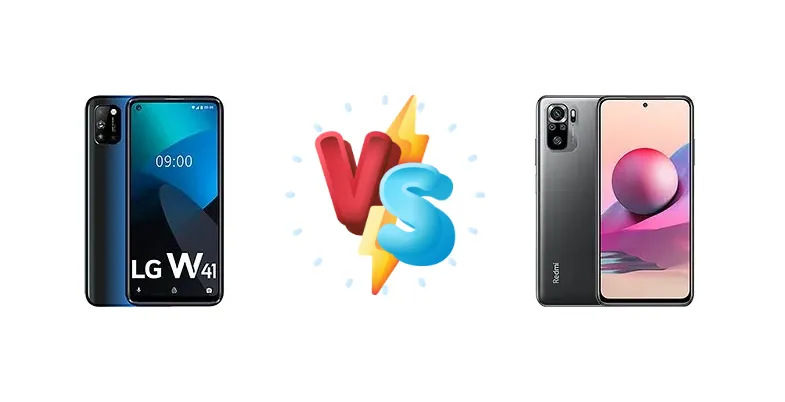
The LG W41 and Xiaomi Redmi Note 10S represent a common battleground in the budget smartphone space. Both aim to deliver a functional experience without breaking the bank, but they achieve this with different approaches to processing power and features. This comparison focuses on the core differences stemming from their respective Mediatek Helio G35 and Helio G95 chipsets, and how those translate to real-world usage.
🏆 Quick Verdict
For the average user prioritizing responsiveness and gaming, the Xiaomi Redmi Note 10S is the clear winner. Its Helio G95 chipset, featuring Cortex-A76 cores, offers a significant performance uplift over the LG W41’s Helio G35. The 33W charging is a substantial bonus, mitigating the impact of a potentially similar battery capacity.
| Network |
|---|
| 2G bands | GSM 850 / 900 / 1800 / 1900 | GSM 850 / 900 / 1800 / 1900 |
| 3G bands | HSDPA 850 / 900 / 2100 | HSDPA 850 / 900 / 1700(AWS) / 1900 / 2100 |
| 4G bands | 1, 3, 5, 8, 40, 41 | 1, 2, 3, 4, 5, 7, 8, 20, 28, 38, 40, 41 |
| Speed | HSPA, LTE | HSPA, LTE |
| Technology | GSM / HSPA / LTE | GSM / HSPA / LTE |
| Launch |
|---|
| Announced | 2021, February 22. Released 2021, March 03 | 2021, March 04 |
| Status | Discontinued | Available. Released 2021, April 28 |
| Body |
|---|
| Dimensions | 166.5 x 77.3 x 9.3 mm (6.56 x 3.04 x 0.37 in) | 160.5 x 74.5 x 8.3 mm (6.32 x 2.93 x 0.33 in) |
| SIM | Nano-SIM + Nano-SIM | Nano-SIM + Nano-SIM |
| Weight | 201 g (7.09 oz) | 178.8 g (6.31 oz) |
| | - | IP53, dust and splash resistant |
| Display |
|---|
| Protection | - | Corning Gorilla Glass 3 |
| Resolution | 900 x 1600 pixels, 16:9 ratio (~280 ppi density) | 1080 x 2400 pixels, 20:9 ratio (~409 ppi density) |
| Size | 6.55 inches, 118.3 cm2 (~91.9% screen-to-body ratio) | 6.43 inches, 99.8 cm2 (~83.5% screen-to-body ratio) |
| Type | IPS LCD, 400 nits (typ) | AMOLED, 450 nits (typ), 1100 nits (peak) |
| Platform |
|---|
| CPU | Octa-core (4x2.3 GHz Cortex-A53 & 4x1.8 GHz Cortex-A53) | Octa-core (2x2.05 GHz Cortex-A76 & 6x2.0 GHz Cortex-A55) |
| Chipset | Mediatek MT6765G Helio G35 (12 nm) | Mediatek MT6785V/CD Helio G95 (12 nm) |
| GPU | PowerVR GE8320 | Mali-G76 MC4 |
| OS | Android 10 | Android 11, upgradable to Android 13, MIUI 14 |
| Memory |
|---|
| Card slot | microSDXC (dedicated slot) | microSDXC (dedicated slot) |
| Internal | 64GB 4GB RAM | 64GB 4GB RAM, 64GB 6GB RAM, 128GB 4GB RAM, 128GB 6GB RAM, 128GB 8GB RAM |
| | eMMC 5.1 | UFS 2.2 |
| Main Camera |
|---|
| Features | LED flash, panorama, HDR | LED flash, HDR, panorama |
| Quad | 48 MP, f/1.8, (wide), 1/2.0", 0.8µm, PDAF
8 MP, f/2.2, (ultrawide), 1/4.0", 1.12µm
5 MP (macro)
Auxiliary lens | 64 MP, f/1.8, 26mm (wide), 1/1.97", 0.7µm, PDAF
8 MP, f/2.2, 118˚ (ultrawide), 1/4.0", 1.12µm
2 MP (macro)
Auxiliary lens |
| Single | 8 MP, (wide), 1/4.0", 1.12µm | 13 MP, f/2.5, (wide), 1/3.06", 1.12µm |
| Video | 1080p@30fps | 4K@30fps, 1080p@30/60/120fps, 720p@960fps |
| Selfie camera |
|---|
| Features | - | HDR |
| Single | 8 MP, (wide), 1/4.0", 1.12µm | 13 MP, f/2.5, (wide), 1/3.06", 1.12µm |
| Video | 1080p@30fps | 1080p@30fps |
| Sound |
|---|
| 3.5mm jack | Yes | Yes |
| 35mm jack | Yes | Yes |
| Loudspeaker | Yes | Yes, with stereo speakers |
| | - | 24-bit/192kHz audio |
| Comms |
|---|
| Bluetooth | 5.0, A2DP, LE | 5.1, A2DP, LE |
| Infrared port | - | Yes |
| NFC | No | Yes (market/region dependent) |
| Positioning | GPS, GLONASS | GPS, GLONASS, GALILEO, BDS |
| Radio | FM radio | FM radio |
| USB | USB Type-C 2.0, OTG | USB Type-C 2.0 |
| WLAN | Wi-Fi 802.11 b/g/n, Wi-Fi Direct | Wi-Fi 802.11 a/b/g/n/ac, dual-band, Wi-Fi Direct |
| Features |
|---|
| Sensors | Fingerprint (rear-mounted), accelerometer, proximity | Fingerprint (side-mounted), accelerometer, gyro, compass |
| | - | Virtual proximity sensing |
| Battery |
|---|
| Charging | - | 33W wired |
| Type | Li-Po 5000 mAh | Li-Po 5000 mAh |
| Misc |
|---|
| Colors | Magic Blue, Laser Blue | Deep Sea Blue (Ocean Blue), Shadow Black (Onyx Gray), (Frost White) Pebble White |
| Models | LMK610IM, LM-K610IM | M2101K7BG, M2101K7BI, M2101K7BNY, M2101K7BL |
| Price | About 160 EUR | € 101.48 / £ 135.82 / ₹ 13,999 |
| SAR | - | 1.07 W/kg (head) 0.81 W/kg (body) |
| SAR EU | - | 0.60 W/kg (head) 0.90 W/kg (body) |
LG W41
- Potentially lower price point
- Functional for basic tasks
- Mediatek Helio G35 is power efficient
- Significantly slower performance
- Likely slower charging speeds
- Less capable for gaming
Xiaomi Redmi Note 10S
- Faster and more responsive performance
- 33W fast charging
- Better gaming capabilities
- Potentially higher price
- Helio G95 may generate more heat under sustained load
- May not have a significantly larger battery capacity
Display Comparison
Neither device's display specifications are provided, so a direct comparison is limited. However, given the market positioning, both likely utilize LCD panels. The Redmi Note 10S, being a slightly more recent release, may benefit from improved color calibration and potentially higher peak brightness. Bezels are likely comparable, reflecting the budget nature of both devices. Without specific data, it's reasonable to assume display quality is not a major differentiating factor.
Camera Comparison
Without detailed camera specifications, analysis is limited. Both phones likely feature a multi-camera setup, but the Redmi Note 10S, given its slightly higher market positioning, may have a larger primary sensor. The Helio G95’s image signal processor (ISP) is also more advanced, potentially leading to better image processing, particularly in low-light conditions. The presence of a 33W charger suggests Xiaomi invested more in the overall user experience, which often extends to camera software optimization. We can assume the Redmi Note 10S will deliver more consistent and higher-quality photos.
Performance
The core difference lies in the chipsets. The LG W41’s Mediatek Helio G35 utilizes four Cortex-A53 cores clocked at 2.3 GHz and another four at 1.8 GHz. This is an older architecture focused on efficiency. The Redmi Note 10S, however, boasts the Helio G95, featuring two high-performance Cortex-A76 cores at 2.05 GHz and six Cortex-A55 cores at 2.0 GHz. The A76 cores represent a significant architectural leap, offering substantially improved single-core performance – crucial for app launch speeds and general responsiveness. This translates to a noticeably smoother user experience on the Redmi Note 10S, especially when multitasking. The G95 also has a more capable GPU, making it better suited for gaming.
Battery Life
Battery capacity isn't specified for either device. However, the Redmi Note 10S’s 33W wired charging is a major advantage. This allows for significantly faster charging times – likely a full charge in under an hour – compared to the LG W41, which likely supports a much slower charging rate. Even if the LG W41 has a slightly larger battery, the Redmi Note 10S’s faster charging mitigates any potential endurance advantage, offering more convenience for users who frequently need to top up their battery.
Buying Guide
Buy the LG W41 if you need a basic, functional smartphone for essential tasks like calls, messaging, and light social media use, and prioritize a potentially lower price point. Buy the Xiaomi Redmi Note 10S if you prefer a smoother, more responsive experience, enjoy mobile gaming, and value faster charging capabilities. The Redmi Note 10S is the better choice for users who anticipate heavier usage.
Frequently Asked Questions
❓ Will the Redmi Note 10S handle demanding games like PUBG Mobile smoothly?
The Helio G95 in the Redmi Note 10S is specifically designed for gaming. While it won't deliver flagship-level performance, it should handle PUBG Mobile at medium to high settings with playable frame rates. The Cortex-A76 cores and improved GPU provide a significant advantage over the LG W41’s Helio G35.
❓ Is the difference in performance between the Helio G35 and G95 noticeable for everyday tasks?
Yes, the difference is quite noticeable. The Helio G95’s Cortex-A76 cores provide a much snappier experience when launching apps, browsing the web, and multitasking. The LG W41’s Helio G35, while adequate for basic tasks, will feel sluggish in comparison, especially with multiple apps open.
❓ How long does it take to fully charge the Redmi Note 10S with the 33W charger?
The Redmi Note 10S’s 33W charging allows for a full charge from 0% to 100% in approximately 65-75 minutes, depending on usage during charging. This is significantly faster than the LG W41, which likely takes over two hours to fully charge.