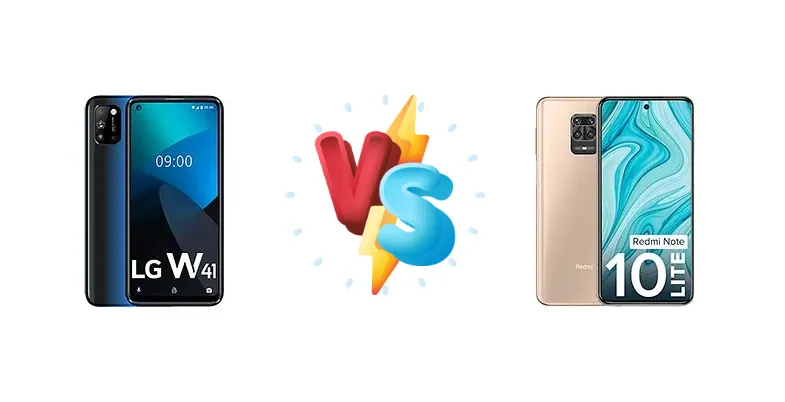
The LG W41 and Xiaomi Redmi Note 10 Lite represent two approaches to the budget smartphone market. The W41, leveraging Mediatek's Helio G35, aims for affordability, while the Redmi Note 10 Lite, powered by the Snapdragon 720G, attempts to deliver a more robust experience. This comparison dissects their core differences to determine which device offers the best value.
🏆 Quick Verdict
For the average user prioritizing performance and future-proofing, the Xiaomi Redmi Note 10 Lite is the clear winner. Its Snapdragon 720G chipset, built on an 8nm process, provides a significant performance advantage over the LG W41’s Helio G35, translating to smoother multitasking and better gaming capabilities. The 18W charging is also a welcome addition.
| Network |
|---|
| 2G bands | GSM 850 / 900 / 1800 / 1900 | GSM 850 / 900 / 1800 / 1900 |
| 3G bands | HSDPA 850 / 900 / 2100 | HSDPA 850 / 900 / 1700(AWS) / 1900 / 2100 |
| 4G bands | 1, 3, 5, 8, 40, 41 | 1, 2, 3, 4, 5, 7, 8, 20, 28, 38, 40, 41 |
| Speed | HSPA, LTE | HSPA, LTE |
| Technology | GSM / HSPA / LTE | GSM / HSPA / LTE |
| Launch |
|---|
| Announced | 2021, February 22. Released 2021, March 03 | 2021, October 01 |
| Status | Discontinued | Available. Released 2021, October 02 |
| Body |
|---|
| Build | - | Glass front (Gorilla Glass 5), glass back (Gorilla Glass 5), plastic frame |
| Dimensions | 166.5 x 77.3 x 9.3 mm (6.56 x 3.04 x 0.37 in) | 165.8 x 76.7 x 8.8 mm (6.53 x 3.02 x 0.35 in) |
| SIM | Nano-SIM + Nano-SIM | Nano-SIM + Nano-SIM |
| Weight | 201 g (7.09 oz) | 209 g (7.37 oz) |
| | - | Water-repellent coating |
| Display |
|---|
| Protection | - | Corning Gorilla Glass 5 |
| Resolution | 900 x 1600 pixels, 16:9 ratio (~280 ppi density) | 1080 x 2400 pixels, 20:9 ratio (~395 ppi density) |
| Size | 6.55 inches, 118.3 cm2 (~91.9% screen-to-body ratio) | 6.67 inches, 107.4 cm2 (~84.5% screen-to-body ratio) |
| Type | IPS LCD, 400 nits (typ) | IPS LCD |
| Platform |
|---|
| CPU | Octa-core (4x2.3 GHz Cortex-A53 & 4x1.8 GHz Cortex-A53) | Octa-core (2x2.3 GHz Kryo 465 Gold & 6x1.8 GHz Kryo 465 Silver) |
| Chipset | Mediatek MT6765G Helio G35 (12 nm) | Qualcomm SM7125 Snapdragon 720G (8 nm) |
| GPU | PowerVR GE8320 | Adreno 618 |
| OS | Android 10 | Android 10, MIUI 11 |
| Memory |
|---|
| Card slot | microSDXC (dedicated slot) | microSDXC (dedicated slot) |
| Internal | 64GB 4GB RAM | 64GB 4GB RAM, 64GB 6GB RAM, 128GB 4GB RAM, 128GB 6GB RAM |
| | eMMC 5.1 | - |
| Main Camera |
|---|
| Features | LED flash, panorama, HDR | LED flash, HDR, panorama |
| Quad | 48 MP, f/1.8, (wide), 1/2.0", 0.8µm, PDAF
8 MP, f/2.2, (ultrawide), 1/4.0", 1.12µm
5 MP (macro)
Auxiliary lens | 48 MP, f/1.9, 26mm (wide), 0.8µm, PDAF
8 MP, f/2.2, 119˚ (ultrawide), 1/4.0", 1.12µm
5 MP (macro), AF
Auxiliary lens |
| Single | 8 MP, (wide), 1/4.0", 1.12µm | 16 MP, f/2.5, (wide), 1/3.06", 1.0µm |
| Video | 1080p@30fps | 4K@30fps, 1080p@30/60/120fps, 720p@960fps, gyro-EIS |
| Selfie camera |
|---|
| Features | - | HDR, panorama |
| Single | 8 MP, (wide), 1/4.0", 1.12µm | 16 MP, f/2.5, (wide), 1/3.06", 1.0µm |
| Video | 1080p@30fps | 1080p@30fps |
| Sound |
|---|
| 3.5mm jack | Yes | Yes |
| 35mm jack | Yes | Yes |
| Loudspeaker | Yes | Yes |
| Comms |
|---|
| Bluetooth | 5.0, A2DP, LE | 5.0, A2DP, LE |
| Infrared port | - | Yes |
| NFC | No | Yes |
| Positioning | GPS, GLONASS | GPS, GLONASS, GALILEO, BDS, NavIC |
| Radio | FM radio | FM radio, recording |
| USB | USB Type-C 2.0, OTG | USB Type-C 2.0 |
| WLAN | Wi-Fi 802.11 b/g/n, Wi-Fi Direct | Wi-Fi 802.11 a/b/g/n/ac, dual-band, Wi-Fi Direct |
| Features |
|---|
| Sensors | Fingerprint (rear-mounted), accelerometer, proximity | Fingerprint (side-mounted), accelerometer, gyro, proximity, compass |
| Battery |
|---|
| Charging | - | 18W wired |
| Type | Li-Po 5000 mAh | Li-Po 5020 mAh |
| Misc |
|---|
| Colors | Magic Blue, Laser Blue | Aurora Blue, Glacier White, Interstellar Black, Champagne Gold |
| Models | LMK610IM, LM-K610IM | M2002F4LG |
| Price | About 160 EUR | About 200 EUR |
| SAR | - | 1.17 W/kg (head) 0.86 W/kg (body) |
| SAR EU | - | 1.01 W/kg (head) 1.39 W/kg (body) |
LG W41
- Potentially lower price point
- Simple and straightforward user experience
- May be more readily available in certain regions
- Significantly weaker performance
- Less efficient chipset leading to shorter battery life
- Inferior image processing capabilities
Xiaomi Redmi Note 10 Lite
- Superior performance with Snapdragon 720G
- Faster 18W wired charging
- More efficient chipset for longer battery life
- May be slightly more expensive
- Software experience (MIUI) can be polarizing
- Potential for bloatware
Display Comparison
Neither device boasts a standout display. While specific display specs (resolution, panel type) are missing for the LG W41, its market positioning suggests a standard LCD panel. The Redmi Note 10 Lite also likely features an LCD. The key difference lies in the underlying chipsets' ability to drive the display efficiently. The Snapdragon 720G’s image signal processor (ISP) will likely offer slightly better color processing, even if the panels themselves are similar. Bezels are expected to be comparable on both devices, typical of this price segment.
Camera Comparison
Without detailed camera specifications, a direct comparison is challenging. However, the Snapdragon 720G’s ISP offers superior image processing capabilities compared to the Helio G35’s. This means the Redmi Note 10 Lite is likely to produce more detailed and vibrant photos, especially in challenging lighting conditions. The Redmi Note 10 Lite’s ISP also supports more advanced features like better HDR processing and potentially more sophisticated night mode algorithms. The LG W41 will likely rely more heavily on software processing to compensate for its less capable chipset.
Performance
The performance gap is the most significant differentiator. The Xiaomi Redmi Note 10 Lite’s Qualcomm Snapdragon 720G (8nm) is a substantial upgrade over the LG W41’s Mediatek Helio G35 (12nm). The 8nm process node of the Snapdragon 720G translates to better power efficiency and reduced thermal throttling during sustained workloads. The CPU architecture also favors the Redmi Note 10 Lite; its Kryo 465 Gold cores (2x2.3 GHz) are more efficient than the Cortex-A53 cores (4x2.3 GHz) in the Helio G35. While both have Cortex-A53 cores at 1.8 GHz, the Snapdragon’s overall architecture provides a more balanced and powerful experience. This benefits gamers and users who frequently multitask.
Battery Life
Battery capacity is not specified for the LG W41, but given its budget nature, it’s likely comparable to the Redmi Note 10 Lite’s. However, the Redmi Note 10 Lite’s 18W wired charging is a significant advantage. The Helio G35’s lower power efficiency means the LG W41 will likely require more frequent charging. While both phones will likely offer all-day battery life with moderate use, the Redmi Note 10 Lite’s faster charging will minimize downtime.
Buying Guide
Buy the LG W41 if you need a basic smartphone for essential tasks like calls, messaging, and light social media use, and are on an extremely tight budget. Its primary strength is its low cost. Buy the Xiaomi Redmi Note 10 Lite if you prefer a more responsive user experience, enjoy occasional gaming, and value faster charging speeds. It’s a better investment for users who anticipate using their phone for more than just basic communication.
Frequently Asked Questions
❓ Will the Redmi Note 10 Lite handle demanding games like PUBG Mobile smoothly?
The Snapdragon 720G in the Redmi Note 10 Lite is capable of running PUBG Mobile at medium to high settings with stable frame rates. While it won't deliver a flagship gaming experience, it provides a significantly smoother experience than the Helio G35-powered LG W41, which will likely struggle with consistent performance.
❓ Is the difference in chipset performance noticeable for everyday tasks like browsing and social media?
Yes, the difference is noticeable. The Snapdragon 720G’s faster CPU and GPU result in snappier app launches, smoother scrolling, and quicker multitasking. While the LG W41 can handle basic tasks, the Redmi Note 10 Lite offers a more responsive and fluid user experience.
❓ Does the Redmi Note 10 Lite support fast charging with any charger other than the one in the box?
The Redmi Note 10 Lite supports Quick Charge 3.0, meaning you can use compatible third-party chargers to achieve faster charging speeds than standard 5W charging. However, ensure the charger is certified for Quick Charge 3.0 to avoid compatibility issues.
❓ How does the Helio G35 in the LG W41 perform with multiple apps open simultaneously?
The Helio G35 struggles with multitasking. Opening several apps can lead to noticeable lag and app reloading, as the chipset has limited resources. The LG W41 is best suited for running one app at a time.