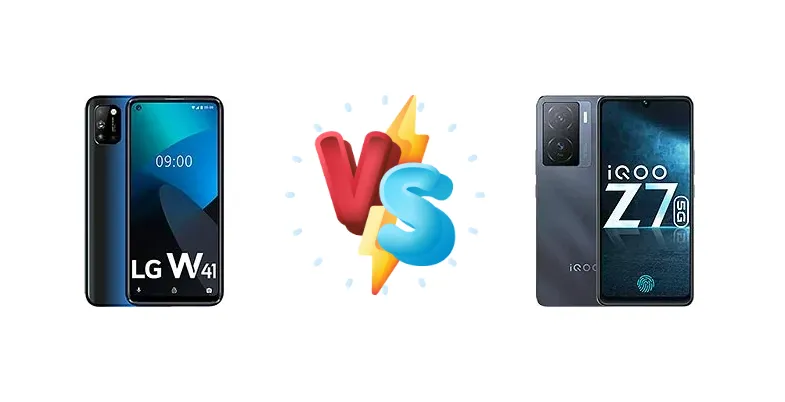
The LG W41 represents a budget-conscious approach to smartphone ownership, while the vivo iQOO Z7 aims for a sweet spot of performance and features at a slightly higher price point. This comparison dissects the core differences between these two Mediatek-powered devices, focusing on how their chipsets impact real-world usage and whether the iQOO Z7’s advancements are worth the investment.
🏆 Quick Verdict
For the average user prioritizing responsiveness and future-proofing, the vivo iQOO Z7 is the clear winner. Its Dimensity 920 chipset delivers a substantial performance uplift over the LG W41’s Helio G35, coupled with significantly faster 44W charging. While the W41 offers affordability, the Z7 provides a smoother, more capable experience.
| Network |
|---|
| 2G bands | GSM 850 / 900 / 1800 / 1900 | GSM 850 / 900 / 1800 / 1900 |
| 3G bands | HSDPA 850 / 900 / 2100 | HSDPA 850 / 900 / 2100 |
| 4G bands | 1, 3, 5, 8, 40, 41 | 1, 3, 5, 8, 38, 40, 41 |
| 5G bands | - | 1, 3, 8, 28, 77, 78 SA/NSA |
| Speed | HSPA, LTE | HSPA, LTE, 5G |
| Technology | GSM / HSPA / LTE | GSM / HSPA / LTE / 5G |
| Launch |
|---|
| Announced | 2021, February 22. Released 2021, March 03 | 2023, March 17 |
| Status | Discontinued | Available. Released 2023, March 21 |
| Body |
|---|
| Dimensions | 166.5 x 77.3 x 9.3 mm (6.56 x 3.04 x 0.37 in) | 158.9 x 73.5 x 7.8 mm (6.26 x 2.89 x 0.31 in) |
| SIM | Nano-SIM + Nano-SIM | Nano-SIM + Nano-SIM |
| Weight | 201 g (7.09 oz) | 173 g (6.10 oz) |
| | - | IP54, dust and water resistant |
| Display |
|---|
| Protection | - | Schott Xensation glass |
| Resolution | 900 x 1600 pixels, 16:9 ratio (~280 ppi density) | 1080 x 2400 pixels, 20:9 ratio (~413 ppi density) |
| Size | 6.55 inches, 118.3 cm2 (~91.9% screen-to-body ratio) | 6.38 inches, 98.3 cm2 (~84.1% screen-to-body ratio) |
| Type | IPS LCD, 400 nits (typ) | AMOLED, 90Hz, HDR10+, 1300 nits (peak) |
| Platform |
|---|
| CPU | Octa-core (4x2.3 GHz Cortex-A53 & 4x1.8 GHz Cortex-A53) | Octa-core (2x2.5 GHz Cortex-A78 & 6x2.0 GHz Cortex-A55) |
| Chipset | Mediatek MT6765G Helio G35 (12 nm) | Mediatek Dimensity 920 (6 nm) |
| GPU | PowerVR GE8320 | Mali-G68 MC4 |
| OS | Android 10 | Android 13, upgradable to Android 14, Funtouch 14 |
| Memory |
|---|
| Card slot | microSDXC (dedicated slot) | microSDXC (uses shared SIM slot) |
| Internal | 64GB 4GB RAM | 128GB 6GB RAM, 128GB 8GB RAM |
| | eMMC 5.1 | UFS 2.2 |
| Main Camera |
|---|
| Dual | - | 64 MP, (wide), 1/1.97", 0.7µm, PDAF, OIS
Auxiliary lens |
| Features | LED flash, panorama, HDR | LED flash, HDR, panorama |
| Quad | 48 MP, f/1.8, (wide), 1/2.0", 0.8µm, PDAF
8 MP, f/2.2, (ultrawide), 1/4.0", 1.12µm
5 MP (macro)
Auxiliary lens | - |
| Single | 8 MP, (wide), 1/4.0", 1.12µm | - |
| Video | 1080p@30fps | 4K@30fps, 1080p@30fps |
| Selfie camera |
|---|
| Single | 8 MP, (wide), 1/4.0", 1.12µm | 16 MP, f/2.0, (wide) |
| Video | 1080p@30fps | 1080p@30fps |
| Sound |
|---|
| 3.5mm jack | Yes | Yes |
| 35mm jack | Yes | Yes |
| Loudspeaker | Yes | Yes |
| Comms |
|---|
| Bluetooth | 5.0, A2DP, LE | 5.2, A2DP, LE |
| NFC | No | No |
| Positioning | GPS, GLONASS | GPS, GLONASS, GALILEO, BDS, QZSS |
| Radio | FM radio | Unspecified |
| USB | USB Type-C 2.0, OTG | USB Type-C 2.0, OTG |
| WLAN | Wi-Fi 802.11 b/g/n, Wi-Fi Direct | Wi-Fi 802.11 a/b/g/n/ac/6, dual-band, Wi-Fi Direct |
| Features |
|---|
| Sensors | Fingerprint (rear-mounted), accelerometer, proximity | Fingerprint (under display, optical), accelerometer, gyro, proximity, compass |
| Battery |
|---|
| Charging | - | 44W wired, 50% in 25 min |
| Type | Li-Po 5000 mAh | 4500 mAh |
| Misc |
|---|
| Colors | Magic Blue, Laser Blue | Norway Blue, Pacific Night |
| Models | LMK610IM, LM-K610IM | I2207 |
| Price | About 160 EUR | About 200 EUR |
| SAR | - | 1.15 W/kg (head) 0.84 W/kg (body) |
LG W41
- Highly affordable price point
- Simple and easy-to-use interface
- Functional for basic smartphone tasks
- Outdated Helio G35 chipset
- Slow charging speeds (likely)
- Limited performance for demanding apps
vivo iQOO Z7
- Powerful Dimensity 920 chipset
- 44W fast charging (50% in 25 min)
- Smoother user experience and gaming
- Higher price compared to the LG W41
- May not have the longest battery life (depending on capacity)
- Potentially more complex software features
Display Comparison
Neither device’s display specifications are provided, so a direct comparison is limited. However, given the W41’s positioning, it likely features a standard 60Hz LCD panel. The iQOO Z7, being a more recent and slightly higher-tier device, may incorporate a higher refresh rate (90Hz or 120Hz) LCD or AMOLED panel, resulting in smoother scrolling and animations. The Z7’s potential for a more advanced panel technology would be a noticeable benefit for media consumption and gaming.
Camera Comparison
Without detailed camera specifications, a precise comparison is difficult. However, the iQOO Z7, positioned as a more feature-rich device, likely benefits from a more sophisticated image signal processor (ISP) integrated within the Dimensity 920 chipset. This ISP would enable better noise reduction, dynamic range, and overall image quality. While both phones likely feature a multi-camera setup, the Z7’s processing capabilities will likely result in superior photos and videos, especially in challenging lighting conditions. We can assume the LG W41 will rely more heavily on software processing to compensate for a potentially less capable sensor.
Performance
The performance gap between these two devices is substantial. The iQOO Z7’s Mediatek Dimensity 920 (6nm) utilizes a more modern architecture – specifically, two Cortex-A78 cores clocked at 2.5GHz alongside six Cortex-A55 cores – compared to the LG W41’s Helio G35 (12nm) which relies on four older Cortex-A53 cores at 2.3GHz and another four at 1.8GHz. The Dimensity 920’s 6nm process also contributes to improved power efficiency and thermal management. This translates to significantly faster app loading times, smoother multitasking, and a far more enjoyable gaming experience on the iQOO Z7. The Helio G35 is adequate for basic tasks, but will struggle with demanding applications.
Battery Life
Battery capacity isn’t specified for either device. However, the iQOO Z7’s 44W wired charging is a major advantage. The ability to reach 50% charge in just 25 minutes significantly reduces downtime. The LG W41 likely supports a much slower charging speed, potentially requiring over two hours for a full charge. Even if the W41 has a slightly larger battery capacity, the Z7’s faster charging mitigates any potential disadvantage, offering greater convenience for users on the go.
Buying Guide
Buy the LG W41 if you need a functional smartphone for basic tasks like calling, texting, and light social media browsing, and your budget is extremely limited. You’ll appreciate its simplicity and affordability. Buy the vivo iQOO Z7 if you prioritize a responsive user experience, enjoy mobile gaming, or frequently multitask. The Z7’s superior chipset and faster charging will significantly enhance your daily usage.
Frequently Asked Questions
❓ Is the iQOO Z7’s Dimensity 920 chipset capable of handling graphically intensive games like PUBG or Genshin Impact?
Yes, the Dimensity 920 is a capable chipset for gaming. It offers a significant performance boost over the Helio G35, allowing for smoother frame rates and higher graphics settings in popular titles like PUBG and Genshin Impact. While it won’t match flagship-level performance, it provides a very enjoyable gaming experience for the price.
❓ How much faster is the 44W charging on the iQOO Z7 compared to a standard 10W or 15W charger?
The 44W charging on the iQOO Z7 is substantially faster. A typical 10W or 15W charger could take over 3 hours to fully charge the device, while the iQOO Z7 can reach 50% charge in just 25 minutes. This difference is particularly noticeable for users who frequently need to top up their battery throughout the day.
❓ Will the LG W41 receive future software updates and security patches?
Given the LG W41's age and positioning, the likelihood of receiving significant software updates or long-term security patches is low. This is a common trade-off with budget devices, and users should be aware of the potential security implications.