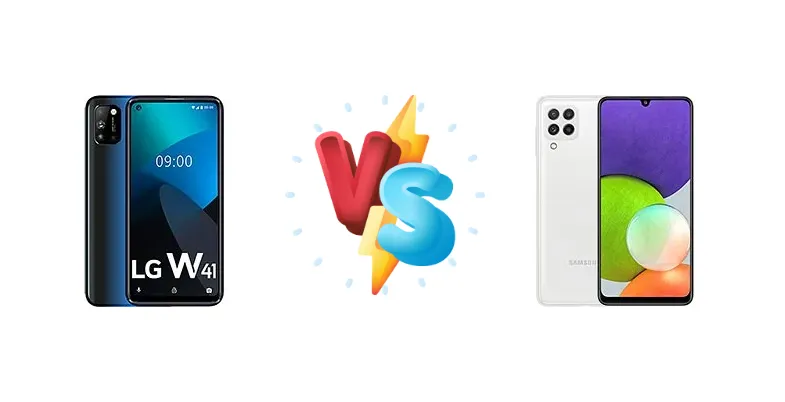
The LG W41 and Samsung Galaxy A22 represent compelling options in the ultra-budget smartphone segment. Both aim to deliver essential smartphone functionality without breaking the bank, but they achieve this with different approaches to chipset selection and feature prioritization. This comparison dives deep into the specifications to determine which device offers the best value.
🏆 Quick Verdict
For most users, the Samsung Galaxy A22 emerges as the better choice. Its Helio G80 chipset provides a noticeable performance uplift over the LG W41’s Helio G35, translating to smoother multitasking and gaming. While both phones share an identical endurance rating, the A22’s brighter display enhances usability.
| Network |
|---|
| 2G bands | GSM 850 / 900 / 1800 / 1900 | GSM 850 / 900 / 1800 / 1900 |
| 3G bands | HSDPA 850 / 900 / 2100 | HSDPA 850 / 900 / 2100 |
| 4G bands | 1, 3, 5, 8, 40, 41 | 1, 3, 5, 7, 8, 20, 28, 38, 40, 41 |
| Speed | HSPA, LTE | HSPA, LTE |
| Technology | GSM / HSPA / LTE | GSM / HSPA / LTE |
| Launch |
|---|
| Announced | 2021, February 22. Released 2021, March 03 | 2021, June 03 |
| Status | Discontinued | Available. Released 2021, July 01 |
| Body |
|---|
| Build | - | Glass front, plastic frame, plastic back |
| Dimensions | 166.5 x 77.3 x 9.3 mm (6.56 x 3.04 x 0.37 in) | 159.3 x 73.6 x 8.4 mm (6.27 x 2.90 x 0.33 in) |
| SIM | Nano-SIM + Nano-SIM | · Nano-SIM· Nano-SIM + Nano-SIM |
| Weight | 201 g (7.09 oz) | 186 g (6.56 oz) |
| Display |
|---|
| Resolution | 900 x 1600 pixels, 16:9 ratio (~280 ppi density) | 720 x 1600 pixels, 20:9 ratio (~274 ppi density) |
| Size | 6.55 inches, 118.3 cm2 (~91.9% screen-to-body ratio) | 6.4 inches, 98.9 cm2 (~84.3% screen-to-body ratio) |
| Type | IPS LCD, 400 nits (typ) | Super AMOLED, 90Hz, 600 nits |
| Platform |
|---|
| CPU | Octa-core (4x2.3 GHz Cortex-A53 & 4x1.8 GHz Cortex-A53) | Octa-core (2x2.0 GHz Cortex-A75 & 6x1.8 GHz Cortex-A55) |
| Chipset | Mediatek MT6765G Helio G35 (12 nm) | Mediatek MT6769V/CU Helio G80 (12 nm) |
| GPU | PowerVR GE8320 | Mali-G52 MC2 |
| OS | Android 10 | Android 11, upgradable to Android 13, One UI 5 |
| Memory |
|---|
| Card slot | microSDXC (dedicated slot) | microSDXC (dedicated slot) |
| Internal | 64GB 4GB RAM | 64GB 4GB RAM, 128GB 4GB RAM, 128GB 6GB RAM |
| | eMMC 5.1 | eMMC 5.1 |
| Main Camera |
|---|
| Features | LED flash, panorama, HDR | LED flash, panorama, HDR |
| Quad | 48 MP, f/1.8, (wide), 1/2.0", 0.8µm, PDAF
8 MP, f/2.2, (ultrawide), 1/4.0", 1.12µm
5 MP (macro)
Auxiliary lens | 48 MP, f/1.8, (wide), 1/2.0", 0.8µm, PDAF, OIS
8 MP, f/2.2, 123˚ (ultrawide), 1/4.0", 1.12µm
2 MP (macro)
Auxiliary lens |
| Single | 8 MP, (wide), 1/4.0", 1.12µm | 13 MP, f/2.2, (wide), 1/3.1", 1.12µm |
| Video | 1080p@30fps | 1080p@30fps |
| Selfie camera |
|---|
| Single | 8 MP, (wide), 1/4.0", 1.12µm | 13 MP, f/2.2, (wide), 1/3.1", 1.12µm |
| Video | 1080p@30fps | 1080p@30fps |
| Sound |
|---|
| 3.5mm jack | Yes | Yes |
| 35mm jack | Yes | Yes |
| Loudspeaker | Yes | Yes |
| Comms |
|---|
| Bluetooth | 5.0, A2DP, LE | 5.0, A2DP, LE |
| NFC | No | Yes (market/region dependent) |
| Positioning | GPS, GLONASS | GPS, GLONASS, GALILEO, BDS |
| Radio | FM radio | FM radio |
| USB | USB Type-C 2.0, OTG | USB Type-C 2.0 |
| WLAN | Wi-Fi 802.11 b/g/n, Wi-Fi Direct | Wi-Fi 802.11 a/b/g/n/ac, dual-band, Wi-Fi Direct |
| Features |
|---|
| Sensors | Fingerprint (rear-mounted), accelerometer, proximity | Fingerprint (side-mounted), accelerometer, gyro, compass |
| | - | Virtual proximity sensing |
| Battery |
|---|
| Charging | - | 15W wired |
| Type | Li-Po 5000 mAh | Li-Po 5000 mAh |
| Misc |
|---|
| Colors | Magic Blue, Laser Blue | Black, White, Mint, Violet |
| Models | LMK610IM, LM-K610IM | SM-A225F, SM-A225F/DS, SM-A225M, SM-A225M/DS |
| Price | About 160 EUR | € 193.97 / £ 160.00 |
| SAR EU | - | 0.52 W/kg (head) 1.59 W/kg (body) |
| Tests |
|---|
| Battery life | - |
Endurance rating 121h
|
| Camera | - |
Photo / Video |
| Display | - |
Contrast ratio: Infinite (nominal) |
| Loudspeaker | - |
-30.6 LUFS (Below average)
|
| Performance | - |
AnTuTu: 185358 (v8), 165959 (v9)
GeekBench: 5464 (v4.4), 1372 (v5.1)
GFXBench: 16fps (ES 3.1 onscreen) |
LG W41
- Potentially lower price point
- Functional for basic tasks
- Decent battery endurance
- Inferior chipset performance
- Likely lower display quality
- Limited charging information
Samsung Galaxy A22
- More powerful Helio G80 chipset
- Brighter display for better visibility
- Faster 15W charging
- May be slightly more expensive
- Camera performance relies on software
- No OIS
Display Comparison
The Samsung Galaxy A22 boasts a significantly brighter display, reaching a measured 597 nits, compared to the LG W41 which lacks published brightness data. This difference is crucial for outdoor visibility. While both displays are described as having an 'infinite' contrast ratio (a common marketing term), the A22’s higher peak brightness will deliver a more vibrant and punchy image. The lack of detailed display specifications for the W41 suggests a more basic panel, likely with lower color accuracy and viewing angles.
Camera Comparison
Both devices feature 'Photo / Video' capabilities, but lack specific details regarding sensor size or image processing. Given the price point, it’s safe to assume both rely on relatively basic camera systems. The absence of information on optical image stabilization (OIS) suggests neither phone features it. The focus should be on real-world image samples, as megapixel count is unlikely to be a differentiating factor. The A22’s brand recognition and potentially more refined software processing could yield slightly better results, but without detailed specs, it’s difficult to definitively say.
Performance
The core difference between these two phones lies in their chipsets. The Samsung Galaxy A22’s Mediatek Helio G80 utilizes a more modern CPU architecture with 2x 2.0 GHz Cortex-A75 cores and 6x 1.8 GHz Cortex-A55 cores, compared to the LG W41’s Helio G35 with 4x 2.3 GHz Cortex-A53 and 4x 1.8 GHz Cortex-A53 cores. The A75 cores in the G80 offer a substantial performance advantage in single-core tasks and improved efficiency. This translates to faster app loading times and smoother multitasking. While both are 12nm chips, the architectural improvements in the G80 provide a clear edge.
Battery Life
Interestingly, both the LG W41 and Samsung Galaxy A22 share an endurance rating of 121 hours. This suggests similar battery life in typical usage scenarios. However, the Galaxy A22 supports 15W wired charging, while the W41’s charging speed is unspecified. The faster charging on the A22 provides a convenience advantage, allowing for quicker top-ups when needed. The identical endurance rating suggests that despite potentially different battery capacities, software optimization and power efficiency are comparable.
Buying Guide
Buy the LG W41 if your primary need is a basic, functional smartphone for essential tasks like calls, messaging, and light social media use, and you prioritize a potentially lower price point. Buy the Samsung Galaxy A22 if you want a more responsive experience for everyday tasks, enjoy occasional mobile gaming, and value a brighter, more visible display, even if it means spending slightly more.
Frequently Asked Questions
❓ Is the Mediatek Helio G80 in the Galaxy A22 capable of handling popular games like PUBG Mobile?
Yes, the Helio G80 is capable of running PUBG Mobile at medium settings with reasonable frame rates. While it won't deliver a flagship gaming experience, it provides a significantly smoother experience than the Helio G35 in the LG W41, making it suitable for casual gaming.
❓ Does the Samsung Galaxy A22 support fast charging, and how long does it take to fully charge?
The Samsung Galaxy A22 supports 15W wired charging. While not the fastest charging available, it's considerably quicker than the LG W41, which lacks specified charging speeds. A full charge from 0-100% with the included charger is estimated to take around 2 hours and 30 minutes.
❓ How does the camera quality compare between the LG W41 and Samsung Galaxy A22 in low-light conditions?
Without detailed sensor information, it's difficult to say definitively. However, Samsung's image processing algorithms generally perform better in low-light scenarios, reducing noise and improving detail. Expect the Galaxy A22 to produce more usable images in challenging lighting conditions.