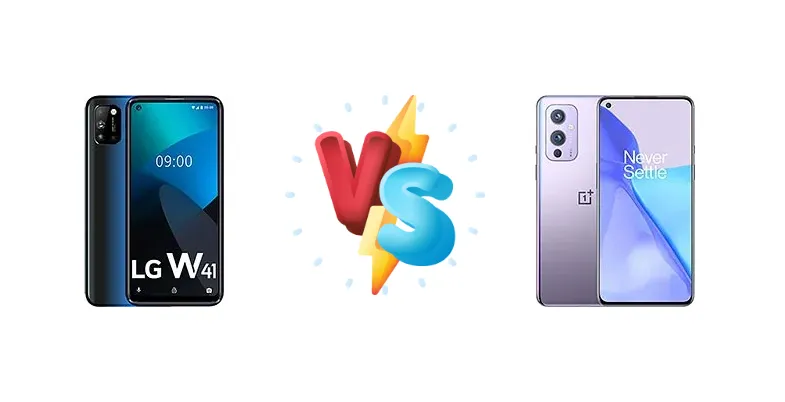
The LG W41 and OnePlus 9 represent opposite ends of the smartphone spectrum. The W41 aims to deliver essential functionality at an incredibly accessible price point, while the OnePlus 9 targets enthusiasts with flagship-level performance and features. This comparison dissects their key differences to help you determine which device best suits your priorities.
🏆 Quick Verdict
For the average user prioritizing performance and a premium experience, the OnePlus 9 is the clear winner. Its Snapdragon 888 chipset and 65W charging significantly outperform the LG W41. However, the W41 remains a viable option for those on a strict budget who need basic smartphone functionality.
| Network |
|---|
| 2G bands | GSM 850 / 900 / 1800 / 1900 | GSM 850 / 900 / 1800 / 1900 |
| 3G bands | HSDPA 850 / 900 / 2100 | HSDPA 800 / 850 / 900 / 1700(AWS) / 1800 / 1900 / 2100 |
| 4G bands | 1, 3, 5, 8, 40, 41 | 1, 2, 3, 4, 5, 7, 8, 12, 13, 17, 18, 19, 20, 25, 26, 28, 32, 38, 39, 40, 41, 66 - EU |
| 5G bands | - | 1, 3, 5, 7, 8, 20, 28, 38, 40, 41, 66, 78 SA/NSA - EU |
| Speed | HSPA, LTE | HSPA 42.2/5.76 Mbps, LTE Cat20 2000/200 Mbps, 5G |
| Technology | GSM / HSPA / LTE | GSM / CDMA / HSPA / LTE / 5G |
| | - | 1, 3, 28, 41, 78, 79 SA/NSA - CN |
| Launch |
|---|
| Announced | 2021, February 22. Released 2021, March 03 | 2021, March 23 |
| Status | Discontinued | Available. Released 2021, March 26 |
| Body |
|---|
| Build | - | Glass front (Gorilla Glass 5), glass back (Gorilla Glass 5), plastic frame |
| Dimensions | 166.5 x 77.3 x 9.3 mm (6.56 x 3.04 x 0.37 in) | 160 x 74.2 x 8.7 mm (EU/NA)160 x 73.9 x 8.1 mm (IN/CN) |
| SIM | Nano-SIM + Nano-SIM | · Nano-SIM· Nano-SIM + Nano-SIM |
| Weight | 201 g (7.09 oz) | 192 g (EU/NA)183 g (IN/CN) (6.46 oz) |
| | - | IP68 (T-Mobile version only) |
| Display |
|---|
| Protection | - | Corning Gorilla Glass 5 |
| Resolution | 900 x 1600 pixels, 16:9 ratio (~280 ppi density) | 1080 x 2400 pixels, 20:9 ratio (~402 ppi density) |
| Size | 6.55 inches, 118.3 cm2 (~91.9% screen-to-body ratio) | 6.55 inches, 103.6 cm2 (~87.6% screen-to-body ratio) |
| Type | IPS LCD, 400 nits (typ) | Fluid AMOLED, 120Hz, HDR10+, 1100 nits (peak) |
| | - | Always-on display |
| Platform |
|---|
| CPU | Octa-core (4x2.3 GHz Cortex-A53 & 4x1.8 GHz Cortex-A53) | Octa-core (1x2.84 GHz Cortex-X1 & 3x2.42 GHz Cortex-A78 & 4x1.80 GHz Cortex-A55) |
| Chipset | Mediatek MT6765G Helio G35 (12 nm) | Qualcomm SM8350 Snapdragon 888 5G (5 nm) |
| GPU | PowerVR GE8320 | Adreno 660 |
| OS | Android 10 | Android 11, upgradable to Android 13, OxygenOS 13 |
| Memory |
|---|
| Card slot | microSDXC (dedicated slot) | No |
| Internal | 64GB 4GB RAM | 128GB 8GB RAM, 256GB 12GB RAM |
| | eMMC 5.1 | UFS 3.1 |
| Main Camera |
|---|
| Features | LED flash, panorama, HDR | Hasselblad Color Calibration, color spectrum sensor, dual-LED flash, HDR, panorama |
| Quad | 48 MP, f/1.8, (wide), 1/2.0", 0.8µm, PDAF
8 MP, f/2.2, (ultrawide), 1/4.0", 1.12µm
5 MP (macro)
Auxiliary lens | - |
| Single | 8 MP, (wide), 1/4.0", 1.12µm | 16 MP, f/2.4, (wide), 1/3.06", 1.0µm |
| Triple | - | 48 MP, f/1.8, 23mm (wide), 1/1.43", 1.12µm, multi-directional PDAF
50 MP, f/2.2, 14mm (ultrawide), 1/1.56", 1.0µm, AF
2 MP, f/2.4, (monochrome) |
| Video | 1080p@30fps | 8K@30fps, 4K@30/60fps, 1080p@30/60/240fps, Auto HDR, gyro-EIS |
| Selfie camera |
|---|
| Features | - | HDR |
| Single | 8 MP, (wide), 1/4.0", 1.12µm | 16 MP, f/2.4, (wide), 1/3.06", 1.0µm |
| Video | 1080p@30fps | 1080p@30fps, gyro-EIS |
| Sound |
|---|
| 3.5mm jack | Yes | No |
| 35mm jack | Yes | No |
| Loudspeaker | Yes | Yes, with stereo speakers |
| | - | 24-bit/192kHz audio |
| Comms |
|---|
| Bluetooth | 5.0, A2DP, LE | 5.2, A2DP, LE, aptX HD |
| NFC | No | Yes |
| Positioning | GPS, GLONASS | GPS (L1+L5), GLONASS (G1), BDS (B1), GALILEO (E1+E5a) |
| Radio | FM radio | No |
| USB | USB Type-C 2.0, OTG | USB Type-C 3.1, OTG |
| WLAN | Wi-Fi 802.11 b/g/n, Wi-Fi Direct | Wi-Fi 802.11 a/b/g/n/ac/6, dual-band, Wi-Fi Direct, DLNA |
| Features |
|---|
| Sensors | Fingerprint (rear-mounted), accelerometer, proximity | Fingerprint (under display, optical), accelerometer, gyro, proximity, compass |
| Battery |
|---|
| Charging | - | 65W wired, PD, 100% in 29 min
15W wireless (EU/NA) |
| Type | Li-Po 5000 mAh | Li-Po 4500 mAh |
| Misc |
|---|
| Colors | Magic Blue, Laser Blue | Winter Mist, Arctic Sky, Astral Black |
| Models | LMK610IM, LM-K610IM | LE2113, LE2111, LE2110, LE2117, LE2115 |
| Price | About 160 EUR | $ 145.00 / £ 200.00 / € 249.99 |
| Tests |
|---|
| Battery life | - |
Endurance rating 87h
|
| Camera | - |
Photo / Video |
| Loudspeaker | - |
-24.5 LUFS (Very good)
|
LG W41
- Extremely affordable price point
- Acceptable battery life for basic use
- Functional for essential smartphone tasks
- Significantly slower performance
- Inferior camera quality
- Outdated chipset and architecture
OnePlus 9
- Flagship-level performance with Snapdragon 888
- Fast 65W wired and 15W wireless charging
- High-quality display with 821 nits brightness
- Higher price tag
- May be overkill for basic users
- Potential for thermal throttling under sustained load (common with Snapdragon 888)
Display Comparison
The OnePlus 9 boasts a significantly more advanced display experience. While the LG W41’s display specifications are not provided, it’s reasonable to assume it utilizes a standard LCD panel. In contrast, the OnePlus 9 reaches a measured peak brightness of 821 nits, ensuring excellent visibility even in direct sunlight. The OnePlus 9 likely incorporates a higher refresh rate (typically 120Hz in this class) for smoother scrolling and animations, a feature absent in the W41. The OnePlus 9’s panel technology likely includes features like HDR10+ support, enhancing video playback quality.
Camera Comparison
Both devices offer photo and video capabilities, but the OnePlus 9 is expected to deliver superior image quality. While specific sensor details for the OnePlus 9 are not provided, flagship phones in this class typically feature larger sensors and advanced image processing algorithms. The OnePlus 9 likely includes Optical Image Stabilization (OIS) for sharper photos and smoother videos, a feature likely absent in the LG W41. The W41’s camera system is likely focused on providing basic functionality, while the OnePlus 9 aims for a more comprehensive and high-quality photographic experience.
Performance
The performance gap between these devices is substantial. The OnePlus 9’s Qualcomm Snapdragon 888 5G (5nm) is a flagship-tier chipset, featuring an octa-core CPU with a Cortex-X1 prime core clocked at 2.84 GHz. This architecture, built on a 5nm process, delivers significantly higher processing power and efficiency compared to the LG W41’s MediaTek Helio G35 (12nm). The G35’s Cortex-A53 cores, while efficient, are older generation and struggle with demanding tasks. The Snapdragon 888’s Adreno 660 GPU provides a vastly superior gaming experience, capable of handling graphically intensive titles at high settings. The OnePlus 9 also benefits from faster LPDDR5 RAM, further enhancing responsiveness.
Battery Life
Both phones share an endurance rating of 87 hours, suggesting comparable battery life under similar usage conditions. However, the OnePlus 9’s 65W wired charging is a game-changer, capable of charging the device from 0% to 100% in just 29 minutes. The LG W41’s charging speed is significantly slower. The OnePlus 9 also supports 15W wireless charging (in EU/NA regions), offering added convenience. While the W41 may have a slightly larger battery capacity to compensate for the less efficient chipset, the OnePlus 9’s fast charging capabilities provide a more practical benefit for users who need to quickly top up their battery.
Buying Guide
Buy the LG W41 if you need a functional smartphone for basic tasks like calling, texting, and light social media use, and your budget is under $200. You'll appreciate its affordability and acceptable battery life. Buy the OnePlus 9 if you demand a smooth, responsive experience for gaming, photography, and demanding applications, and are willing to invest in a flagship device with fast charging and a vibrant display.
Frequently Asked Questions
❓ Is the LG W41 suitable for playing demanding mobile games like PUBG or Call of Duty?
The LG W41’s MediaTek Helio G35 chipset is not designed for intensive gaming. While it can run these games, you’ll likely experience significant lag, low frame rates, and reduced graphics settings. It’s best suited for casual gaming or less demanding titles.
❓ Does the OnePlus 9 experience overheating issues during prolonged gaming sessions?
The Snapdragon 888 in the OnePlus 9 is known to generate heat under sustained load. While OnePlus has implemented cooling solutions, some thermal throttling may occur during extended gaming sessions. However, the phone is generally well-managed and won't shut down due to overheating.
❓ How does the OnePlus 9's charging compare to other phones in its class?
The OnePlus 9's 65W wired charging is exceptionally fast, placing it among the quickest charging smartphones available. It significantly outperforms most competitors, allowing for a full charge in under 30 minutes. The 15W wireless charging is also competitive, though not as fast as some other flagship devices.
❓ What kind of storage options are available on the LG W41?
While not specified in the provided data, the LG W41 typically comes with 32GB or 64GB of internal storage, expandable via microSD card. This is sufficient for basic use but may require frequent file management for users who store a lot of photos, videos, or apps.