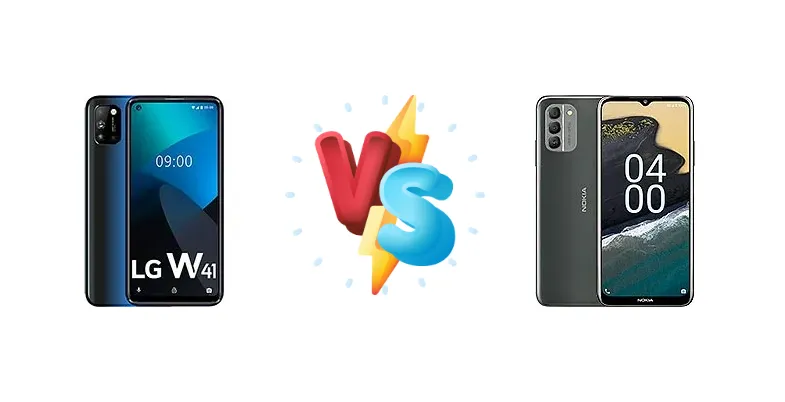
The LG W41 and Nokia G400 represent distinct approaches to the budget 5G smartphone market. The LG W41, leveraging Mediatek’s Helio G35, aims for affordability, while the Nokia G400, powered by Qualcomm’s Snapdragon 480+, prioritizes 5G connectivity and a more modern chipset architecture. This comparison dissects their key differences to help you choose the right device.
🏆 Quick Verdict
For the average user prioritizing 5G connectivity and smoother performance, the Nokia G400 is the clear winner. Its Snapdragon 480+ chipset, built on an 8nm process, offers a significant performance advantage over the LG W41’s Helio G35, despite the LG’s potentially longer software support history.
| Network |
|---|
| 2G bands | GSM 850 / 900 / 1800 / 1900 | GSM 850 / 900 / 1800 / 1900 |
| 3G bands | HSDPA 850 / 900 / 2100 | HSDPA 850 / 1700(AWS) / 1900 |
| 4G bands | 1, 3, 5, 8, 40, 41 | 2, 4, 5, 12, 13, 25, 26, 41, 66, 71 |
| 5G bands | - | 2, 5, 25, 41, 66, 71, 77 SA/NSA |
| Speed | HSPA, LTE | HSPA, LTE, 5G |
| Technology | GSM / HSPA / LTE | GSM / HSPA / LTE / 5G |
| Launch |
|---|
| Announced | 2021, February 22. Released 2021, March 03 | 2022, January 05 |
| Status | Discontinued | Available. Released 2022, August 24 |
| Body |
|---|
| Build | - | Glass front (Gorilla Glass 3), aluminum frame |
| Dimensions | 166.5 x 77.3 x 9.3 mm (6.56 x 3.04 x 0.37 in) | 166.4 x 76.7 x 8.8 mm (6.55 x 3.02 x 0.35 in) |
| SIM | Nano-SIM + Nano-SIM | Nano-SIM |
| Weight | 201 g (7.09 oz) | 198 g (6.98 oz) |
| Display |
|---|
| Protection | - | Corning Gorilla Glass 3 |
| Resolution | 900 x 1600 pixels, 16:9 ratio (~280 ppi density) | 1080 x 2408 pixels, 20:9 ratio (~401 ppi density) |
| Size | 6.55 inches, 118.3 cm2 (~91.9% screen-to-body ratio) | 6.58 inches, 104.3 cm2 (~81.7% screen-to-body ratio) |
| Type | IPS LCD, 400 nits (typ) | IPS LCD, 120Hz |
| Platform |
|---|
| CPU | Octa-core (4x2.3 GHz Cortex-A53 & 4x1.8 GHz Cortex-A53) | Octa-core (2x2.2 GHz Kryo 460 & 6x1.9 GHz Kryo 460) |
| Chipset | Mediatek MT6765G Helio G35 (12 nm) | Qualcomm SM4350-AC Snapdragon 480+ 5G (8 nm) |
| GPU | PowerVR GE8320 | Adreno 619 |
| OS | Android 10 | Android 12 |
| Memory |
|---|
| Card slot | microSDXC (dedicated slot) | microSDXC (dedicated slot) |
| Internal | 64GB 4GB RAM | 64GB 4GB RAM |
| | eMMC 5.1 | - |
| Main Camera |
|---|
| Features | LED flash, panorama, HDR | LED flash, HDR, panorama |
| Quad | 48 MP, f/1.8, (wide), 1/2.0", 0.8µm, PDAF
8 MP, f/2.2, (ultrawide), 1/4.0", 1.12µm
5 MP (macro)
Auxiliary lens | - |
| Single | 8 MP, (wide), 1/4.0", 1.12µm | 16 MP, (wide) |
| Triple | - | 48 MP, f/1.8, (wide), PDAF
5 MP, f/2.2, 115˚ (ultrawide)
Auxiliary lens |
| Video | 1080p@30fps | 1080p@30/60fps |
| Selfie camera |
|---|
| Single | 8 MP, (wide), 1/4.0", 1.12µm | 16 MP, (wide) |
| Video | 1080p@30fps | 1080p@30fps |
| Sound |
|---|
| 3.5mm jack | Yes | Yes |
| 35mm jack | Yes | Yes |
| Loudspeaker | Yes | Yes |
| Comms |
|---|
| Bluetooth | 5.0, A2DP, LE | 5.1, A2DP, LE, aptX HD, aptX Adaptive |
| NFC | No | Yes |
| Positioning | GPS, GLONASS | GPS, GALILEO |
| Radio | FM radio | FM radio |
| USB | USB Type-C 2.0, OTG | USB Type-C 2.0, OTG |
| WLAN | Wi-Fi 802.11 b/g/n, Wi-Fi Direct | Wi-Fi 802.11 b/g/n/ac |
| Features |
|---|
| Sensors | Fingerprint (rear-mounted), accelerometer, proximity | Fingerprint (side-mounted), accelerometer, gyro, proximity, compass, barometer |
| Battery |
|---|
| Charging | - | 20W wired, PD3.0 |
| Type | Li-Po 5000 mAh | Li-Po 5000 mAh |
| Misc |
|---|
| Colors | Magic Blue, Laser Blue | Meteor Grey |
| Models | LMK610IM, LM-K610IM | TA-1530, TA-1448, TA-1476, N1530DL |
| Price | About 160 EUR | About 70 EUR |
| SAR | - | 1.05 W/kg (head) 1.09 W/kg (body) |
LG W41
- Potentially longer software support (historical LG trend)
- Lower price point (likely)
- May be more readily available in certain markets
- Significantly weaker performance
- No 5G connectivity
- Less efficient chipset (12nm)
Nokia G400
- 5G connectivity
- Faster and more efficient Snapdragon 480+ chipset (8nm)
- 20W fast charging with PD3.0
- Potentially shorter software support
- May be slightly more expensive
- 720p display resolution
Display Comparison
Neither device boasts a standout display. Specifications are unavailable for the LG W41's display, but given its market positioning, it likely features a 720p LCD panel. The Nokia G400 features a large 6.6-inch display, but its resolution is also 720p. The key difference lies in the underlying processing power needed to drive the display; the Snapdragon 480+ will likely handle UI elements and video playback with greater fluidity. The lack of high refresh rates on either device suggests a focus on power conservation rather than visual smoothness.
Camera Comparison
Camera performance is difficult to assess without detailed sensor information. Both devices likely feature a multi-camera setup, but the LG W41’s camera specifications are unavailable. The Nokia G400’s camera details are also limited, but the Snapdragon 480+’s image signal processor (ISP) offers superior image processing capabilities compared to the Helio G35’s ISP. This means better dynamic range, noise reduction, and overall image quality on the Nokia G400, particularly in challenging lighting conditions. The presence of a dedicated ISP in the Snapdragon chipset is a key advantage.
Performance
The performance gap is the most significant differentiator. The Nokia G400’s Qualcomm Snapdragon 480+ (8nm) is a substantial upgrade over the LG W41’s Mediatek Helio G35 (12nm). The 8nm process node inherently offers better power efficiency and thermal characteristics, reducing throttling during sustained workloads. While both are octa-core CPUs, the Snapdragon 480+ utilizes Qualcomm’s Kryo 460 cores (2x2.2 GHz & 6x1.9 GHz) which offer a more modern architecture compared to the LG W41’s Cortex-A53 cores (4x2.3 GHz & 4x1.8 GHz). This translates to faster app loading times, smoother multitasking, and a more responsive overall experience on the Nokia G400. The Snapdragon also includes an integrated 5G modem, a feature absent in the LG W41.
Battery Life
Battery life will depend heavily on usage patterns. The LG W41’s battery capacity is unknown, but its less powerful chipset may result in comparable battery life to the Nokia G400, despite the latter’s 5G capabilities. However, the Nokia G400 benefits from 20W wired charging with PD3.0 support, allowing for significantly faster charging times than the LG W41, which likely supports a slower charging standard. A full charge from 0-100% on the Nokia G400 will be considerably quicker.
Buying Guide
Buy the LG W41 if you need a very basic smartphone for essential tasks and prioritize a potentially longer software support lifecycle from a brand with a history of updates (though LG has exited the mobile market). Buy the Nokia G400 if you want a more future-proof device with 5G capabilities, a more responsive user experience, and faster charging, even if it means potentially shorter software support.
Frequently Asked Questions
❓ Will the Nokia G400's 5G connectivity actually make a difference in my daily use?
5G's impact depends on your location and carrier coverage. However, even in areas with limited 5G, the Snapdragon 480+'s modem provides improved 4G LTE performance and future-proofs the device for wider 5G availability. The LG W41 is limited to 4G, which will become increasingly congested over time.
❓ Is the Snapdragon 480+ in the Nokia G400 powerful enough for gaming?
While not a gaming powerhouse, the Snapdragon 480+ can handle most casual mobile games at medium settings. Demanding titles may require lower graphics settings to maintain a smooth frame rate. The Helio G35 in the LG W41 will struggle with even moderately demanding games.
❓ Given LG's exit from the smartphone market, is the LG W41 still a good buy?
LG's departure raises concerns about long-term software support. While the W41 may receive some updates, it's unlikely to receive the same level of ongoing support as the Nokia G400, which benefits from Nokia's commitment to Android updates.