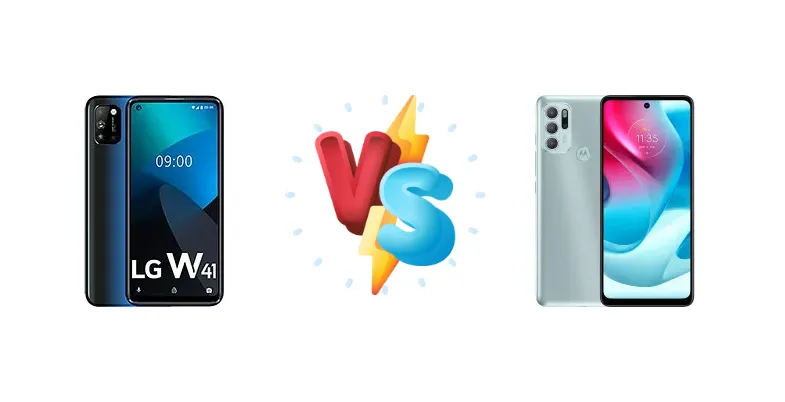
Both the LG W41 and Motorola Moto G60S target the budget-conscious smartphone user, but they approach this segment with markedly different hardware. The LG W41 represents a more basic offering, while the Moto G60S aims to deliver a more robust experience with a focus on performance and faster charging. This comparison dissects the key differences to help you determine which device best suits your needs.
🏆 Quick Verdict
For the average user prioritizing performance and convenience, the Motorola Moto G60S is the clear winner. Its Helio G95 chipset and 50W fast charging provide a significantly smoother experience than the LG W41’s Helio G35. While the W41 offers a lower entry price, the G60S delivers better value overall.
| Network |
|---|
| 2G bands | GSM 850 / 900 / 1800 / 1900 | GSM 850 / 900 / 1800 / 1900 |
| 3G bands | HSDPA 850 / 900 / 2100 | HSDPA 850 / 900 / 1700(AWS) / 1900 / 2100 |
| 4G bands | 1, 3, 5, 8, 40, 41 | 1, 2, 3, 4, 5, 7, 8, 12, 13, 17, 28, 40, 66 |
| Speed | HSPA, LTE | HSPA, LTE |
| Technology | GSM / HSPA / LTE | GSM / HSPA / LTE |
| Launch |
|---|
| Announced | 2021, February 22. Released 2021, March 03 | 2021, August 12 |
| Status | Discontinued | Available. Released 2021, August 12 |
| Body |
|---|
| Build | - | Glass front, plastic frame, plastic back |
| Dimensions | 166.5 x 77.3 x 9.3 mm (6.56 x 3.04 x 0.37 in) | 169.7 x 75.9 x 9.6 mm (6.68 x 2.99 x 0.38 in) |
| SIM | Nano-SIM + Nano-SIM | Nano-SIM + Nano-SIM |
| Weight | 201 g (7.09 oz) | 212 g (7.48 oz) |
| | - | Water repellent design |
| Display |
|---|
| Resolution | 900 x 1600 pixels, 16:9 ratio (~280 ppi density) | 1080 x 2460 pixels (~395 ppi density) |
| Size | 6.55 inches, 118.3 cm2 (~91.9% screen-to-body ratio) | 6.8 inches, 109.8 cm2 (~85.3% screen-to-body ratio) |
| Type | IPS LCD, 400 nits (typ) | IPS LCD, 120Hz, HDR10, 450 nits (typ), 562 nits (HBM) |
| Platform |
|---|
| CPU | Octa-core (4x2.3 GHz Cortex-A53 & 4x1.8 GHz Cortex-A53) | Octa-core (2x2.05 GHz Cortex-A76 & 6x2.0 GHz Cortex-A55) |
| Chipset | Mediatek MT6765G Helio G35 (12 nm) | Mediatek MT6785V/CD Helio G95 (12 nm) |
| GPU | PowerVR GE8320 | Mali-G76 MC4 |
| OS | Android 10 | Android 11 |
| Memory |
|---|
| Card slot | microSDXC (dedicated slot) | microSDXC (uses shared SIM slot) |
| Internal | 64GB 4GB RAM | 128GB 4GB RAM, 128GB 6GB RAM |
| | eMMC 5.1 | UFS 2.1 |
| Main Camera |
|---|
| Features | LED flash, panorama, HDR | LED flash, HDR, panorama |
| Quad | 48 MP, f/1.8, (wide), 1/2.0", 0.8µm, PDAF
8 MP, f/2.2, (ultrawide), 1/4.0", 1.12µm
5 MP (macro)
Auxiliary lens | 64 MP, f/1.7, 26mm (wide), PDAF
8 MP, f/2.2, 119˚, (ultrawide)
5 MP (macro)
Auxiliary lens |
| Single | 8 MP, (wide), 1/4.0", 1.12µm | - |
| Video | 1080p@30fps | 4K@30/120fps, 1080p@30/60/240fps |
| Selfie camera |
|---|
| Features | - | LED flash, HDR |
| Single | 8 MP, (wide), 1/4.0", 1.12µm | 16 MP, f/2.2, (wide) |
| Video | 1080p@30fps | 4K@30fps, 1080p@30/60/240fps |
| Sound |
|---|
| 3.5mm jack | Yes | Yes |
| 35mm jack | Yes | Yes |
| Loudspeaker | Yes | Yes |
| Comms |
|---|
| Bluetooth | 5.0, A2DP, LE | 5.0, A2DP, LE |
| NFC | No | Yes |
| Positioning | GPS, GLONASS | GPS, GLONASS, GALILEO |
| Radio | FM radio | FM radio |
| USB | USB Type-C 2.0, OTG | USB Type-C 2.0, OTG |
| WLAN | Wi-Fi 802.11 b/g/n, Wi-Fi Direct | Wi-Fi 802.11 a/b/g/n/ac, dual-band, Wi-Fi Direct |
| Features |
|---|
| Sensors | Fingerprint (rear-mounted), accelerometer, proximity | Fingerprint (rear-mounted), accelerometer, gyro, proximity |
| Battery |
|---|
| Charging | - | 50W wired, QC4 |
| Type | Li-Po 5000 mAh | Li-Po 5000 mAh |
| Misc |
|---|
| Colors | Magic Blue, Laser Blue | Green, Blue |
| Models | LMK610IM, LM-K610IM | XT2133-2, XT2133-1 |
| Price | About 160 EUR | About 200 EUR |
LG W41
- Potentially lower price point
- Functional for basic smartphone tasks
- May have longer battery life due to less demanding processor (depending on battery capacity)
- Significantly slower performance
- Slow charging speeds
- Less capable camera system
Motorola Moto G60S
- Faster and more responsive performance
- 50W fast charging with QC4
- Potentially better camera image processing
- Likely higher price point
- May have slightly shorter battery life under heavy load
Display Comparison
Neither device boasts a particularly standout display. Both utilize 12nm chipsets, suggesting a similar focus on cost optimization rather than premium display features. Specifics like panel type (IPS vs AMOLED) and resolution are missing, but given the price points, IPS LCDs are likely. The absence of high refresh rates on either device indicates a prioritization of battery life over visual fluidity. Bezels are likely comparable, reflecting the budget nature of both phones.
Camera Comparison
Without detailed camera specifications, a direct comparison is difficult. However, the chipset difference suggests the G60S will have more processing power available for image processing, potentially leading to better dynamic range and noise reduction. The LG W41 likely relies on simpler image algorithms due to its weaker processor. The presence of a 50W charger on the G60S suggests a more modern overall design, potentially extending to camera hardware. It's reasonable to assume the G60S will offer a more versatile and capable camera system, even if the megapixel counts are similar.
Performance
The core difference lies in the chipsets. The Motorola Moto G60S’s Mediatek Helio G95 is a substantial upgrade over the LG W41’s Helio G35. The G95 features a dual-core Cortex-A76 configuration alongside six Cortex-A55 cores, while the G35 relies solely on Cortex-A53 cores. This architectural difference translates to a significant performance advantage for the G60S in CPU-intensive tasks and gaming. The G95’s 2x2.05 GHz cores offer a noticeable speed boost compared to the G35’s 4x2.3 GHz cores, especially in applications optimized for the A76 architecture. The G60S is likely to exhibit smoother multitasking and faster app loading times. While both are 12nm chips, the G95’s more efficient core design likely results in better sustained performance under load.
Battery Life
Battery capacity is not specified for either device, but the Moto G60S’s 50W wired charging with QC4 support is a game-changer. This allows for significantly faster charging times compared to the LG W41, which likely supports a much slower charging rate. Even if the LG W41 has a slightly larger battery, the G60S’s rapid charging will minimize downtime and provide a more convenient user experience. A full charge on the G60S could take under an hour, while the W41 might require several hours.
Buying Guide
Buy the LG W41 if you need a functional smartphone for basic tasks like calls, messaging, and light social media use, and your budget is extremely limited. Buy the Motorola Moto G60S if you prefer a more responsive experience for gaming, multitasking, and content consumption, and value faster charging speeds to minimize downtime. The G60S is ideal for users who want a phone that can keep up with a moderately demanding lifestyle.
Frequently Asked Questions
❓ Will the Moto G60S handle demanding games like PUBG Mobile smoothly?
The Helio G95 in the Moto G60S is capable of running PUBG Mobile at medium to high settings with reasonable frame rates. While it won't match flagship performance, it offers a significantly better gaming experience than the LG W41's Helio G35, which would likely struggle with consistent performance.
❓ Is the 50W charging on the Moto G60S compatible with all my existing chargers?
The Moto G60S supports Quick Charge 4 (QC4) and USB Power Delivery (USB-PD). While it will charge with standard USB chargers, you'll need a QC4 or USB-PD compatible charger to achieve the full 50W charging speed. Using a standard charger will result in significantly slower charging times.
❓ How much of a performance difference can I realistically expect between the Helio G95 and Helio G35?
The Helio G95 offers a substantial performance improvement over the Helio G35, estimated to be around 30-50% in CPU-intensive tasks and gaming. This is due to the G95's more modern CPU architecture (Cortex-A76 vs A53) and higher clock speeds. You'll notice a difference in app loading times, multitasking, and overall system responsiveness.