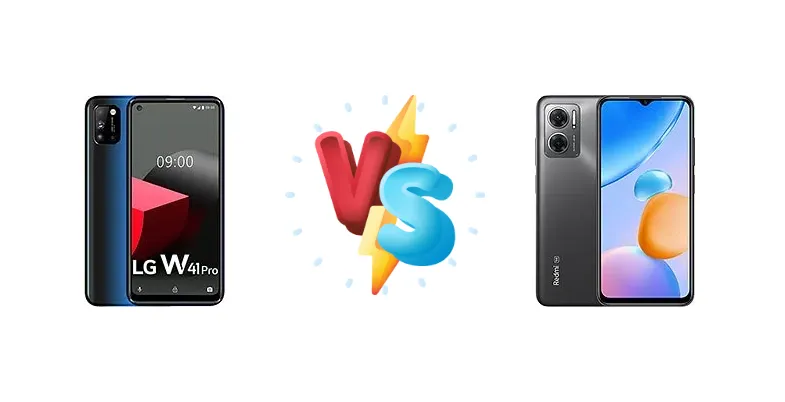
The LG W41 Pro and Xiaomi Redmi 10 5G represent two approaches to affordable 5G connectivity. The W41 Pro, while older, offers a familiar LG experience, while the Redmi 10 5G aims to deliver modern features and performance at a competitive price point. This comparison dissects their core components to determine which device offers the best value for budget-conscious consumers.
🏆 Quick Verdict
For the average user prioritizing performance and future-proofing, the Xiaomi Redmi 10 5G is the clear winner. Its Dimensity 700 chipset provides a substantial leap in processing power and 5G capabilities compared to the LG W41 Pro’s Helio G35. However, the W41 Pro may appeal to those seeking a simpler experience and potentially longer software support from LG (though diminishing).
| Network |
|---|
| 2G bands | GSM 850 / 900 / 1800 / 1900 | GSM 850 / 900 / 1800 / 1900 |
| 3G bands | HSDPA 850 / 900 / 2100 | HSDPA 850 / 900 / 1700(AWS) / 1900 / 2100 |
| 4G bands | 1, 3, 5, 8, 40, 41 | 1, 2, 3, 4, 5, 7, 8, 20, 28, 38, 40, 41 |
| 5G bands | - | 1, 3, 5, 7, 8, 20, 28, 38, 40, 41, 77, 78 SA/NSA |
| Speed | HSPA, LTE | HSPA, LTE, 5G |
| Technology | GSM / HSPA / LTE | GSM / HSPA / LTE / 5G |
| Launch |
|---|
| Announced | 2021, February 22. Released 2021, March 03 | 2022, March 29 |
| Status | Discontinued | Available. Released 2022, September 23 |
| Body |
|---|
| Dimensions | 166.5 x 77.3 x 9.3 mm (6.56 x 3.04 x 0.37 in) | 164 x 76.1 x 8.9 mm (6.46 x 3.00 x 0.35 in) |
| SIM | Nano-SIM + Nano-SIM | Nano-SIM + Nano-SIM |
| Weight | 201 g (7.09 oz) | 200 g (7.05 oz) |
| Display |
|---|
| Protection | - | Corning Gorilla Glass 3 |
| Resolution | 900 x 1600 pixels, 16:9 ratio (~280 ppi density) | 1080 x 2408 pixels, 20:9 ratio (~401 ppi density) |
| Size | 6.55 inches, 118.3 cm2 (~91.9% screen-to-body ratio) | 6.58 inches, 104.3 cm2 (~83.6% screen-to-body ratio) |
| Type | IPS LCD, 400 nits (typ) | IPS LCD, 90Hz |
| Platform |
|---|
| CPU | Octa-core (4x2.3 GHz Cortex-A53 & 4x1.8 GHz Cortex-A53) | Octa-core (2x2.2 GHz Cortex-A76 & 6x2.0 GHz Cortex-A55) |
| Chipset | Mediatek MT6765G Helio G35 (12 nm) | Mediatek Dimensity 700 (7 nm) |
| GPU | PowerVR GE8320 | Mali-G57 MC2 |
| OS | Android 10 | Android 12, MIUI 13 |
| Memory |
|---|
| Card slot | microSDXC (dedicated slot) | microSDXC (dedicated slot) |
| Internal | 128GB 6GB RAM | 64GB 4GB RAM, 128GB 4GB RAM, 128GB 6GB RAM |
| | eMMC 5.1 | UFS 2.2 |
| Main Camera |
|---|
| Dual | - | 50 MP, f/1.8, (wide), PDAF
Auxiliary lens |
| Features | LED flash, panorama, HDR | LED flash, HDR, panorama |
| Quad | 48 MP, f/1.8, (wide), 1/2.0", 0.8µm, PDAF
8 MP, f/2.2, (ultrawide), 1/4.0", 1.12µm
5 MP (macro)
Auxiliary lens | - |
| Single | 8 MP, (wide), 1/4.0", 1.12µm | 5 MP, f/2.2 |
| Video | 1080p@30fps | 1080p@30fps |
| Selfie camera |
|---|
| Features | - | HDR |
| Single | 8 MP, (wide), 1/4.0", 1.12µm | 5 MP, f/2.2 |
| Video | 1080p@30fps | 1080p@30fps |
| Sound |
|---|
| 3.5mm jack | Yes | Yes |
| 35mm jack | Yes | Yes |
| Loudspeaker | Yes | Yes |
| | - | 24-bit/192kHz audio |
| Comms |
|---|
| Bluetooth | 5.0, A2DP, LE | 5.1, A2DP, LE |
| Infrared port | - | Yes |
| NFC | No | Yes (market/region dependent) |
| Positioning | GPS, GLONASS | GPS, GLONASS, BDS, GALILEO |
| Radio | FM radio | FM radio |
| USB | USB Type-C 2.0, OTG | USB Type-C 2.0, OTG |
| WLAN | Wi-Fi 802.11 b/g/n, Wi-Fi Direct | Wi-Fi 802.11 a/b/g/n/ac, dual-band, Wi-Fi Direct |
| Features |
|---|
| Sensors | Fingerprint (rear-mounted), accelerometer, proximity | Fingerprint (side-mounted), accelerometer, proximity, compass |
| Battery |
|---|
| Charging | - | 18W wired |
| Type | Li-Po 5000 mAh | Li-Po 5000 mAh |
| Misc |
|---|
| Colors | Magic Blue, Laser Blue | Graphite Gray, Chrome Silver, Aurora Green |
| Models | LMK610IM, LM-K610IM | 22041219G, 22041219NY |
| Price | About 180 EUR | About 100 EUR |
| SAR | - | 1.09 W/kg (head) 1.09 W/kg (body) |
| SAR EU | - | 0.60 W/kg (head) 0.99 W/kg (body) |
LG W41 Pro
- Potentially simpler software experience.
- May receive longer software support (though diminishing).
- Lower initial price (potentially).
- Significantly weaker processor performance.
- Less efficient chipset.
- Limited 5G capabilities.
Xiaomi Redmi 10 5G
- Much faster processor (Dimensity 700).
- More efficient chipset (7nm process).
- 18W fast charging.
- Better 5G connectivity.
- Xiaomi’s MIUI software can be resource-intensive.
- Potentially shorter software support lifespan.
Display Comparison
Neither device boasts a particularly standout display. While specific display specs (resolution, brightness) are unavailable for the LG W41 Pro, its market positioning suggests a standard LCD panel. The Redmi 10 5G also utilizes an LCD, but the focus here is on the chipset's ability to drive a smoother experience. The Redmi 10 5G’s processor is more capable of handling higher refresh rate displays, should one be desired in the future, a feature the W41 Pro’s Helio G35 would struggle with.
Camera Comparison
Without detailed camera specifications, a direct comparison is difficult. However, given the price points, both devices likely feature modest camera setups. The Redmi 10 5G’s chipset includes an ISP capable of handling more complex image processing algorithms, potentially leading to better image quality in challenging lighting conditions. The W41 Pro’s Helio G35 ISP is less sophisticated. It’s reasonable to assume the Redmi 10 5G will offer a more versatile and capable camera experience, even if the megapixel counts are similar.
Performance
The performance gap is the most significant differentiator. The Xiaomi Redmi 10 5G’s Mediatek Dimensity 700 (7nm) is a substantial upgrade over the LG W41 Pro’s Mediatek Helio G35 (12nm). The Dimensity 700 features a more modern CPU architecture – Cortex-A76 cores versus the W41 Pro’s Cortex-A53 – resulting in significantly faster single-core and multi-core performance. This translates to snappier app launches, smoother multitasking, and a more enjoyable gaming experience. The 7nm process also contributes to better power efficiency, potentially offsetting the Redmi 10 5G’s higher performance demands. The Helio G35 is adequate for basic tasks, but will struggle with demanding applications and modern games.
Battery Life
Battery capacity details for the LG W41 Pro are missing, but the Redmi 10 5G’s 18W wired charging is a notable advantage. While not exceptionally fast, it’s significantly quicker than what the W41 Pro likely offers. The Dimensity 700’s improved power efficiency also contributes to better battery life, despite potentially being used for more demanding tasks. The Redmi 10 5G’s charging speed allows for a quicker top-up, minimizing downtime.
Buying Guide
Buy the LG W41 Pro if you need a basic, functional smartphone with 5G connectivity and prefer a potentially more streamlined software experience, and are less concerned with demanding applications or future performance needs. Buy the Xiaomi Redmi 10 5G if you prioritize faster performance for gaming, streaming, and everyday tasks, and want a device that’s better equipped to handle future software updates and 5G network demands. The Redmi 10 5G is the better choice for users who anticipate using their phone for more than just basic communication.
Frequently Asked Questions
❓ Will the Redmi 10 5G’s Dimensity 700 handle demanding games like PUBG Mobile?
Yes, the Dimensity 700 is capable of running PUBG Mobile at medium to high settings with playable frame rates. While it won’t deliver a flagship-level gaming experience, it’s a significant improvement over the Helio G35 in the LG W41 Pro, which would struggle with consistent performance.
❓ How does the 5G performance differ between the LG W41 Pro and the Redmi 10 5G?
The Redmi 10 5G’s Dimensity 700 supports a wider range of 5G bands and offers faster download and upload speeds compared to the LG W41 Pro’s Helio G35. This means the Redmi 10 5G will be able to take full advantage of 5G networks in more locations and provide a more responsive online experience.
❓ Is the software experience on the Redmi 10 5G heavily customized?
Yes, the Redmi 10 5G runs Xiaomi’s MIUI, which is a heavily customized version of Android. While MIUI offers many features and customization options, it can also be resource-intensive and include pre-installed bloatware. The LG W41 Pro likely offers a closer-to-stock Android experience, which some users may prefer.