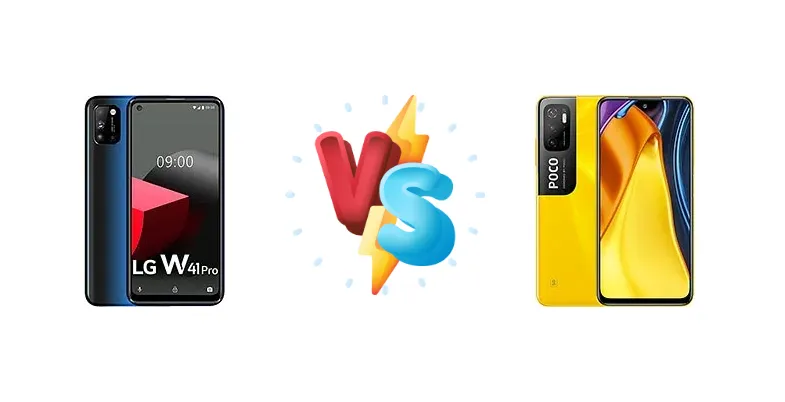
The sub-$200 smartphone market is fiercely competitive, and the LG W41 Pro and Xiaomi Poco M3 Pro 5G represent compelling options for users seeking 5G connectivity without breaking the bank. However, they approach this goal with vastly different hardware, creating a clear divergence in performance and user experience. This comparison dissects these differences to help you choose the right device.
🏆 Quick Verdict
For most users, the Xiaomi Poco M3 Pro 5G is the superior choice. Its Mediatek Dimensity 700 chipset, built on a 7nm process, delivers significantly better CPU and GPU performance than the LG W41 Pro’s Helio G35. While both offer similar battery endurance, the Poco’s faster charging and overall responsiveness make it a more compelling daily driver.
| Network |
|---|
| 2G bands | GSM 850 / 900 / 1800 / 1900 | GSM 850 / 900 / 1800 / 1900 |
| 3G bands | HSDPA 850 / 900 / 2100 | HSDPA 850 / 900 / 1700(AWS) / 1900 / 2100 |
| 4G bands | 1, 3, 5, 8, 40, 41 | 1, 2, 3, 4, 5, 7, 8, 12, 17, 20, 28, 32, 38, 40, 41, 66 |
| 5G bands | - | 1, 3, 7, 8, 20, 28, 38, 40, 41, 66, 77, 78 SA/NSA |
| Speed | HSPA, LTE | HSPA, LTE, 5G |
| Technology | GSM / HSPA / LTE | GSM / HSPA / LTE / 5G |
| Launch |
|---|
| Announced | 2021, February 22. Released 2021, March 03 | 2021, May 19 |
| Status | Discontinued | Available. Released 2021, May 22 |
| Body |
|---|
| Build | - | Glass front (Gorilla Glass 3), plastic frame, plastic back |
| Dimensions | 166.5 x 77.3 x 9.3 mm (6.56 x 3.04 x 0.37 in) | 161.8 x 75.3 x 8.9 mm (6.37 x 2.96 x 0.35 in) |
| SIM | Nano-SIM + Nano-SIM | Nano-SIM + Nano-SIM |
| Weight | 201 g (7.09 oz) | 190 g (6.70 oz) |
| Display |
|---|
| Protection | - | Corning Gorilla Glass 3 |
| Resolution | 900 x 1600 pixels, 16:9 ratio (~280 ppi density) | 1080 x 2400 pixels, 20:9 ratio (~405 ppi density) |
| Size | 6.55 inches, 118.3 cm2 (~91.9% screen-to-body ratio) | 6.5 inches, 102.0 cm2 (~83.7% screen-to-body ratio) |
| Type | IPS LCD, 400 nits (typ) | IPS LCD, 90Hz, 400 nits (typ), 500 nits (HBM) |
| Platform |
|---|
| CPU | Octa-core (4x2.3 GHz Cortex-A53 & 4x1.8 GHz Cortex-A53) | Octa-core (2x2.2 GHz Cortex-A76 & 6x2.0 GHz Cortex-A55) |
| Chipset | Mediatek MT6765G Helio G35 (12 nm) | Mediatek Dimensity 700 (7 nm) |
| GPU | PowerVR GE8320 | Mali-G57 MC2 |
| OS | Android 10 | Android 11, MIUI 12 |
| Memory |
|---|
| Card slot | microSDXC (dedicated slot) | microSDXC (uses shared SIM slot) |
| Internal | 128GB 6GB RAM | 64GB 4GB RAM, 128GB 6GB RAM |
| | eMMC 5.1 | UFS 2.2 |
| Main Camera |
|---|
| Features | LED flash, panorama, HDR | Dual-LED dual-tone flash, HDR, panorama |
| Quad | 48 MP, f/1.8, (wide), 1/2.0", 0.8µm, PDAF
8 MP, f/2.2, (ultrawide), 1/4.0", 1.12µm
5 MP (macro)
Auxiliary lens | - |
| Single | 8 MP, (wide), 1/4.0", 1.12µm | 8 MP, f/2.0, (wide) |
| Triple | - | 48 MP, f/1.8, 26mm (wide), 1/2.0", 0.8µm, PDAF
2 MP (macro)
Auxiliary lens |
| Video | 1080p@30fps | 1080p@30fps |
| Selfie camera |
|---|
| Single | 8 MP, (wide), 1/4.0", 1.12µm | 8 MP, f/2.0, (wide) |
| Video | 1080p@30fps | 1080p@30fps |
| Sound |
|---|
| 3.5mm jack | Yes | Yes |
| 35mm jack | Yes | Yes |
| Loudspeaker | Yes | Yes |
| | - | 24-bit/192kHz audio |
| Comms |
|---|
| Bluetooth | 5.0, A2DP, LE | 5.1, A2DP, LE |
| Infrared port | - | Yes |
| NFC | No | Yes (market/region dependent) |
| Positioning | GPS, GLONASS | GPS, GLONASS, GALILEO, BDS |
| Radio | FM radio | FM radio |
| USB | USB Type-C 2.0, OTG | USB Type-C 2.0 |
| WLAN | Wi-Fi 802.11 b/g/n, Wi-Fi Direct | Wi-Fi 802.11 a/b/g/n/ac, dual-band, Wi-Fi Direct |
| Features |
|---|
| Sensors | Fingerprint (rear-mounted), accelerometer, proximity | Fingerprint (side-mounted), accelerometer, gyro, proximity, compass |
| Battery |
|---|
| Charging | - | 18W wired |
| Type | Li-Po 5000 mAh | Li-Po 5000 mAh |
| Misc |
|---|
| Colors | Magic Blue, Laser Blue | Poco Yellow, Power Black, Cool Blue |
| Models | LMK610IM, LM-K610IM | M2103K19PG, M2103K19PI, M2103K19PY |
| Price | About 180 EUR | About 140 EUR |
| SAR | - | 0.94 W/kg (head) 1.06 W/kg (body) |
| SAR EU | - | 0.54 W/kg (head) 0.90 W/kg (body) |
| Tests |
|---|
| Battery life | - |
Endurance rating 121h
|
| Camera | - |
Photo / Video |
| Display | - |
Contrast ratio: 1475:1 (nominal) |
| Loudspeaker | - |
-27.9 LUFS (Good)
|
LG W41 Pro
- Extremely affordable price point
- Decent battery endurance
- Functional for basic smartphone tasks
- Outdated Helio G35 chipset
- Likely inferior camera performance
- Slower overall performance
Xiaomi Poco M3 Pro 5G
- Powerful Mediatek Dimensity 700 chipset
- Faster 18W charging
- Brighter display for outdoor visibility
- Slightly higher price than the LG W41 Pro
- May not be significantly better for extremely light usage
- IPS LCD panel (no OLED)
Display Comparison
Both the LG W41 Pro and Poco M3 Pro 5G share a contrast ratio of 1475:1, suggesting similar color reproduction capabilities. However, the Poco M3 Pro 5G boasts a measured peak brightness of 536 nits, a significant advantage over the LG W41 Pro (brightness data unavailable), making it more usable in direct sunlight. While both likely utilize IPS LCD panels, the Poco’s higher brightness translates to a better viewing experience outdoors.
Camera Comparison
Both phones offer 'Photo / Video' capabilities, but detailed camera specifications are limited. Without sensor size or aperture information, a direct comparison is difficult. However, the market positioning suggests the Poco M3 Pro 5G likely features a more advanced camera system. The LG W41 Pro, being a more budget-focused device, likely relies on simpler sensors and image processing. The presence of a dedicated Night Mode on the Poco, often requiring more processing power, hints at a more sophisticated camera experience.
Performance
The performance gap between these devices is substantial. The Poco M3 Pro 5G’s Mediatek Dimensity 700, fabricated on a 7nm process, features a more modern CPU architecture – two Cortex-A76 cores clocked at 2.2 GHz and six Cortex-A55 cores at 2.0 GHz – compared to the LG W41 Pro’s Helio G35. The G35 utilizes four older Cortex-A53 cores at 2.3 GHz and another four at 1.8 GHz. This architectural difference, combined with the smaller fabrication node, results in a noticeable performance uplift for the Poco in both single-core and multi-core tasks. The Dimensity 700 also benefits from a more capable integrated GPU, making it better suited for gaming.
Battery Life
Both devices achieve an endurance rating of 121 hours, indicating comparable battery life under similar usage conditions. However, the Poco M3 Pro 5G offers 18W wired charging, a significant advantage over the LG W41 Pro (charging speed unavailable). This faster charging allows the Poco to replenish its battery more quickly, minimizing downtime and providing a more convenient user experience. The similar endurance ratings suggest that despite potential differences in battery capacity, the more efficient Dimensity 700 chipset helps the Poco maintain comparable battery life.
Buying Guide
Buy the LG W41 Pro if your primary need is basic smartphone functionality – calls, texts, and light social media – and you are on an extremely tight budget. The W41 Pro prioritizes affordability above all else. Buy the Xiaomi Poco M3 Pro 5G if you want a smoother, more responsive experience, especially when using 5G networks, and value faster charging and a more capable processor for gaming and multitasking.
Frequently Asked Questions
❓ Does the Poco M3 Pro 5G support carrier aggregation, and will that impact 5G speeds?
Yes, the Mediatek Dimensity 700 supports carrier aggregation, allowing it to combine multiple 5G channels for faster and more stable download speeds. This is crucial for maximizing 5G performance, especially in areas with strong network coverage. The LG W41 Pro's Helio G35 has limited 5G capabilities and likely lacks advanced carrier aggregation features.
❓ Is the gaming experience on the Poco M3 Pro 5G significantly better than on the LG W41 Pro?
Absolutely. The Poco M3 Pro 5G’s Dimensity 700 chipset features a more powerful GPU and a more efficient CPU, resulting in significantly higher frame rates and smoother gameplay in demanding mobile games. The LG W41 Pro’s Helio G35 will struggle with graphically intensive titles, requiring lower settings and potentially experiencing noticeable lag.
❓ How does the software experience differ between the Poco M3 Pro 5G and the LG W41 Pro?
The Poco M3 Pro 5G runs Xiaomi’s MIUI, a heavily customized Android skin known for its features and occasional bloatware. The LG W41 Pro likely runs a near-stock Android experience, which is generally cleaner and more responsive but may lack some of the advanced features found in MIUI. Software updates are also a consideration; Xiaomi generally provides more frequent updates than LG, though LG has since exited the smartphone market.