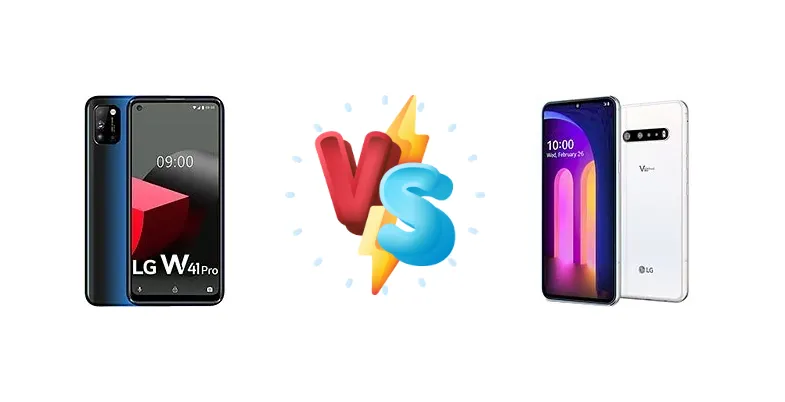
The LG V60 ThinQ 5G represented LG’s 2020 flagship offering, boasting a premium price and cutting-edge specs. The LG W41 Pro, released around the same time, targeted a significantly lower price point. This comparison dissects the core differences between these two LG devices, helping you determine if the V60’s power justifies its cost, or if the W41 Pro offers sufficient performance for everyday tasks.
🏆 Quick Verdict
For the average user prioritizing performance and future-proofing, the LG V60 ThinQ 5G is the clear winner. Its Snapdragon 865 chipset provides a substantial performance leap over the W41 Pro’s Helio G35, making it ideal for gaming and demanding applications. However, the W41 Pro presents a compelling value proposition for budget-conscious users.
| Network |
|---|
| 2G bands | GSM 850 / 900 / 1800 / 1900 | GSM 850 / 900 / 1800 / 1900 |
| 3G bands | HSDPA 850 / 900 / 2100 | HSDPA 850 / 900 / 1700(AWS) / 1900 / 2100 |
| 4G bands | 1, 3, 5, 8, 40, 41 | 2, 4, 5, 12, 25, 26, 41, 46, 48, 66, 71 - USA |
| 5G bands | - | 2, 25, 41, 66, 71 SA/NSA/Sub6 |
| Speed | HSPA, LTE | HSPA 42.2/5.76 Mbps, LTE (7CA) Cat22, 5G |
| Technology | GSM / HSPA / LTE | GSM / CDMA / HSPA / EVDO / LTE / 5G |
| | - | CDMA2000 1xEV-DO |
| Launch |
|---|
| Announced | 2021, February 22. Released 2021, March 03 | 2020, February 26. Released 2020, March 20 |
| Status | Discontinued | Discontinued |
| Body |
|---|
| Build | - | Glass front (Gorilla Glass 5), glass back (Gorilla Glass 6), aluminum frame |
| Dimensions | 166.5 x 77.3 x 9.3 mm (6.56 x 3.04 x 0.37 in) | 169.3 x 77.6 x 8.9 mm (6.67 x 3.06 x 0.35 in) |
| SIM | Nano-SIM + Nano-SIM | · Nano-SIM· Nano-SIM + Nano-SIM |
| Weight | 201 g (7.09 oz) | 213 g (Global)/ 218 g (Verizon) (7.51 oz) |
| | - | IP68 dust/water resistant (up to 1.5m for 30 min)
MIL-STD-810G compliant*
Method 516.6, Procedure IV "Transit Drop"
*does not guarantee ruggedness or use in extreme conditions |
| Display |
|---|
| Protection | - | Corning Gorilla Glass 5 |
| Resolution | 900 x 1600 pixels, 16:9 ratio (~280 ppi density) | 1080 x 2460 pixels (~395 ppi density) |
| Size | 6.55 inches, 118.3 cm2 (~91.9% screen-to-body ratio) | 6.8 inches, 109.8 cm2 (~83.6% screen-to-body ratio) |
| Type | IPS LCD, 400 nits (typ) | P-OLED, HDR10+ |
| | - | Always-on display |
| Platform |
|---|
| CPU | Octa-core (4x2.3 GHz Cortex-A53 & 4x1.8 GHz Cortex-A53) | Octa-core (1x2.84 GHz Cortex-A77 & 3x2.42 GHz Cortex-A77 & 4x1.80 GHz Cortex-A55) |
| Chipset | Mediatek MT6765G Helio G35 (12 nm) | Qualcomm SM8250 Snapdragon 865 5G (7 nm+) |
| GPU | PowerVR GE8320 | Adreno 650 |
| OS | Android 10 | Android 10, upgradable to Android 13 |
| Memory |
|---|
| Card slot | microSDXC (dedicated slot) | microSDXC (uses shared SIM slot) - dual-SIM model |
| Internal | 128GB 6GB RAM | 128GB 8GB RAM, 256GB 8GB RAM |
| | eMMC 5.1 | UFS 2.1 |
| Main Camera |
|---|
| Dual | - | 64 MP, f/1.8, 27mm (standard), 1/1.72", 0.8µm, dual pixel PDAF, OIS
13 MP, f/1.9, 12mm (ultrawide), 1/3.4", 1.0µm
0.3 MP, TOF 3D, f/1.4, (depth) |
| Features | LED flash, panorama, HDR | Dual-LED dual-tone flash, HDR, panorama |
| Quad | 48 MP, f/1.8, (wide), 1/2.0", 0.8µm, PDAF
8 MP, f/2.2, (ultrawide), 1/4.0", 1.12µm
5 MP (macro)
Auxiliary lens | - |
| Single | 8 MP, (wide), 1/4.0", 1.12µm | - |
| Video | 1080p@30fps | 8K@30fps, 4K@30/60fps, 1080p, HDR10+, 24-bit/192kHz stereo sound rec., gyro-EIS |
| Selfie camera |
|---|
| Features | - | HDR |
| Single | 8 MP, (wide), 1/4.0", 1.12µm | 10 MP, f/1.9, 30mm (standard), 1/3.1", 1.22µm |
| Video | 1080p@30fps | 4K@30fps, gyro-EIS |
| Sound |
|---|
| 3.5mm jack | Yes | Yes |
| 35mm jack | Yes | Yes |
| Loudspeaker | Yes | Yes, with stereo speakers |
| | - | 32-bit/192kHz audio
24-bit/192kHz audio recording |
| Comms |
|---|
| Bluetooth | 5.0, A2DP, LE | 5.1, A2DP, LE, aptX HD |
| NFC | No | Yes |
| Positioning | GPS, GLONASS | GPS, GLONASS, GALILEO, BDS |
| Radio | FM radio | FM radio (USA model only) |
| USB | USB Type-C 2.0, OTG | USB Type-C 3.1, OTG |
| WLAN | Wi-Fi 802.11 b/g/n, Wi-Fi Direct | Wi-Fi 802.11 a/b/g/n/ac/6, dual-band, Wi-Fi Direct, DLNA |
| Features |
|---|
| Sensors | Fingerprint (rear-mounted), accelerometer, proximity | Fingerprint (under display, optical), accelerometer, gyro, proximity, compass, barometer |
| Battery |
|---|
| Charging | - | Wired, PD2.0, QC4
Wireless |
| Type | Li-Po 5000 mAh | Li-Po 5000 mAh |
| Misc |
|---|
| Colors | Magic Blue, Laser Blue | Classy Blue, Classy White |
| Models | LMK610IM, LM-K610IM | LM-V600, A001LG |
| Price | About 180 EUR | About 700 EUR |
| Tests |
|---|
| Battery life | - |
Endurance rating 103h
|
LG W41 Pro
- Significantly lower price point
- Acceptable battery life for basic use
- Functional for everyday tasks
- Weak performance for gaming and multitasking
- Outdated processor architecture
- Likely lower quality display and camera
LG V60 ThinQ 5G
- Flagship-level performance with Snapdragon 865
- Faster charging and wireless charging support
- Superior camera capabilities (likely)
- Higher price point
- Potential for throttling under heavy load (though mitigated by 7nm+)
- May be difficult to find new
Display Comparison
While both phones likely feature LCD panels (specific panel tech is not provided), the V60’s higher price point suggests a potentially brighter display with better color accuracy. The W41 Pro, targeting a lower market segment, likely prioritizes cost savings over display quality. The V60’s 5G connectivity also implies a higher refresh rate panel is more likely, though not confirmed. Bezels are expected to be larger on the W41 Pro due to its budget nature.
Camera Comparison
Without detailed camera specs, it’s difficult to make precise comparisons. However, the V60, as a flagship, likely features a larger main sensor with optical image stabilization (OIS), resulting in better low-light performance and sharper images. The W41 Pro likely relies on smaller sensors and digital image stabilization. The V60’s image processing algorithms are also expected to be more sophisticated, delivering more accurate colors and dynamic range. The presence of a 5G modem in the V60 suggests a more advanced ISP (Image Signal Processor) capable of handling higher data throughput for video recording.
Performance
The core difference lies in the chipsets. The LG V60’s Snapdragon 865 (7nm+) is a flagship-level processor built on a more advanced manufacturing process than the W41 Pro’s Mediatek Helio G35 (12nm). The Snapdragon 865’s octa-core CPU, featuring Cortex-A77 cores, delivers significantly higher single-core and multi-core performance. The G35’s Cortex-A53 cores are older and less efficient. This translates to noticeably faster app loading times, smoother multitasking, and a far superior gaming experience on the V60. The V60 also benefits from faster RAM (likely LPDDR5) compared to the W41 Pro, further enhancing performance. Thermal management is also superior on the V60 due to the more efficient 7nm+ process, reducing the likelihood of throttling during sustained workloads.
Battery Life
Both phones share an endurance rating of 103 hours, suggesting similar real-world battery life despite the V60’s more powerful processor. This is likely due to the V60’s larger battery capacity (not specified, but expected to be larger than the W41 Pro’s) and optimized power management. The V60 also supports faster charging technologies – PD2.0 and QC4 – and wireless charging, offering greater convenience than the W41 Pro’s likely slower wired charging only. The V60’s faster charging will significantly reduce the time to reach a full charge.
Buying Guide
Buy the LG W41 Pro if you need a functional smartphone for basic tasks like calling, texting, social media, and light web browsing, and your budget is a primary concern. You’ll appreciate its affordability and acceptable battery life. Buy the LG V60 ThinQ 5G if you prioritize smooth multitasking, demanding mobile gaming, 5G connectivity, and a more refined user experience, and are willing to pay a premium for those features.
Frequently Asked Questions
❓ Is the Mediatek Helio G35 in the LG W41 Pro capable of running modern mobile games?
The Helio G35 is an entry-level chipset. While it can run some mobile games, expect to play them at lower settings and frame rates. Demanding titles like PUBG or Genshin Impact will likely experience significant lag and stuttering. It's best suited for casual gaming and less graphically intensive titles.
❓ Does the LG V60 ThinQ 5G suffer from significant thermal throttling during extended gaming sessions?
The Snapdragon 865 is known to generate heat under sustained load. However, the V60’s 7nm+ manufacturing process and likely robust cooling system help mitigate throttling. While some performance degradation is possible during very long gaming sessions, it’s less pronounced than on devices with less efficient chipsets.
❓ What kind of charging speeds can I expect with the LG W41 Pro?
The LG W41 Pro likely supports standard wired charging, but lacks the fast charging capabilities of the V60 (PD2.0, QC4). Expect a full charge to take several hours, potentially exceeding 3 hours from 0%.
❓ Is the LG V60 still a good buy in [current year], considering its age?
The LG V60 remains a capable device, especially if found at a discounted price. Its Snapdragon 865 still offers plenty of performance for most tasks. However, it will no longer receive major software updates, and battery health may be degraded depending on its usage history.