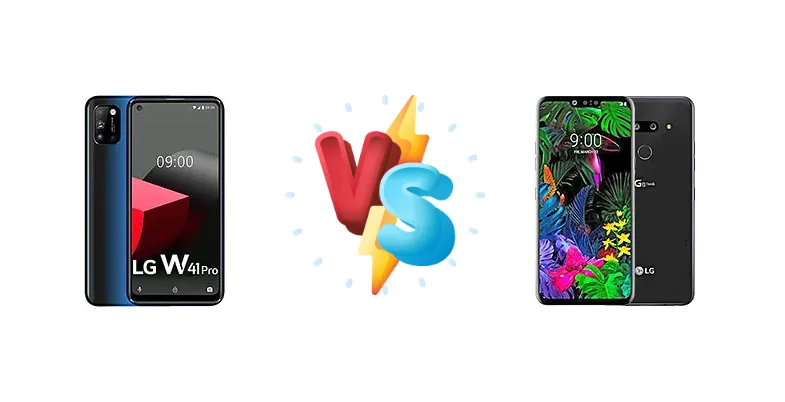
The LG G8 ThinQ represented a premium Android experience in 2019, boasting a flagship Snapdragon processor and a bright display. The LG W41 Pro, released later, targets a significantly lower price point with a Mediatek Helio G35 chipset. This comparison dissects the trade-offs between these two LG devices, helping you determine if the G8 ThinQ’s age justifies its potential benefits or if the W41 Pro offers sufficient functionality for everyday use.
🏆 Quick Verdict
For most users, the LG G8 ThinQ remains the superior choice. Its Snapdragon 855 chipset delivers significantly faster performance, and the 655 nit display provides a brighter, more vibrant viewing experience. While the W41 Pro offers a newer design, the performance gap is too large to ignore for anyone beyond the most basic smartphone tasks.
| Network |
|---|
| 2G bands | GSM 850 / 900 / 1800 / 1900 | GSM 850 / 900 / 1800 / 1900 |
| 3G bands | HSDPA 850 / 900 / 2100 | HSDPA 850 / 900 / 1900 / 2100 |
| 4G bands | 1, 3, 5, 8, 40, 41 | 1, 2, 3, 4, 5, 7, 8, 12, 13, 14, 17, 20, 25, 26, 28, 29, 30, 38, 39, 40, 41, 46, 48, 66, 71 - USA |
| Speed | HSPA, LTE | HSPA 42.2/5.76 Mbps, LTE Cat19 1600/150 Mbps |
| Technology | GSM / HSPA / LTE | GSM / CDMA / HSPA / EVDO / LTE |
| | - | 2, 3, 4, 5, 7, 13, 20, 28, 46, 48, 66 - Verison |
| Launch |
|---|
| Announced | 2021, February 22. Released 2021, March 03 | 2019, February 24. Released 2019, April 11 |
| Status | Discontinued | Discontinued |
| Body |
|---|
| Build | - | Glass front (Gorilla Glass 5), glass back (Gorilla Glass 6), aluminum frame |
| Dimensions | 166.5 x 77.3 x 9.3 mm (6.56 x 3.04 x 0.37 in) | 151.9 x 71.8 x 8.4 mm (5.98 x 2.83 x 0.33 in) |
| SIM | Nano-SIM + Nano-SIM | · Nano-SIM· Nano-SIM + Nano-SIM |
| Weight | 201 g (7.09 oz) | 167 g (5.89 oz) |
| | - | IP68 dust/water resistant (up to 1.5m for 30 min)
MIL-STD-810G compliant*
Method 516.6, Procedure IV "Transit Drop"
*does not guarantee ruggedness or use in extreme conditions |
| Display |
|---|
| Protection | - | Corning Gorilla Glass 5 |
| Resolution | 900 x 1600 pixels, 16:9 ratio (~280 ppi density) | 1440 x 3120 pixels, 19.5:9 ratio (~564 ppi density) |
| Size | 6.55 inches, 118.3 cm2 (~91.9% screen-to-body ratio) | 6.1 inches, 91.0 cm2 (~83.5% screen-to-body ratio) |
| Type | IPS LCD, 400 nits (typ) | P-OLED, HDR10 |
| | - | Always-on display |
| Platform |
|---|
| CPU | Octa-core (4x2.3 GHz Cortex-A53 & 4x1.8 GHz Cortex-A53) | Octa-core (1x2.84 GHz Kryo 485 & 3x2.42 GHz Kryo 485 & 4x1.78 GHz Kryo 485) |
| Chipset | Mediatek MT6765G Helio G35 (12 nm) | Qualcomm SM8150 Snapdragon 855 (7 nm) |
| GPU | PowerVR GE8320 | Adreno 640 |
| OS | Android 10 | Android 9.0 (Pie), upgradable to Android 11 |
| Memory |
|---|
| Card slot | microSDXC (dedicated slot) | microSDXC (dedicated slot) - single-SIM modelmicroSDXC (uses shared SIM slot) - dual-SIM model |
| Internal | 128GB 6GB RAM | 128GB 6GB RAM |
| | eMMC 5.1 | UFS 2.1 |
| Main Camera |
|---|
| Dual or Triple | - | 12 MP, f/1.5, 27mm (standard), 1/2.55", 1.4µm, dual pixel PDAF, OIS
16 MP, f/1.9, 16mm (ultrawide), 1/3.1", 1.0µm, no AF
or
12 MP, f/1.5, 27mm (standard), 1/2.55", 1.4µm, dual pixel PDAF, OIS
16 MP, f/1.9, 16mm (ultrawide), 1/3.1", 1.0µm, no AF
12 MP, 52mm (telephoto), f/2.4, 1.0µm, 2x optical zoom, dual pixel PDAF, OIS |
| Features | LED flash, panorama, HDR | LED flash, HDR, panorama |
| Quad | 48 MP, f/1.8, (wide), 1/2.0", 0.8µm, PDAF
8 MP, f/2.2, (ultrawide), 1/4.0", 1.12µm
5 MP (macro)
Auxiliary lens | - |
| Single | 8 MP, (wide), 1/4.0", 1.12µm | - |
| Video | 1080p@30fps | 4K@30/60fps, 1080p@30/60fps, 720p@240fps, HDR10, 24-bit/192kHz stereo sound rec. |
| Selfie camera |
|---|
| Features | - | HDR |
| Single | 8 MP, (wide), 1/4.0", 1.12µm | 8 MP, f/1.7, 26mm (wide), 1/3.6", 1.22µm, AF
TOF 3D, f/1.4, (depth/biometrics sensor) |
| Video | 1080p@30fps | 1080p@60fps |
| Sound |
|---|
| 3.5mm jack | Yes | Yes |
| 35mm jack | Yes | Yes |
| Loudspeaker | Yes | Yes |
| | - | 32-bit/192kHz audio |
| Comms |
|---|
| Bluetooth | 5.0, A2DP, LE | 5.0, A2DP, LE, aptX HD |
| NFC | No | Yes |
| Positioning | GPS, GLONASS | GPS, GLONASS, GALILEO, BDS |
| Radio | FM radio | FM radio (market/region dependent) |
| USB | USB Type-C 2.0, OTG | USB Type-C 3.1, OTG |
| WLAN | Wi-Fi 802.11 b/g/n, Wi-Fi Direct | Wi-Fi 802.11 a/b/g/n/ac, dual-band, Wi-Fi Direct, DLNA |
| Features |
|---|
| Sensors | Fingerprint (rear-mounted), accelerometer, proximity | Face ID, Hand ID, fingerprint (rear-mounted), accelerometer, gyro, proximity, compass, barometer |
| Battery |
|---|
| Charging | - | 21W wired, PD, QC3
9W wireless |
| Type | Li-Po 5000 mAh | Li-Po 3500 mAh, non-removable |
| Misc |
|---|
| Colors | Magic Blue, Laser Blue | Platinum Gray, New Aurora Black, New Moroccan Blue, Carmine Red |
| Models | LMK610IM, LM-K610IM | LMG820QM7, LM-G820UMB, LMG820UM0, LMG820UM1, LMG820UM2, LM-G820N, LM-G820, LM-G820QM |
| Price | About 180 EUR | About 350 EUR |
| Tests |
|---|
| Audio quality | - |
Noise -94.1dB / Crosstalk -87.6dB |
| Battery life | - |
Endurance rating 79h
|
| Camera | - |
Photo / Video |
| Display | - |
Contrast ratio: infinite |
| Loudspeaker | - |
Voice 68dB / Noise 74dB / Ring 92dB
|
| Performance | - |
AnTuTu: 331537 (v7), 362730 (v8)
GeekBench: 10735 (v4.4), 2700 (v5.1)
GFXBench: 20fps (ES 3.1 onscreen) |
LG W41 Pro
- Significantly faster processor (Snapdragon 855)
- Brighter and higher-quality display (655 nits)
- Faster charging options (21W wired, 9W wireless)
- Older device, potentially reduced battery longevity
- May be harder to find new
LG G8 ThinQ
- More affordable price point
- Potentially longer software support (newer device)
- Modern design (likely)
- Significantly slower processor (Helio G35)
- Lower display quality (likely)
- Limited charging options (unspecified)
Display Comparison
The LG G8 ThinQ features a display capable of reaching 655 nits of peak brightness, ensuring excellent visibility even in direct sunlight. While the W41 Pro’s display specifications are not provided, it’s reasonable to assume a lower peak brightness given its budget positioning. The G8 ThinQ’s infinite contrast ratio, likely achieved through OLED technology, provides deeper blacks and more vibrant colors compared to what is typically found in the W41 Pro’s likely LCD panel. This difference is crucial for media consumption and gaming.
Camera Comparison
Both devices offer photo and video capabilities, but the specifics are limited. Without detailed sensor information, it’s difficult to make a precise comparison. However, given the G8 ThinQ’s flagship status, it likely features a more sophisticated camera system with a larger sensor and better image processing. The W41 Pro’s camera is likely geared towards basic photography, while the G8 ThinQ could offer features like optical image stabilization (OIS) and more advanced shooting modes. The absence of details on the W41 Pro’s camera suggests it won’t compete with the G8 ThinQ in image quality.
Performance
The core difference lies in the chipsets. The LG G8 ThinQ’s Qualcomm Snapdragon 855 (7nm) is a flagship-level processor with a Kryo 485 architecture, offering a substantial performance advantage over the LG W41 Pro’s Mediatek Helio G35 (12nm). The Snapdragon 855’s octa-core configuration (1x2.84 GHz & 3x2.42 GHz & 4x1.78 GHz) is significantly faster than the Helio G35’s (4x2.3 GHz & 4x1.8 GHz). The 7nm process node of the Snapdragon 855 also contributes to better thermal efficiency, reducing the likelihood of performance throttling during sustained workloads. The W41 Pro will struggle with demanding games and applications, while the G8 ThinQ can handle them with relative ease.
Battery Life
Both phones share an endurance rating of 79 hours, suggesting similar real-world battery performance despite the difference in chipsets. However, this rating doesn't account for usage patterns. The more efficient Snapdragon 855, despite its higher performance, could potentially offer comparable battery life to the Helio G35 under moderate use. The G8 ThinQ also supports 21W wired charging with Power Delivery (PD) and Quick Charge 3.0, as well as 9W wireless charging, offering significantly faster and more versatile charging options than the W41 Pro, whose charging capabilities are not specified.
Buying Guide
Buy the LG W41 Pro if you need a very affordable smartphone for essential tasks like calling, texting, and light social media browsing, and battery life is your absolute top priority. Buy the LG G8 ThinQ if you prioritize performance for gaming, multitasking, and demanding applications, and value a brighter, higher-quality display, even if it means accepting an older device with potentially reduced battery longevity.
Frequently Asked Questions
❓ Will the LG G8 ThinQ struggle with modern apps and updates?
While the Snapdragon 855 is an older chip, it remains capable of running most modern apps. However, long-term software support from LG is limited. Expect to receive security updates for a shorter period compared to the newer W41 Pro, but the G8 ThinQ’s performance will likely remain smoother for longer due to its superior processing power.
❓ Is the Helio G35 in the LG W41 Pro sufficient for casual gaming?
The Helio G35 is suitable for very light gaming and basic tasks. However, demanding games like PUBG or Call of Duty will likely require significant graphics settings reductions and may still experience lag or stuttering. It's not a gaming-focused chipset.
❓ Does the LG G8 ThinQ's battery health degrade significantly due to its age?
Battery degradation is a natural process for all smartphones. The LG G8 ThinQ, being an older device, may exhibit some battery health decline. However, the 79-hour endurance rating suggests it still offers respectable battery life, and replacing the battery is an option if needed.