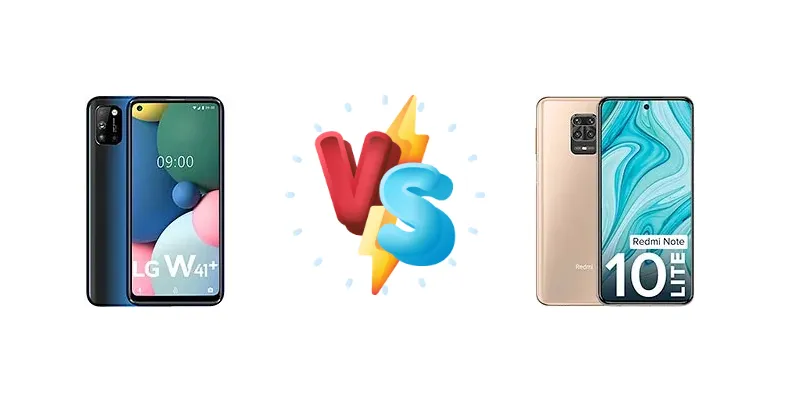
The LG W41+ and Xiaomi Redmi Note 10 Lite represent compelling options in the crowded budget smartphone market. While both aim to deliver essential features at an accessible price point, they diverge significantly in their core hardware, particularly in their chipsets. This comparison dissects these differences to determine which device offers the best overall experience for various user needs.
🏆 Quick Verdict
For the average user prioritizing consistent performance and future-proofing, the Xiaomi Redmi Note 10 Lite emerges as the stronger contender. Its Snapdragon 720G chipset, built on a more efficient 8nm process, provides a noticeable advantage in both everyday tasks and gaming, despite the LG W41+'s slightly lower price point.
| Network |
|---|
| 2G bands | GSM 850 / 900 / 1800 / 1900 - SIM 1 & SIM 2 | GSM 850 / 900 / 1800 / 1900 |
| 3G bands | HSDPA 850 / 900 / 2100 | HSDPA 850 / 900 / 1700(AWS) / 1900 / 2100 |
| 4G bands | 1, 3, 5, 8, 40, 41 | 1, 2, 3, 4, 5, 7, 8, 20, 28, 38, 40, 41 |
| Speed | HSPA, LTE | HSPA, LTE |
| Technology | GSM / HSPA / LTE | GSM / HSPA / LTE |
| Launch |
|---|
| Announced | 2021, February 22 | 2021, October 01 |
| Status | Available. Released 2021, March 03 | Available. Released 2021, October 02 |
| Body |
|---|
| Build | - | Glass front (Gorilla Glass 5), glass back (Gorilla Glass 5), plastic frame |
| Dimensions | 166.5 x 77.3 x 9.3 mm (6.56 x 3.04 x 0.37 in) | 165.8 x 76.7 x 8.8 mm (6.53 x 3.02 x 0.35 in) |
| SIM | Dual SIM (Nano-SIM, dual stand-by) | Nano-SIM + Nano-SIM |
| Weight | 201 g (7.09 oz) | 209 g (7.37 oz) |
| | - | Water-repellent coating |
| Display |
|---|
| Protection | - | Corning Gorilla Glass 5 |
| Resolution | 900 x 1600 pixels, 16:9 ratio (~280 ppi density) | 1080 x 2400 pixels, 20:9 ratio (~395 ppi density) |
| Size | 6.55 inches, 118.3 cm2 (~91.9% screen-to-body ratio) | 6.67 inches, 107.4 cm2 (~84.5% screen-to-body ratio) |
| Type | IPS LCD, 400 nits (typ) | IPS LCD |
| Platform |
|---|
| CPU | Octa-core (4x2.3 GHz Cortex-A53 & 4x1.8 GHz Cortex-A53) | Octa-core (2x2.3 GHz Kryo 465 Gold & 6x1.8 GHz Kryo 465 Silver) |
| Chipset | Mediatek MT6765G Helio G35 (12 nm) | Qualcomm SM7125 Snapdragon 720G (8 nm) |
| GPU | PowerVR GE8320 | Adreno 618 |
| OS | Android 10 | Android 10, MIUI 11 |
| Memory |
|---|
| Card slot | microSDXC (dedicated slot) | microSDXC (dedicated slot) |
| Internal | 128GB 4GB RAM | 64GB 4GB RAM, 64GB 6GB RAM, 128GB 4GB RAM, 128GB 6GB RAM |
| | eMMC 5.1 | - |
| Main Camera |
|---|
| Features | LED flash, panorama, HDR | LED flash, HDR, panorama |
| Quad | 48 MP, f/1.8, (wide), 1/2.0", 0.8µm, PDAF
8 MP, f/2.2, (ultrawide), 1/4.0", 1.12µm
5 MP, f/2.4, (macro)
2 MP, f/2.4, (depth) | 48 MP, f/1.9, 26mm (wide), 0.8µm, PDAF
8 MP, f/2.2, 119˚ (ultrawide), 1/4.0", 1.12µm
5 MP (macro), AF
Auxiliary lens |
| Single | 8 MP, (wide), 1/4.0", 1.12µm | 16 MP, f/2.5, (wide), 1/3.06", 1.0µm |
| Video | 1080p@30fps | 4K@30fps, 1080p@30/60/120fps, 720p@960fps, gyro-EIS |
| Selfie camera |
|---|
| Features | - | HDR, panorama |
| Single | 8 MP, (wide), 1/4.0", 1.12µm | 16 MP, f/2.5, (wide), 1/3.06", 1.0µm |
| Video | 1080p@30fps | 1080p@30fps |
| Sound |
|---|
| 3.5mm jack | Yes | Yes |
| 35mm jack | - | Yes |
| Loudspeaker | Yes | Yes |
| Comms |
|---|
| Bluetooth | 5.0, A2DP, LE | 5.0, A2DP, LE |
| Infrared port | - | Yes |
| NFC | No | Yes |
| Positioning | GPS, GLONASS | GPS, GLONASS, GALILEO, BDS, NavIC |
| Radio | FM radio | FM radio, recording |
| USB | USB Type-C 2.0, OTG | USB Type-C 2.0 |
| WLAN | Wi-Fi 802.11 b/g/n, Wi-Fi Direct | Wi-Fi 802.11 a/b/g/n/ac, dual-band, Wi-Fi Direct |
| Features |
|---|
| Sensors | Fingerprint (rear-mounted), accelerometer, proximity | Fingerprint (side-mounted), accelerometer, gyro, proximity, compass |
| Battery |
|---|
| Charging | - | 18W wired |
| Type | Li-Po 5000 mAh, non-removable | Li-Po 5020 mAh |
| Misc |
|---|
| Colors | Magic Blue, Laser Blue | Aurora Blue, Glacier White, Interstellar Black, Champagne Gold |
| Models | LMK610IM, LM-K610IM | M2002F4LG |
| Price | About 170 EUR | About 200 EUR |
| SAR | - | 1.17 W/kg (head) 0.86 W/kg (body) |
| SAR EU | - | 1.01 W/kg (head) 1.39 W/kg (body) |
LG W41+
- Potentially lower price point
- May offer a more compact form factor (speculation)
- Simple and straightforward user experience
- Inferior chipset performance (Helio G35)
- Less efficient 12nm process
- Likely slower charging speeds
Xiaomi Redmi Note 10 Lite
- Superior chipset performance (Snapdragon 720G)
- More efficient 8nm process
- Faster 18W wired charging
- Potentially higher price point
- May have more bloatware (Xiaomi's MIUI)
- Larger form factor (potentially)
Display Comparison
Neither device boasts a particularly standout display. While specific details like panel type and resolution are missing for the LG W41+, the Redmi Note 10 Lite's display is likely a standard IPS LCD. The key differentiator lies under the hood: processing power impacts UI responsiveness. A smoother experience is expected on the Redmi Note 10 Lite due to the more capable chipset driving the display.
Camera Comparison
Without detailed camera specifications for the LG W41+, a direct comparison is challenging. However, given its market positioning, it's likely to feature a more basic camera setup. The Redmi Note 10 Lite, while not a camera champion, benefits from Qualcomm’s image signal processor (ISP) within the Snapdragon 720G, which provides better image processing capabilities. This translates to improved dynamic range and noise reduction, particularly in challenging lighting conditions. The absence of Optical Image Stabilization (OIS) on either device suggests a reliance on software stabilization, where the Snapdragon 720G’s ISP will again provide an advantage.
Performance
The core of the difference lies in the chipsets. The Xiaomi Redmi Note 10 Lite’s Qualcomm Snapdragon 720G (8nm) is a significant step up from the LG W41+'s MediaTek Helio G35 (12nm). The 8nm process inherently offers better power efficiency, translating to less heat generation and potentially less throttling during sustained workloads. The Snapdragon 720G’s Kryo 465 Gold cores, with a peak clock speed of 2.3 GHz, are architecturally more advanced than the Cortex-A53 cores in the Helio G35, resulting in superior single-core and multi-core performance. This means faster app loading times, smoother multitasking, and a more enjoyable gaming experience on the Redmi Note 10 Lite.
Battery Life
The Redmi Note 10 Lite’s 18W wired charging is a clear advantage over the LG W41+, which lacks any specified fast charging capability. While battery capacity isn’t provided for the LG W41+, the Redmi Note 10 Lite’s charging speed will significantly reduce downtime. The Snapdragon 720G’s 8nm process also contributes to better power efficiency, potentially offsetting any capacity difference between the two devices, resulting in comparable real-world battery life despite the charging advantage.
Buying Guide
Buy the LG W41+ if you need a basic smartphone for light tasks like calls, messaging, and occasional social media browsing, and are extremely budget-constrained. Buy the Xiaomi Redmi Note 10 Lite if you prioritize smoother multitasking, a more responsive gaming experience, and faster charging, even if it means spending a bit more upfront. The Redmi Note 10 Lite is the better choice for users who anticipate using their phone for more than just the basics.
Frequently Asked Questions
❓ Will the Redmi Note 10 Lite handle demanding games like PUBG Mobile smoothly?
The Snapdragon 720G in the Redmi Note 10 Lite is capable of running PUBG Mobile at medium to high settings with a stable frame rate. While it won't deliver a flagship-level experience, it provides a significantly smoother gaming experience compared to the Helio G35 in the LG W41+, which may struggle with consistent performance.
❓ Is the difference in chipset performance noticeable in everyday tasks like browsing and social media?
Yes, the Snapdragon 720G’s superior processing power translates to a more responsive and fluid experience in everyday tasks. App loading times will be faster, multitasking will be smoother, and scrolling through social media feeds will feel less laggy on the Redmi Note 10 Lite.
❓ Does the Redmi Note 10 Lite's MIUI software significantly impact performance?
MIUI, Xiaomi's custom Android skin, is known for being feature-rich but can sometimes be resource-intensive. While it may introduce some bloatware, the Snapdragon 720G’s processing power is sufficient to handle MIUI without significant performance degradation. Optimizations and updates can further improve the experience.
❓ How much faster is the 18W charging on the Redmi Note 10 Lite compared to a standard charger?
18W charging on the Redmi Note 10 Lite will significantly reduce charging times compared to a standard 5W or 10W charger. Expect a full charge in approximately 2-3 hours with the included charger, whereas a standard charger could take 5+ hours. This is a substantial convenience factor.