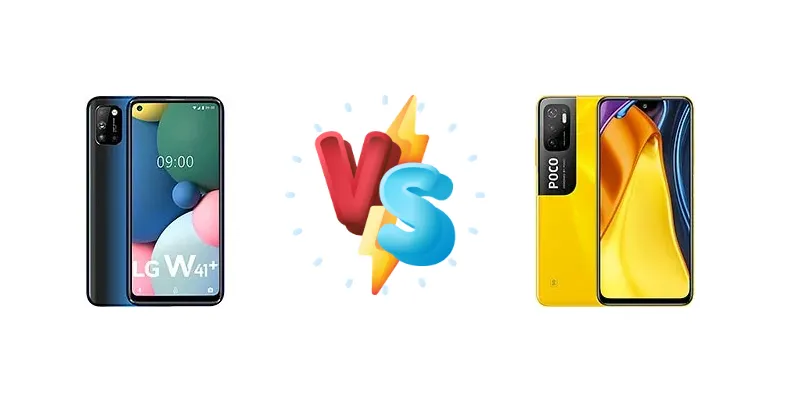
The sub-$200 5G smartphone market is heating up, and the LG W41+ and Xiaomi Poco M3 Pro 5G are two contenders vying for your attention. While both offer 5G connectivity at an accessible price point, they diverge significantly in their internal hardware and target user. This comparison dissects these differences to determine which device delivers the best overall experience.
🏆 Quick Verdict
For most users, the Xiaomi Poco M3 Pro 5G is the clear winner. Its Mediatek Dimensity 700 chipset, built on a more efficient 7nm process, provides a substantial performance uplift over the LG W41+'s Helio G35. While both phones boast similar battery endurance ratings, the Poco's faster charging and superior processing power make it the more compelling choice.
| Network |
|---|
| 2G bands | GSM 850 / 900 / 1800 / 1900 - SIM 1 & SIM 2 | GSM 850 / 900 / 1800 / 1900 |
| 3G bands | HSDPA 850 / 900 / 2100 | HSDPA 850 / 900 / 1700(AWS) / 1900 / 2100 |
| 4G bands | 1, 3, 5, 8, 40, 41 | 1, 2, 3, 4, 5, 7, 8, 12, 17, 20, 28, 32, 38, 40, 41, 66 |
| 5G bands | - | 1, 3, 7, 8, 20, 28, 38, 40, 41, 66, 77, 78 SA/NSA |
| Speed | HSPA, LTE | HSPA, LTE, 5G |
| Technology | GSM / HSPA / LTE | GSM / HSPA / LTE / 5G |
| Launch |
|---|
| Announced | 2021, February 22 | 2021, May 19 |
| Status | Available. Released 2021, March 03 | Available. Released 2021, May 22 |
| Body |
|---|
| Build | - | Glass front (Gorilla Glass 3), plastic frame, plastic back |
| Dimensions | 166.5 x 77.3 x 9.3 mm (6.56 x 3.04 x 0.37 in) | 161.8 x 75.3 x 8.9 mm (6.37 x 2.96 x 0.35 in) |
| SIM | Dual SIM (Nano-SIM, dual stand-by) | Nano-SIM + Nano-SIM |
| Weight | 201 g (7.09 oz) | 190 g (6.70 oz) |
| Display |
|---|
| Protection | - | Corning Gorilla Glass 3 |
| Resolution | 900 x 1600 pixels, 16:9 ratio (~280 ppi density) | 1080 x 2400 pixels, 20:9 ratio (~405 ppi density) |
| Size | 6.55 inches, 118.3 cm2 (~91.9% screen-to-body ratio) | 6.5 inches, 102.0 cm2 (~83.7% screen-to-body ratio) |
| Type | IPS LCD, 400 nits (typ) | IPS LCD, 90Hz, 400 nits (typ), 500 nits (HBM) |
| Platform |
|---|
| CPU | Octa-core (4x2.3 GHz Cortex-A53 & 4x1.8 GHz Cortex-A53) | Octa-core (2x2.2 GHz Cortex-A76 & 6x2.0 GHz Cortex-A55) |
| Chipset | Mediatek MT6765G Helio G35 (12 nm) | Mediatek Dimensity 700 (7 nm) |
| GPU | PowerVR GE8320 | Mali-G57 MC2 |
| OS | Android 10 | Android 11, MIUI 12 |
| Memory |
|---|
| Card slot | microSDXC (dedicated slot) | microSDXC (uses shared SIM slot) |
| Internal | 128GB 4GB RAM | 64GB 4GB RAM, 128GB 6GB RAM |
| | eMMC 5.1 | UFS 2.2 |
| Main Camera |
|---|
| Features | LED flash, panorama, HDR | Dual-LED dual-tone flash, HDR, panorama |
| Quad | 48 MP, f/1.8, (wide), 1/2.0", 0.8µm, PDAF
8 MP, f/2.2, (ultrawide), 1/4.0", 1.12µm
5 MP, f/2.4, (macro)
2 MP, f/2.4, (depth) | - |
| Single | 8 MP, (wide), 1/4.0", 1.12µm | 8 MP, f/2.0, (wide) |
| Triple | - | 48 MP, f/1.8, 26mm (wide), 1/2.0", 0.8µm, PDAF
2 MP (macro)
Auxiliary lens |
| Video | 1080p@30fps | 1080p@30fps |
| Selfie camera |
|---|
| Single | 8 MP, (wide), 1/4.0", 1.12µm | 8 MP, f/2.0, (wide) |
| Video | 1080p@30fps | 1080p@30fps |
| Sound |
|---|
| 3.5mm jack | Yes | Yes |
| 35mm jack | - | Yes |
| Loudspeaker | Yes | Yes |
| | - | 24-bit/192kHz audio |
| Comms |
|---|
| Bluetooth | 5.0, A2DP, LE | 5.1, A2DP, LE |
| Infrared port | - | Yes |
| NFC | No | Yes (market/region dependent) |
| Positioning | GPS, GLONASS | GPS, GLONASS, GALILEO, BDS |
| Radio | FM radio | FM radio |
| USB | USB Type-C 2.0, OTG | USB Type-C 2.0 |
| WLAN | Wi-Fi 802.11 b/g/n, Wi-Fi Direct | Wi-Fi 802.11 a/b/g/n/ac, dual-band, Wi-Fi Direct |
| Features |
|---|
| Sensors | Fingerprint (rear-mounted), accelerometer, proximity | Fingerprint (side-mounted), accelerometer, gyro, proximity, compass |
| Battery |
|---|
| Charging | - | 18W wired |
| Type | Li-Po 5000 mAh, non-removable | Li-Po 5000 mAh |
| Misc |
|---|
| Colors | Magic Blue, Laser Blue | Poco Yellow, Power Black, Cool Blue |
| Models | LMK610IM, LM-K610IM | M2103K19PG, M2103K19PI, M2103K19PY |
| Price | About 170 EUR | About 140 EUR |
| SAR | - | 0.94 W/kg (head) 1.06 W/kg (body) |
| SAR EU | - | 0.54 W/kg (head) 0.90 W/kg (body) |
| Tests |
|---|
| Battery life | - |
Endurance rating 121h
|
| Camera | - |
Photo / Video |
| Display | - |
Contrast ratio: 1475:1 (nominal) |
| Loudspeaker | - |
-27.9 LUFS (Good)
|
LG W41+
- Potentially lower price point (depending on region)
- Simple and straightforward user experience
- Acceptable battery life
- Significantly weaker processor performance
- Less efficient 12nm chipset
- Likely limited camera capabilities
Xiaomi Poco M3 Pro 5G
- Faster and more efficient Mediatek Dimensity 700 chipset
- Faster 18W charging
- Brighter display for outdoor visibility
- May be slightly more expensive than the LG W41+
- Software experience can be more feature-rich (and potentially bloated)
- Build quality may not be as premium as some competitors
Display Comparison
Both the LG W41+ and Poco M3 Pro 5G feature displays with a 1475:1 contrast ratio, suggesting similar visual pop. However, the Poco M3 Pro 5G boasts a measured peak brightness of 536 nits, a significant advantage over the LG W41+ (brightness data unavailable), making it more usable outdoors in bright sunlight. While both contrast ratios are nominally the same, real-world viewing experience will likely favor the Poco due to its higher brightness.
Camera Comparison
Both phones offer photo and video capabilities, but detailed camera specifications are limited. Without sensor size or aperture information, a direct comparison is difficult. However, the Poco M3 Pro 5G’s more powerful processor likely enables more sophisticated image processing algorithms, potentially resulting in better image quality, especially in low-light conditions. The LG W41+’s camera system is likely geared towards basic photography, while the Poco offers a more versatile experience.
Performance
The performance gap between these two devices is substantial. The Poco M3 Pro 5G’s Mediatek Dimensity 700, fabricated on a 7nm process, utilizes Cortex-A76 performance cores alongside efficient A55 cores. This contrasts sharply with the LG W41+'s Helio G35, which relies solely on Cortex-A53 cores across all eight threads and is built on a less efficient 12nm process. The Dimensity 700’s architecture translates to significantly faster CPU and GPU performance, making the Poco M3 Pro 5G better suited for multitasking, gaming, and demanding applications. The 7nm process also contributes to better thermal efficiency, reducing the likelihood of performance throttling under sustained load.
Battery Life
Both the LG W41+ and Xiaomi Poco M3 Pro 5G achieve an endurance rating of 121 hours, indicating comparable battery life under similar usage patterns. However, the Poco M3 Pro 5G features 18W wired charging, allowing for faster replenishment of the battery compared to the LG W41+ (charging speed data unavailable). This faster charging capability provides a convenience advantage, minimizing downtime and ensuring you can quickly get back to using your phone.
Buying Guide
Buy the LG W41+ if you prioritize a simple, no-frills experience and are primarily focused on basic smartphone tasks like calling, texting, and light social media use. Buy the Xiaomi Poco M3 Pro 5G if you want a phone capable of handling more demanding applications, enjoy occasional gaming, and value the benefits of a faster processor and 5G connectivity for smoother streaming and downloads.
Frequently Asked Questions
❓ Does the Poco M3 Pro 5G's Dimensity 700 chipset handle graphically intensive games like PUBG Mobile smoothly?
Yes, the Mediatek Dimensity 700 is capable of running PUBG Mobile at medium to high settings with stable frame rates. While it won't deliver the same performance as flagship chipsets, it provides a significantly better gaming experience than the LG W41+'s Helio G35, which would likely struggle with consistent performance.
❓ Is the 18W charging on the Poco M3 Pro 5G a significant improvement over the LG W41+ (assuming the LG charges at a slower rate)?
Yes, 18W charging is noticeably faster than typical slower charging solutions found in this price range. While a full charge won't be as rapid as flagship phones with 65W or higher charging, it will significantly reduce the time spent plugged into the wall compared to a slower charging phone like the LG W41+.
❓ How does the 5G performance differ between the Poco M3 Pro 5G and the LG W41+ in real-world scenarios?
Both phones support 5G, but the Dimensity 700 in the Poco M3 Pro 5G generally offers more robust 5G modem capabilities and wider band support. This translates to potentially faster and more reliable 5G connections, especially in areas with varying 5G network coverage.