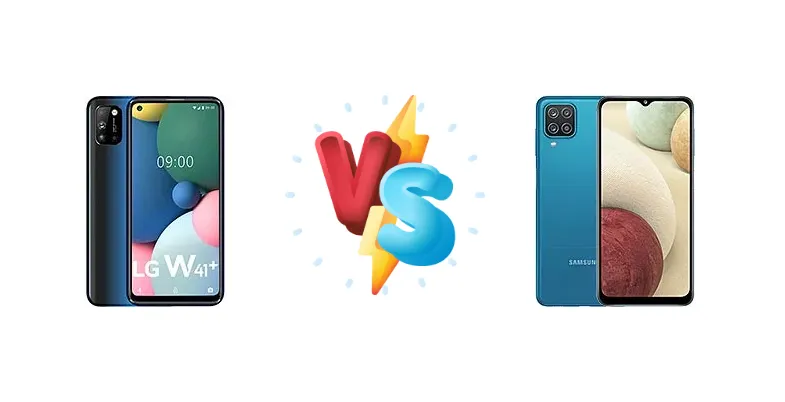
The sub-₹15,000 (approximately $180 USD) smartphone segment in India is fiercely competitive. Both the Samsung Galaxy A12 and the LG W41+ aim to deliver essential smartphone functionality at an accessible price. However, they take different approaches to achieving this, primarily through their chipset choices. This comparison dives deep into the architectural differences and real-world implications of the Exynos 850 and Helio G35, helping you determine which device best suits your needs.
🏆 Quick Verdict
For the average user prioritizing sustained performance and a more modern architecture, the Samsung Galaxy A12 (India) is the better choice. Its Exynos 850, built on an 8nm process, offers a noticeable advantage in efficiency and processing power over the LG W41+'s 12nm Helio G35, despite similar clock speeds. While the LG W41+ may offer a slightly better price, the A12's superior chipset justifies the potential cost difference.
| Network |
|---|
| 2G bands | GSM 850 / 900 / 1800 / 1900 - SIM 1 & SIM 2 | GSM 850 / 900 / 1800 / 1900 |
| 3G bands | HSDPA 850 / 900 / 2100 | HSDPA 850 / 900 / 2100 |
| 4G bands | 1, 3, 5, 8, 40, 41 | 1, 3, 5, 7, 8, 20, 28, 38, 40, 41 |
| Speed | HSPA, LTE | HSPA 42.2/5.76 Mbps, LTE Cat4 150/50 Mbps |
| Technology | GSM / HSPA / LTE | GSM / HSPA / LTE |
| Launch |
|---|
| Announced | 2021, February 22 | 2021, August 12 |
| Status | Available. Released 2021, March 03 | Available. Released 2021, August 12 |
| Body |
|---|
| Build | - | Glass front, plastic back, plastic frame |
| Dimensions | 166.5 x 77.3 x 9.3 mm (6.56 x 3.04 x 0.37 in) | 164 x 75.8 x 8.9 mm (6.46 x 2.98 x 0.35 in) |
| SIM | Dual SIM (Nano-SIM, dual stand-by) | · Nano-SIM· Nano-SIM + Nano-SIM |
| Weight | 201 g (7.09 oz) | 205 g (7.23 oz) |
| Display |
|---|
| Resolution | 900 x 1600 pixels, 16:9 ratio (~280 ppi density) | 720 x 1600 pixels, 20:9 ratio (~270 ppi density) |
| Size | 6.55 inches, 118.3 cm2 (~91.9% screen-to-body ratio) | 6.5 inches, 102.0 cm2 (~82.1% screen-to-body ratio) |
| Type | IPS LCD, 400 nits (typ) | PLS LCD |
| Platform |
|---|
| CPU | Octa-core (4x2.3 GHz Cortex-A53 & 4x1.8 GHz Cortex-A53) | Octa-core (4x2.0 GHz Cortex-A55 & 4x2.0 GHz Cortex-A55) |
| Chipset | Mediatek MT6765G Helio G35 (12 nm) | Exynos 850 (8 nm) |
| GPU | PowerVR GE8320 | Mali-G52 |
| OS | Android 10 | Android 11, upgradable to Android 13, One UI 5.1 |
| Memory |
|---|
| Card slot | microSDXC (dedicated slot) | microSDXC (dedicated slot) |
| Internal | 128GB 4GB RAM | 64GB 4GB RAM, 128GB 4GB RAM, 128GB 6GB RAM |
| | eMMC 5.1 | eMMC 5.1 |
| Main Camera |
|---|
| Features | LED flash, panorama, HDR | LED flash, panorama, HDR |
| Quad | 48 MP, f/1.8, (wide), 1/2.0", 0.8µm, PDAF
8 MP, f/2.2, (ultrawide), 1/4.0", 1.12µm
5 MP, f/2.4, (macro)
2 MP, f/2.4, (depth) | 48 MP, f/2.0, 26mm (wide), AF
5 MP, f/2.2, 123˚ (ultrawide)
2 MP (macro)
Auxiliary lens |
| Single | 8 MP, (wide), 1/4.0", 1.12µm | - |
| Video | 1080p@30fps | 1080p@30fps |
| Selfie camera |
|---|
| Single | 8 MP, (wide), 1/4.0", 1.12µm | 8 MP, f/2.2 |
| Video | 1080p@30fps | 1080p@30fps |
| Sound |
|---|
| 3.5mm jack | Yes | Yes |
| 35mm jack | - | Yes |
| Loudspeaker | Yes | Yes |
| Comms |
|---|
| Bluetooth | 5.0, A2DP, LE | 5.0, A2DP, LE |
| NFC | No | No |
| Positioning | GPS, GLONASS | GPS, GLONASS, GALILEO, BDS |
| Radio | FM radio | FM radio, RDS, recording |
| USB | USB Type-C 2.0, OTG | USB Type-C 2.0 |
| WLAN | Wi-Fi 802.11 b/g/n, Wi-Fi Direct | Wi-Fi 802.11 b/g/n, Wi-Fi Direct |
| Features |
|---|
| Sensors | Fingerprint (rear-mounted), accelerometer, proximity | Fingerprint (side-mounted), accelerometer |
| | - | Virtual proximity sensing |
| Battery |
|---|
| Charging | - | 15W wired |
| Type | Li-Po 5000 mAh, non-removable | Li-Po 5000 mAh |
| Misc |
|---|
| Colors | Magic Blue, Laser Blue | Black, Blue, White |
| Models | LMK610IM, LM-K610IM | SM-A127F, SM-A127F/DS |
| Price | About 170 EUR | About 160 EUR |
| SAR | - | 0.79 W/kg (head) |
LG W41+
- More efficient Exynos 850 chipset
- Faster 15W charging
- Likely better software support from Samsung
- Potentially slightly higher price
- May have similar display quality to the W41+
Samsung Galaxy A12 (India)
- Potentially lower price point
- Adequate for basic smartphone tasks
- May offer similar battery capacity
- Less efficient Helio G35 chipset
- Slower charging (likely)
- Older CPU architecture
Display Comparison
Neither device boasts a particularly impressive display. Specifics like panel type (IPS vs. TFT) and resolution are missing, but both likely target a 720p+ resolution given the price point. The key difference lies under the hood: processing power impacts UI smoothness. The Exynos 850's GPU will contribute to a more responsive experience when scrolling and navigating the interface, even if the raw pixel count is similar. Bezels are likely comparable, typical of this segment.
Camera Comparison
Without detailed sensor information, a direct camera comparison is difficult. However, the market segment suggests both phones will feature a primary sensor around 13-16MP, accompanied by several lower-resolution auxiliary lenses (likely including a 2MP macro on both). The Exynos 850’s image signal processor (ISP) is likely more advanced than the Helio G35’s, resulting in better dynamic range and noise reduction in photos. The 2MP macro cameras on both devices are largely marketing features and offer limited practical benefit. The real-world image quality will depend more on software processing than raw sensor specs.
Performance
The core of the difference lies in the chipsets. The Samsung Galaxy A12’s Exynos 850, fabricated on an 8nm process, is significantly more efficient than the LG W41+'s MediaTek Helio G35 (12nm). While both are octa-core CPUs, the Exynos 850 utilizes newer Cortex-A55 cores across all eight, offering improved instructions per clock (IPC) compared to the W41+'s mix of A53 cores. This translates to faster app loading times and smoother multitasking. The Helio G35's architecture, while adequate for basic tasks, will struggle with demanding applications. The 8nm process of the Exynos 850 also means less heat generation, potentially leading to more sustained performance under load.
Battery Life
Battery capacity is not specified for either device, but both likely fall in the 4000-5000mAh range. The Samsung Galaxy A12 has a clear advantage with its 15W wired charging support. The LG W41+’s charging speed is unknown, but it’s likely slower. The Exynos 850’s superior efficiency will also contribute to longer battery life in real-world usage, offsetting any potential capacity difference. The faster charging on the A12 means less time tethered to a wall outlet.
Buying Guide
Buy the LG W41+ if you need a phone primarily for very basic tasks like calls, messaging, and light social media browsing, and are extremely budget-constrained. Buy the Samsung Galaxy A12 (India) if you prefer a smoother experience with multitasking, occasional gaming, and a chipset that will likely receive longer software support due to Samsung's broader market presence.
Frequently Asked Questions
❓ Does the Exynos 850 in the Galaxy A12 get hot during prolonged gaming sessions?
The Exynos 850, built on an 8nm process, is relatively efficient. While it will warm up during extended gaming, it's unlikely to experience significant thermal throttling like the Helio G35 in the LG W41+ due to the more advanced manufacturing process and improved heat dissipation.
❓ Is the 2MP macro camera on either phone worth using?
Generally, 2MP macro cameras on budget smartphones offer limited practical benefit. The image quality is often poor, lacking detail and sharpness. They are primarily a marketing feature and are unlikely to produce satisfying results compared to using the main camera in close-up mode.
❓ Can the Samsung Galaxy A12 (India) handle popular games like PUBG Mobile?
The Galaxy A12 can run PUBG Mobile, but you'll likely need to lower the graphics settings to medium or low to achieve a consistently smooth frame rate. The Exynos 850 is capable, but it's not a gaming powerhouse. The LG W41+ will struggle to maintain a playable frame rate even on the lowest settings.
❓ Which phone is likely to receive more software updates?
Samsung generally provides longer software support for its devices than LG, especially in the budget segment. The Galaxy A12 is more likely to receive Android version updates and security patches for a longer period, enhancing its longevity.