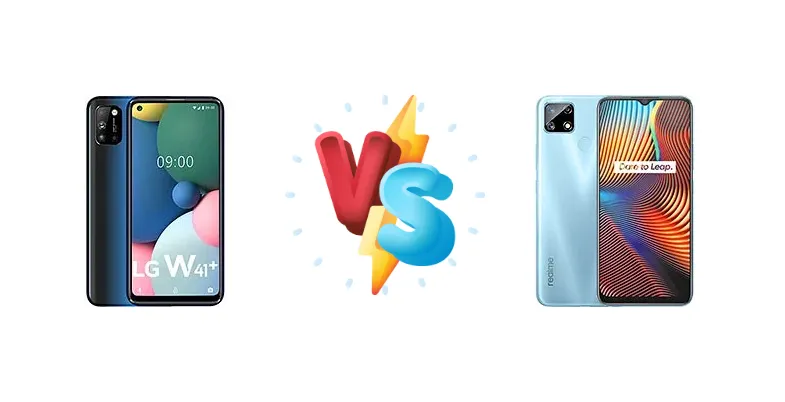
Both the LG W41+ and Realme 7i (Global) target the entry-level smartphone market, but cater to slightly different priorities. The LG W41+ aims for a balanced experience, while the Realme 7i focuses on delivering more processing power for gaming and multimedia, albeit with compromises in other areas. This comparison dissects their key differences to help you choose the right device.
🏆 Quick Verdict
For the average user prioritizing gaming and faster charging, the Realme 7i is the clear winner. Its Helio G85 chipset provides a significant performance boost over the LG W41+'s Helio G35, and the 18W charging is a substantial advantage. However, the LG W41+ may appeal to those seeking a slightly more balanced, if less powerful, experience.
| Network |
|---|
| 2G bands | GSM 850 / 900 / 1800 / 1900 - SIM 1 & SIM 2 | GSM 850 / 900 / 1800 / 1900 |
| 3G bands | HSDPA 850 / 900 / 2100 | HSDPA 850 / 900 / 1700(AWS) / 1900 / 2100 |
| 4G bands | 1, 3, 5, 8, 40, 41 | 1, 2, 3, 4, 5, 7, 8, 20, 28, 38, 40, 41 |
| Speed | HSPA, LTE | HSPA, LTE |
| Technology | GSM / HSPA / LTE | GSM / HSPA / LTE |
| Launch |
|---|
| Announced | 2021, February 22 | 2020, December 22. Released 2020, December 23 |
| Status | Available. Released 2021, March 03 | Discontinued |
| Body |
|---|
| Dimensions | 166.5 x 77.3 x 9.3 mm (6.56 x 3.04 x 0.37 in) | 164.5 x 75.9 x 9.8 mm (6.48 x 2.99 x 0.39 in) |
| SIM | Dual SIM (Nano-SIM, dual stand-by) | Nano-SIM + Nano-SIM |
| Weight | 201 g (7.09 oz) | 208 g (7.34 oz) |
| Display |
|---|
| Resolution | 900 x 1600 pixels, 16:9 ratio (~280 ppi density) | 720 x 1600 pixels, 20:9 ratio (~270 ppi density) |
| Size | 6.55 inches, 118.3 cm2 (~91.9% screen-to-body ratio) | 6.5 inches, 102.0 cm2 (~81.7% screen-to-body ratio) |
| Type | IPS LCD, 400 nits (typ) | IPS LCD, 450 nits (typ), 560 nits (peak) |
| Platform |
|---|
| CPU | Octa-core (4x2.3 GHz Cortex-A53 & 4x1.8 GHz Cortex-A53) | Octa-core (2x2.0 GHz Cortex-A75 & 6x1.8 GHz Cortex-A55) |
| Chipset | Mediatek MT6765G Helio G35 (12 nm) | Mediatek MT6769Z Helio G85 (12 nm) |
| GPU | PowerVR GE8320 | Mali-G52 MC2 |
| OS | Android 10 | Android 10, Realme UI |
| Memory |
|---|
| Card slot | microSDXC (dedicated slot) | microSDXC (dedicated slot) |
| Internal | 128GB 4GB RAM | 64GB 4GB RAM |
| | eMMC 5.1 | eMMC 5.1 |
| Main Camera |
|---|
| Features | LED flash, panorama, HDR | LED flash, HDR, panorama |
| Quad | 48 MP, f/1.8, (wide), 1/2.0", 0.8µm, PDAF
8 MP, f/2.2, (ultrawide), 1/4.0", 1.12µm
5 MP, f/2.4, (macro)
2 MP, f/2.4, (depth) | - |
| Single | 8 MP, (wide), 1/4.0", 1.12µm | - |
| Triple | - | 48 MP, f/1.8, 26mm (wide), 1/2.0", 0.8µm, PDAF
8 MP, f/2.3, 16mm, 119˚ (ultrawide), 1/4.0", 1.12µm
2 MP (macro) |
| Video | 1080p@30fps | 1080p@30/60fps |
| Selfie camera |
|---|
| Features | - | HDR, panorama |
| Single | 8 MP, (wide), 1/4.0", 1.12µm | 8 MP, f/2.0, 26mm (wide), 1/4.0", 1.12µm |
| Video | 1080p@30fps | 1080p@30fps |
| Sound |
|---|
| 3.5mm jack | Yes | Yes |
| 35mm jack | - | Yes |
| Loudspeaker | Yes | Yes |
| Comms |
|---|
| Bluetooth | 5.0, A2DP, LE | 5.0, A2DP, LE, aptX HD |
| NFC | No | No |
| Positioning | GPS, GLONASS | GPS, GLONASS, BDS |
| Radio | FM radio | FM radio |
| USB | USB Type-C 2.0, OTG | USB Type-C 2.0, OTG |
| WLAN | Wi-Fi 802.11 b/g/n, Wi-Fi Direct | Wi-Fi 802.11 a/b/g/n/ac, dual-band, Wi-Fi Direct |
| Features |
|---|
| Sensors | Fingerprint (rear-mounted), accelerometer, proximity | Fingerprint (rear-mounted), accelerometer, proximity, compass |
| Battery |
|---|
| Charging | - | 18W wired
5W reverse wired |
| Type | Li-Po 5000 mAh, non-removable | 6000 mAh |
| Misc |
|---|
| Colors | Magic Blue, Laser Blue | Glory Silver, Victory Blue |
| Models | LMK610IM, LM-K610IM | - |
| Price | About 170 EUR | About 190 EUR |
LG W41+
- Potentially more refined software experience (depending on LG's skin)
- Balanced feature set for basic users
- May prioritize color accuracy in display
- Significantly weaker processor performance
- Slower charging speeds (unspecified)
- Likely less capable camera system
Realme 7i (Global)
- Faster and more powerful Helio G85 processor
- 18W fast charging for quicker top-ups
- 5W reverse wired charging for accessories
- Realme UI may not appeal to all users
- Potentially less emphasis on display color accuracy
- Build quality may be more plastic-focused
Display Comparison
Neither device boasts a standout display. Both utilize 12nm chipsets, suggesting similar power constraints impacting display capabilities. While specific display specs (resolution, panel type) are missing for the LG W41+, it's reasonable to assume both employ LCD panels given their price point. The Realme 7i's display is likely optimized for power efficiency, while the LG W41+ may prioritize color accuracy, though this is speculative without further data. Bezels are likely comparable, typical of this segment.
Camera Comparison
Without detailed camera specs beyond the presence of cameras, a direct comparison is difficult. However, the Realme 7i’s brand positioning suggests a greater emphasis on camera capabilities. It’s likely to feature a more capable main sensor and potentially better image processing algorithms. The LG W41+ likely focuses on providing a functional camera experience, but may lack the advanced features and image quality of the Realme 7i. The prevalence of 2MP macro/depth sensors on both devices suggests limited utility; these are often included for marketing purposes rather than substantial photographic improvements.
Performance
The Realme 7i’s Helio G85 chipset is the defining performance advantage. Its octa-core configuration with 2x2.0 GHz Cortex-A75 cores provides a significant uplift over the LG W41+'s Helio G35, which uses 4x2.3 GHz Cortex-A53 and 4x1.8 GHz Cortex-A53 cores. The Cortex-A75 cores in the G85 are architecturally superior, offering better single-core performance crucial for app responsiveness and smoother multitasking. This translates to a noticeably faster and more fluid user experience on the Realme 7i, especially when running demanding applications or games. The G85's GPU will also deliver superior graphics performance. While both use 12nm process technology, the architectural improvements in the G85 outweigh the clock speed difference.
Battery Life
The Realme 7i’s 18W wired charging is a major advantage over the LG W41+, for which charging speed is not specified. 18W charging significantly reduces charging times, allowing users to quickly top up their battery. While battery capacity isn’t specified for either device, the faster charging of the Realme 7i mitigates any potential capacity disadvantage. The Realme 7i also includes 5W reverse wired charging, a useful feature for topping up accessories like wireless earbuds, which the LG W41+ lacks.
Buying Guide
Buy the LG W41+ if you need a basic smartphone for everyday tasks like calling, texting, and light social media use, and prioritize a potentially more refined software experience (depending on LG's skin at the time). Buy the Realme 7i (Global) if you prefer a phone capable of handling mobile games at reasonable settings, value faster charging, and are comfortable with Realme UI, which is known for its feature set and customization options.
Frequently Asked Questions
❓ Is the Realme 7i's Helio G85 capable of running demanding games like PUBG Mobile?
Yes, the Helio G85 is specifically designed for gaming. While you may need to adjust graphics settings for optimal performance, the Realme 7i can comfortably run PUBG Mobile at medium settings with stable frame rates. The G85's GPU provides a significant advantage over the LG W41+'s Helio G35 in this regard.
❓ Does the LG W41+ offer any software features not found on the Realme 7i?
This depends on the specific software versions and customizations applied by LG and Realme. LG's software historically focused on features like Quick Circle View, but their smartphone support has been inconsistent. Realme UI is known for its extensive customization options and features, so the LG W41+ would need a unique software advantage to stand out.
❓ How much faster is the charging on the Realme 7i compared to a typical 10W charger?
The Realme 7i's 18W charging is significantly faster than a standard 10W charger. Expect a 0-100% charge to take approximately 2-2.5 hours with the included 18W charger, compared to 3-4 hours with a 10W charger. This difference is particularly noticeable when you need a quick top-up before leaving the house.