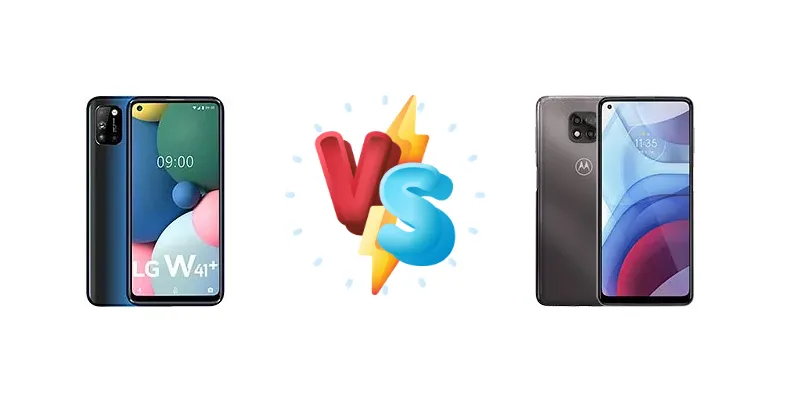
Both the LG W41+ and the Motorola Moto G Power (2021) target the budget-conscious smartphone user, but they take different approaches to achieving affordability. The LG relies on MediaTek’s Helio G35, while Motorola opts for Qualcomm’s Snapdragon 662. This comparison dissects the core differences between these two chipsets and their impact on real-world performance, battery life, and overall user experience.
🏆 Quick Verdict
For the average user prioritizing consistent performance and efficiency, the Motorola Moto G Power (2021) is the better choice. Its Snapdragon 662, built on an 11nm process, offers a noticeable advantage in multitasking and sustained performance compared to the LG W41+'s 12nm Helio G35, despite similar CPU core counts.
| Network |
|---|
| 2G bands | GSM 850 / 900 / 1800 / 1900 - SIM 1 & SIM 2 | GSM 850 / 900 / 1800 / 1900 |
| 3G bands | HSDPA 850 / 900 / 2100 | HSDPA 850 / 900 / 1700(AWS) / 1900 / 2100 |
| 4G bands | 1, 3, 5, 8, 40, 41 | 1, 2, 3, 4, 5, 7, 8, 12, 13, 14, 17, 25, 26, 29, 30, 38, 41, 66, 71 |
| Speed | HSPA, LTE | HSPA, LTE |
| Technology | GSM / HSPA / LTE | GSM / CDMA / HSPA / EVDO / LTE |
| | - | CDMA2000 1xEV-DO |
| Launch |
|---|
| Announced | 2021, February 22 | 2021, January 08 |
| Status | Available. Released 2021, March 03 | Available. Released 2021, January 14 |
| Body |
|---|
| Build | - | Glass front, plastic back, plastic frame |
| Dimensions | 166.5 x 77.3 x 9.3 mm (6.56 x 3.04 x 0.37 in) | 165.3 x 75.9 x 9.5 mm (6.51 x 2.99 x 0.37 in) |
| SIM | Dual SIM (Nano-SIM, dual stand-by) | Nano-SIM |
| Weight | 201 g (7.09 oz) | 206.5 g (7.30 oz) |
| | - | Water-repellent coating |
| Display |
|---|
| Resolution | 900 x 1600 pixels, 16:9 ratio (~280 ppi density) | 720 x 1600 pixels, 20:9 ratio (~266 ppi density) |
| Size | 6.55 inches, 118.3 cm2 (~91.9% screen-to-body ratio) | 6.6 inches, 105.2 cm2 (~83.8% screen-to-body ratio) |
| Type | IPS LCD, 400 nits (typ) | IPS LCD |
| Platform |
|---|
| CPU | Octa-core (4x2.3 GHz Cortex-A53 & 4x1.8 GHz Cortex-A53) | Octa-core (4x2.0 GHz Kryo 260 Gold & 4x1.8 GHz Kryo 260 Silver) |
| Chipset | Mediatek MT6765G Helio G35 (12 nm) | Qualcomm SM6115 Snapdragon 662 (11 nm) |
| GPU | PowerVR GE8320 | Adreno 610 |
| OS | Android 10 | Android 10 |
| Memory |
|---|
| Card slot | microSDXC (dedicated slot) | microSDXC (dedicated slot) |
| Internal | 128GB 4GB RAM | 32GB 3GB RAM, 64GB 4GB RAM |
| | eMMC 5.1 | eMMC 5.1 |
| Main Camera |
|---|
| Features | LED flash, panorama, HDR | LED flash, HDR, panorama |
| Quad | 48 MP, f/1.8, (wide), 1/2.0", 0.8µm, PDAF
8 MP, f/2.2, (ultrawide), 1/4.0", 1.12µm
5 MP, f/2.4, (macro)
2 MP, f/2.4, (depth) | - |
| Single | 8 MP, (wide), 1/4.0", 1.12µm | - |
| Triple | - | 48 MP, f/1.7, (wide), 1/2.0", 0.8µm, PDAF
2 MP (macro)
Auxiliary lens |
| Video | 1080p@30fps | 1080p@30/60fps, gyro-EIS |
| Selfie camera |
|---|
| Features | - | HDR |
| Single | 8 MP, (wide), 1/4.0", 1.12µm | 8 MP, f/2.0, 1.12µm |
| Video | 1080p@30fps | 1080p@30fps, gyro-EIS |
| Sound |
|---|
| 3.5mm jack | Yes | Yes |
| 35mm jack | - | Yes |
| Loudspeaker | Yes | Yes |
| Comms |
|---|
| Bluetooth | 5.0, A2DP, LE | 5.0, A2DP, LE |
| NFC | No | No |
| Positioning | GPS, GLONASS | GPS, GLONASS, GALILEO |
| Radio | FM radio | FM radio |
| USB | USB Type-C 2.0, OTG | USB Type-C 2.0 |
| WLAN | Wi-Fi 802.11 b/g/n, Wi-Fi Direct | Wi-Fi 802.11 a/b/g/n/ac, dual-band, Wi-Fi Direct |
| Features |
|---|
| Sensors | Fingerprint (rear-mounted), accelerometer, proximity | Fingerprint (side-mounted), accelerometer, gyro, proximity, compass, barometer |
| Battery |
|---|
| Charging | - | 15W wired |
| Type | Li-Po 5000 mAh, non-removable | Li-Po 5000 mAh |
| Misc |
|---|
| Colors | Magic Blue, Laser Blue | Flash Gray, Polar Silver |
| Models | LMK610IM, LM-K610IM | - |
| Price | About 170 EUR | About 60 EUR |
LG W41+
- Potentially lower price point
- MediaTek Helio G35 is adequate for basic tasks
- Likely large battery capacity
- Less efficient chipset (12nm)
- Potentially slower charging speeds
- Inferior CPU architecture compared to Snapdragon
Motorola Moto G Power (2021)
- More efficient Snapdragon 662 chipset (11nm)
- 15W fast charging support
- Better CPU architecture for smoother performance
- May be slightly more expensive
- Performance still limited by budget segment
- LCD display is not exceptional
Display Comparison
Neither device boasts a standout display. Both likely utilize LCD panels, common in this price bracket. The key difference lies under the hood. While specific display specs are unavailable for the LG W41+, the Motorola Moto G Power (2021) benefits from Qualcomm’s display optimization, potentially leading to slightly more accurate color reproduction. However, without knowing the LG’s peak brightness or color gamut coverage, it’s difficult to declare a clear winner. Bezels are expected to be substantial on both devices, reflecting their budget positioning.
Camera Comparison
Camera performance is likely to be similar on both devices, leaning towards adequate for casual snapshots. Both phones likely feature a primary camera as the main selling point, with supplementary lenses of limited utility. Without specific sensor size or aperture information, it’s difficult to make a definitive judgment. However, Qualcomm’s image signal processor (ISP) within the Snapdragon 662 generally offers superior image processing capabilities, potentially resulting in better dynamic range and noise reduction compared to the Helio G35’s ISP. The LG W41+’s camera system is likely to be more reliant on software processing to compensate for hardware limitations.
Performance
The core of the difference lies in the chipsets. The Motorola Moto G Power (2021) features the Qualcomm Snapdragon 662, fabricated on an 11nm process. This smaller node generally translates to better power efficiency and thermal performance compared to the LG W41+'s MediaTek Helio G35, which is built on a 12nm process. While both CPUs utilize an octa-core configuration with similar clock speeds on their efficiency cores (1.8 GHz Cortex-A53 vs. 1.8 GHz Kryo 260 Silver), the Snapdragon 662’s Kryo 260 Gold cores (2.0 GHz) offer a performance edge over the Helio G35’s Cortex-A53 cores (2.3 GHz). The Snapdragon’s architecture is more modern, leading to better instructions per clock (IPC) and overall responsiveness. This translates to snappier app launches and smoother multitasking on the Motorola.
Battery Life
The Motorola Moto G Power (2021) includes 15W wired charging, a feature absent from readily available information regarding the LG W41+. While both phones likely have large batteries (typical of the 'Power' branding), the Snapdragon 662’s superior power efficiency means the Motorola will likely achieve longer screen-on time with a similar battery capacity. The 15W charging on the Motorola allows for a reasonable 0-100% charge time, while the LG’s charging speed remains unknown, potentially being significantly slower.
Buying Guide
Buy the LG W41+ if you primarily need a phone for basic tasks like calls, messaging, and light social media use, and are looking for the absolute lowest price point. Buy the Motorola Moto G Power (2021) if you value smoother multitasking, slightly better gaming performance, and the benefit of Qualcomm’s optimized power efficiency, even if it means spending a bit more.
Frequently Asked Questions
❓ Will the Motorola Moto G Power (2021) struggle with demanding games like PUBG Mobile?
While the Snapdragon 662 isn't a gaming powerhouse, it can handle PUBG Mobile at medium settings with reasonable frame rates. Expect some occasional stuttering, especially in intense firefights. The LG W41+'s Helio G35 will likely offer a less consistent gaming experience, requiring even lower settings.
❓ Does the LG W41+ have any notable software features or customizations?
LG's software experience on the W41+ is likely to be relatively stock Android with some minor customizations. It won't offer the same level of software support or feature richness as Motorola's My UX, which provides a cleaner Android experience with useful additions.
❓ How does the Snapdragon 662 handle multitasking compared to the Helio G35?
The Snapdragon 662 excels at multitasking due to its more efficient architecture and better memory management. You'll experience fewer app reloads and smoother switching between applications compared to the LG W41+, which may struggle with numerous apps open simultaneously.