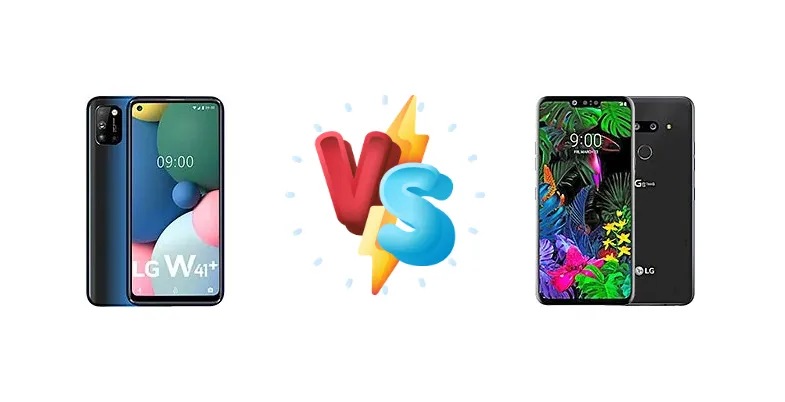
The LG G8 ThinQ, released as a 2019 flagship, represents a peak in LG's smartphone ambitions with its Snapdragon 855 processor and advanced features. The LG W41+, a more recent offering, targets the budget-conscious market with a Mediatek Helio G35 chipset. This comparison dissects the trade-offs between a premium, older device and a modern, affordable one.
🏆 Quick Verdict
For users prioritizing performance and a brighter display, the LG G8 ThinQ is the clear winner. Its Snapdragon 855 delivers a significantly smoother experience. However, the LG W41+ offers a compelling value proposition for those on a tight budget who don't require demanding applications.
| Network |
|---|
| 2G bands | GSM 850 / 900 / 1800 / 1900 - SIM 1 & SIM 2 | GSM 850 / 900 / 1800 / 1900 |
| 3G bands | HSDPA 850 / 900 / 2100 | HSDPA 850 / 900 / 1900 / 2100 |
| 4G bands | 1, 3, 5, 8, 40, 41 | 1, 2, 3, 4, 5, 7, 8, 12, 13, 14, 17, 20, 25, 26, 28, 29, 30, 38, 39, 40, 41, 46, 48, 66, 71 - USA |
| Speed | HSPA, LTE | HSPA 42.2/5.76 Mbps, LTE Cat19 1600/150 Mbps |
| Technology | GSM / HSPA / LTE | GSM / CDMA / HSPA / EVDO / LTE |
| | - | 2, 3, 4, 5, 7, 13, 20, 28, 46, 48, 66 - Verison |
| Launch |
|---|
| Announced | 2021, February 22 | 2019, February 24. Released 2019, April 11 |
| Status | Available. Released 2021, March 03 | Discontinued |
| Body |
|---|
| Build | - | Glass front (Gorilla Glass 5), glass back (Gorilla Glass 6), aluminum frame |
| Dimensions | 166.5 x 77.3 x 9.3 mm (6.56 x 3.04 x 0.37 in) | 151.9 x 71.8 x 8.4 mm (5.98 x 2.83 x 0.33 in) |
| SIM | Dual SIM (Nano-SIM, dual stand-by) | · Nano-SIM· Nano-SIM + Nano-SIM |
| Weight | 201 g (7.09 oz) | 167 g (5.89 oz) |
| | - | IP68 dust/water resistant (up to 1.5m for 30 min)
MIL-STD-810G compliant*
Method 516.6, Procedure IV "Transit Drop"
*does not guarantee ruggedness or use in extreme conditions |
| Display |
|---|
| Protection | - | Corning Gorilla Glass 5 |
| Resolution | 900 x 1600 pixels, 16:9 ratio (~280 ppi density) | 1440 x 3120 pixels, 19.5:9 ratio (~564 ppi density) |
| Size | 6.55 inches, 118.3 cm2 (~91.9% screen-to-body ratio) | 6.1 inches, 91.0 cm2 (~83.5% screen-to-body ratio) |
| Type | IPS LCD, 400 nits (typ) | P-OLED, HDR10 |
| | - | Always-on display |
| Platform |
|---|
| CPU | Octa-core (4x2.3 GHz Cortex-A53 & 4x1.8 GHz Cortex-A53) | Octa-core (1x2.84 GHz Kryo 485 & 3x2.42 GHz Kryo 485 & 4x1.78 GHz Kryo 485) |
| Chipset | Mediatek MT6765G Helio G35 (12 nm) | Qualcomm SM8150 Snapdragon 855 (7 nm) |
| GPU | PowerVR GE8320 | Adreno 640 |
| OS | Android 10 | Android 9.0 (Pie), upgradable to Android 11 |
| Memory |
|---|
| Card slot | microSDXC (dedicated slot) | microSDXC (dedicated slot) - single-SIM modelmicroSDXC (uses shared SIM slot) - dual-SIM model |
| Internal | 128GB 4GB RAM | 128GB 6GB RAM |
| | eMMC 5.1 | UFS 2.1 |
| Main Camera |
|---|
| Dual or Triple | - | 12 MP, f/1.5, 27mm (standard), 1/2.55", 1.4µm, dual pixel PDAF, OIS
16 MP, f/1.9, 16mm (ultrawide), 1/3.1", 1.0µm, no AF
or
12 MP, f/1.5, 27mm (standard), 1/2.55", 1.4µm, dual pixel PDAF, OIS
16 MP, f/1.9, 16mm (ultrawide), 1/3.1", 1.0µm, no AF
12 MP, 52mm (telephoto), f/2.4, 1.0µm, 2x optical zoom, dual pixel PDAF, OIS |
| Features | LED flash, panorama, HDR | LED flash, HDR, panorama |
| Quad | 48 MP, f/1.8, (wide), 1/2.0", 0.8µm, PDAF
8 MP, f/2.2, (ultrawide), 1/4.0", 1.12µm
5 MP, f/2.4, (macro)
2 MP, f/2.4, (depth) | - |
| Single | 8 MP, (wide), 1/4.0", 1.12µm | - |
| Video | 1080p@30fps | 4K@30/60fps, 1080p@30/60fps, 720p@240fps, HDR10, 24-bit/192kHz stereo sound rec. |
| Selfie camera |
|---|
| Features | - | HDR |
| Single | 8 MP, (wide), 1/4.0", 1.12µm | 8 MP, f/1.7, 26mm (wide), 1/3.6", 1.22µm, AF
TOF 3D, f/1.4, (depth/biometrics sensor) |
| Video | 1080p@30fps | 1080p@60fps |
| Sound |
|---|
| 3.5mm jack | Yes | Yes |
| 35mm jack | - | Yes |
| Loudspeaker | Yes | Yes |
| | - | 32-bit/192kHz audio |
| Comms |
|---|
| Bluetooth | 5.0, A2DP, LE | 5.0, A2DP, LE, aptX HD |
| NFC | No | Yes |
| Positioning | GPS, GLONASS | GPS, GLONASS, GALILEO, BDS |
| Radio | FM radio | FM radio (market/region dependent) |
| USB | USB Type-C 2.0, OTG | USB Type-C 3.1, OTG |
| WLAN | Wi-Fi 802.11 b/g/n, Wi-Fi Direct | Wi-Fi 802.11 a/b/g/n/ac, dual-band, Wi-Fi Direct, DLNA |
| Features |
|---|
| Sensors | Fingerprint (rear-mounted), accelerometer, proximity | Face ID, Hand ID, fingerprint (rear-mounted), accelerometer, gyro, proximity, compass, barometer |
| Battery |
|---|
| Charging | - | 21W wired, PD, QC3
9W wireless |
| Type | Li-Po 5000 mAh, non-removable | Li-Po 3500 mAh, non-removable |
| Misc |
|---|
| Colors | Magic Blue, Laser Blue | Platinum Gray, New Aurora Black, New Moroccan Blue, Carmine Red |
| Models | LMK610IM, LM-K610IM | LMG820QM7, LM-G820UMB, LMG820UM0, LMG820UM1, LMG820UM2, LM-G820N, LM-G820, LM-G820QM |
| Price | About 170 EUR | About 350 EUR |
| Tests |
|---|
| Audio quality | - |
Noise -94.1dB / Crosstalk -87.6dB |
| Battery life | - |
Endurance rating 79h
|
| Camera | - |
Photo / Video |
| Display | - |
Contrast ratio: infinite |
| Loudspeaker | - |
Voice 68dB / Noise 74dB / Ring 92dB
|
| Performance | - |
AnTuTu: 331537 (v7), 362730 (v8)
GeekBench: 10735 (v4.4), 2700 (v5.1)
GFXBench: 20fps (ES 3.1 onscreen) |
LG W41+
- Significantly faster processor (Snapdragon 855)
- Brighter and higher-quality display (655 nits)
- Faster charging (21W wired, 9W wireless)
- Older device, potentially limited software updates
- Higher price point
LG G8 ThinQ
- More affordable price
- Modern design (assumed)
- Decent battery life (79h endurance)
- Significantly slower processor (Helio G35)
- Likely lower display quality
- Slower charging (specifications unknown)
Display Comparison
The LG G8 ThinQ boasts a display capable of reaching 655 nits of peak brightness, ensuring excellent visibility even in direct sunlight. While the W41+'s display specifications are not provided, it's reasonable to assume a lower peak brightness given its budget positioning. The G8's 'infinite' contrast ratio suggests a high-quality panel, likely OLED, offering deep blacks and vibrant colors. The absence of display details for the W41+ suggests a focus on cost reduction, potentially resulting in a less visually impressive experience.
Camera Comparison
Both devices offer photo and video capabilities, but details are limited. The LG G8 ThinQ, as a flagship, likely features a more sophisticated camera system with larger sensors and advanced image processing algorithms. The W41+'s camera specifications are unknown, but budget phones often compromise on sensor quality and features. Without specific sensor details, it's difficult to make a direct comparison, but the G8's flagship status suggests a superior imaging experience.
Performance
The core difference lies in the chipsets. The LG G8 ThinQ's Qualcomm Snapdragon 855 (7nm) is a flagship-level processor featuring an octa-core configuration with a prime Kryo 485 core clocked at 2.84 GHz. This architecture provides substantial processing power for demanding tasks. Conversely, the LG W41+ utilizes the Mediatek Helio G35 (12nm), an entry-level chipset with an octa-core CPU clocked up to 2.3 GHz. The 7nm process node of the Snapdragon 855 offers superior power efficiency and thermal performance compared to the 12nm Helio G35, meaning the G8 ThinQ will experience less throttling during sustained workloads. This translates to smoother gaming and faster app loading times on the G8.
Battery Life
Both the LG G8 ThinQ and W41+ achieve an endurance rating of 79 hours, indicating similar overall battery life despite the differing chipsets. However, the G8 ThinQ offers significantly faster charging with 21W wired charging (PD, QC3) and 9W wireless charging, allowing for quicker top-ups. The W41+'s charging specifications are not provided, but it's likely to be slower, potentially requiring longer charging times to reach a full charge.
Buying Guide
Buy the LG W41+ if you need a functional smartphone for everyday tasks like calling, texting, social media, and light web browsing, and prioritize affordability. Buy the LG G8 ThinQ if you prefer a faster, more responsive experience for gaming, video editing, or multitasking, and value a brighter, higher-quality display and faster charging capabilities.
Frequently Asked Questions
❓ Will the Helio G35 in the LG W41+ be able to handle popular games like PUBG Mobile?
The Helio G35 is an entry-level chipset. While it can run PUBG Mobile, expect to play at lower graphics settings and potentially experience frame drops during intense moments. It's not designed for demanding gaming experiences.
❓ How long will the LG G8 ThinQ receive software updates?
As a 2019 device, the LG G8 ThinQ is nearing the end of its software update lifecycle. While it may still receive security patches, major Android version updates are unlikely. This is a key consideration for users who prioritize long-term software support.
❓ Does the LG G8 ThinQ support fast wireless charging?
Yes, the LG G8 ThinQ supports 9W wireless charging, allowing for convenient charging without cables. This is a feature absent in the LG W41+ based on available information.
❓ Is the LG W41+ a good option for someone upgrading from a very old smartphone?
Yes, the LG W41+ is a solid choice for users upgrading from older devices. It offers a modern smartphone experience with essential features at an affordable price, making it a good entry point into the world of smartphones.