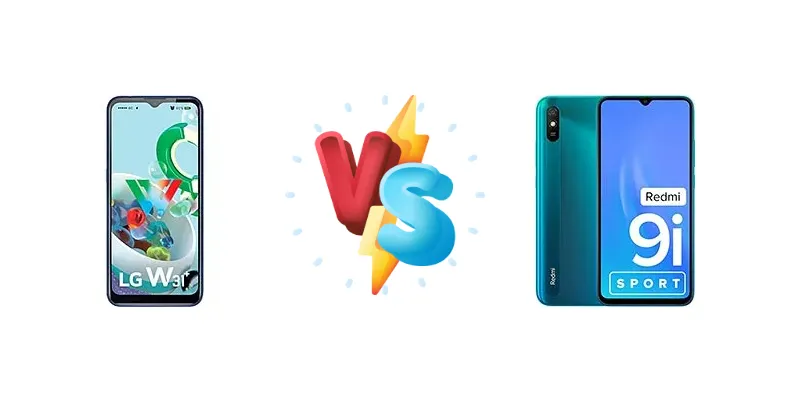
The LG W31+ and Xiaomi Redmi 9i Sport represent the fiercely competitive entry-level smartphone market. Both devices aim to deliver essential functionality at an accessible price point, but they differ in their core processing power. This comparison dissects the nuances between the Mediatek Helio P22 in the LG W31+ and the Helio G25 in the Redmi 9i Sport, revealing which phone offers the better user experience.
🏆 Quick Verdict
For the average user prioritizing slightly smoother multitasking and potential for light gaming, the Xiaomi Redmi 9i Sport emerges as the better choice. Its Helio G25 chipset, with its combination of Cortex-A53 cores clocked at 2.0GHz and 1.5GHz, provides a performance edge over the LG W31+'s uniformly clocked Helio P22.
| Network |
|---|
| 2G bands | GSM 850 / 900 / 1800 / 1900 | GSM 850 / 900 / 1800 / 1900 |
| 3G bands | HSDPA 850 / 900 / 2100 | HSDPA 850 / 900 / 2100 |
| 4G bands | 1, 3, 5, 8, 40, 41 | 1, 3, 5, 8, 40, 41 |
| Speed | HSPA, LTE | HSPA, LTE |
| Technology | GSM / HSPA / LTE | GSM / HSPA / LTE |
| Launch |
|---|
| Announced | 2020, November 06. Released 2020, December 23 | 2021, September 28 |
| Status | Discontinued | Available. Released 2021, September 28 |
| Body |
|---|
| Dimensions | 166.2 x 76.3 x 8.4 mm (6.54 x 3.00 x 0.33 in) | 164.9 x 77.1 x 9 mm (6.49 x 3.04 x 0.35 in) |
| SIM | Nano-SIM + Nano-SIM | Nano-SIM + Nano-SIM |
| Weight | 173.6 g (6.14 oz) | 194 g (6.84 oz) |
| | - | Water-repellent coating |
| Display |
|---|
| Resolution | 720 x 1600 pixels, 20:9 ratio (~269 ppi density) | 720 x 1600 pixels, 20:9 ratio (~269 ppi density) |
| Size | 6.52 inches, 102.6 cm2 (~80.9% screen-to-body ratio) | 6.53 inches, 102.9 cm2 (~81.0% screen-to-body ratio) |
| Type | IPS LCD | IPS LCD, 400 nits (typ) |
| Platform |
|---|
| CPU | Octa-core 2.0 GHz Cortex-A53 | Octa-core (4x2.0 GHz Cortex-A53 & 4x1.5 GHz Cortex-A53) |
| Chipset | Mediatek MT6762 Helio P22 (12 nm) | Mediatek MT6762G Helio G25 (12 nm) |
| GPU | PowerVR GE8320 | PowerVR GE8320 |
| OS | Android 10 | Android 10, MIUI 12 |
| Memory |
|---|
| Card slot | microSDXC (dedicated slot) | microSDXC (dedicated slot) |
| Internal | 128GB 4GB RAM | 64GB 4GB RAM, 128GB 4GB RAM |
| | eMMC 5.1 | eMMC 5.1 |
| Main Camera |
|---|
| Features | LED flash, panorama, HDR | LED flash, HDR |
| Single | - | 13 MP, f/2.2, 28mm (wide), 1.0µm, PDAF |
| Triple | 13 MP, (wide), 1/3.0", 1.12µm, PDAF
5 MP, (ultrawide)
Auxiliary lens | - |
| Video | 1080p@30fps | 1080p@30fps |
| Selfie camera |
|---|
| Features | - | HDR |
| Single | 8 MP, (wide) | 5 MP, f/2.2, (wide), 1.12µm |
| Video | 1080p@30fps | 1080p@30fps |
| Sound |
|---|
| 3.5mm jack | Yes | Yes |
| 35mm jack | Yes | Yes |
| Loudspeaker | Yes | Yes |
| Comms |
|---|
| Bluetooth | 4.2, A2DP, LE | 5.0, A2DP, LE |
| NFC | No | No |
| Positioning | GPS, GLONASS | GPS, GLONASS, BDS |
| Radio | FM radio | FM radio |
| USB | microUSB 2.0, OTG | microUSB 2.0, OTG |
| WLAN | Wi-Fi 802.11 b/g/n, Wi-Fi Direct | Wi-Fi 802.11 а/b/g/n, Wi-Fi Direct |
| Features |
|---|
| Sensors | Fingerprint (rear-mounted), accelerometer, proximity | Accelerometer, proximity, compass |
| Battery |
|---|
| Charging | - | 10W wired |
| Type | Li-Po 4000 mAh | Li-Po 5000 mAh |
| Misc |
|---|
| Colors | Midnight Blue | Carbon Black, Coral Green, Metallic Blue |
| Models | LMK315IM, LM-K315, LM-K315IM | - |
| Price | About 140 EUR | About 100 EUR |
LG W31+
- Stable and reliable performance for basic tasks.
- Potentially lower price point (depending on market).
- Simple and user-friendly interface (typical of LG).
- Less powerful chipset compared to the Redmi 9i Sport.
- May struggle with multitasking or demanding apps.
- Likely lacks optimized gaming performance.
Xiaomi Redmi 9i Sport
- More powerful Helio G25 chipset for smoother performance.
- Optimized core configuration for better efficiency.
- 10W charging for quicker top-ups.
- May experience slight thermal throttling under sustained load.
- Software experience may be less refined than LG's.
- Build quality may be slightly less premium.
Display Comparison
Neither device boasts a standout display. Both likely utilize LCD panels, typical for this price bracket. Detailed specifications regarding brightness, color gamut coverage, or resolution are unavailable, but we can assume both offer adequate, though not exceptional, viewing experiences. Bezels are likely substantial on both, maximizing screen real estate within a budget-friendly form factor. Color accuracy will likely be standard for the segment.
Camera Comparison
Camera performance is likely similar on both devices, relying heavily on software processing. Without detailed sensor information, it's difficult to make definitive claims. Both will likely feature a primary camera and potentially multiple secondary sensors (depth, macro) of limited utility. Image quality will be acceptable in good lighting conditions, but will suffer in low light due to the limitations of the sensors and processors. The Redmi 9i Sport's slightly more powerful chipset *may* translate to marginally faster image processing, but the difference will likely be minimal.
Performance
The core difference lies in the chipsets. The LG W31+ features the Mediatek Helio P22 (MT6762), an octa-core processor with eight Cortex-A53 cores clocked at 2.0 GHz. The Redmi 9i Sport, however, utilizes the Helio G25 (MT6762G). While also an octa-core processor, the G25 employs a big.LITTLE architecture: four cores at 2.0 GHz and four cores at 1.5 GHz. This configuration allows the G25 to dynamically allocate tasks, using the faster cores for demanding operations and the slower cores for background processes, resulting in improved efficiency and responsiveness. The G25 also includes a slightly more capable GPU, offering a marginal improvement in graphics performance. Both phones likely feature similar RAM configurations, but the G25's chipset architecture provides a clear advantage in overall performance.
Battery Life
Battery capacity is not specified for the LG W31+, but typical for this segment is around 4000-5000mAh. The Redmi 9i Sport supports 10W wired charging, a standard offering in this price range. While neither device offers fast charging, the 10W charging on the Redmi 9i Sport provides a quicker top-up compared to potentially slower charging on the LG W31+ if it lacks dedicated charging specifications. Real-world battery life will depend heavily on usage patterns, but both phones should comfortably last a full day with moderate use.
Buying Guide
Buy the LG W31+ if you prioritize a consistently stable, if less powerful, experience for basic tasks like calling, texting, and social media. It's a solid option for users who don't intend to push their phone's processing limits. Buy the Xiaomi Redmi 9i Sport if you prefer a device capable of handling slightly more demanding applications and occasional gaming sessions, benefiting from the G25's optimized core configuration and 10W charging for quicker top-ups.
Frequently Asked Questions
❓ Will the Redmi 9i Sport handle games like PUBG Mobile?
The Redmi 9i Sport's Helio G25 chipset can run PUBG Mobile, but likely at lower graphics settings and frame rates to maintain a playable experience. Expect to adjust settings to prioritize smoothness over visual fidelity. The Helio P22 in the LG W31+ will struggle more significantly with this title.
❓ Is the difference in performance between the Helio P22 and G25 noticeable in everyday use?
For basic tasks like browsing, social media, and calling, the difference may be subtle. However, when multitasking, opening apps, or performing more demanding operations, the Redmi 9i Sport's Helio G25 will feel noticeably snappier and more responsive due to its big.LITTLE core configuration.
❓ Does the Redmi 9i Sport's 10W charging significantly reduce charging time?
While 10W isn't 'fast charging' in the modern sense, it's a step up from potentially slower charging on the LG W31+. Expect a full charge to take around 3-4 hours, which is reasonable for a budget smartphone. It will provide a quicker boost when you need it compared to a device without specified charging wattage.