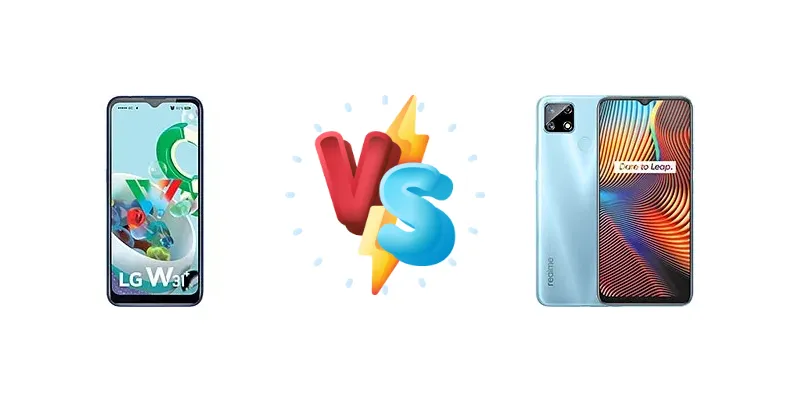
The Realme 7i and LG W31+ represent two distinct approaches to the budget smartphone market. The Realme 7i aims for a more feature-rich experience, particularly for gaming, while the LG W31+ focuses on a streamlined, user-friendly interface. This comparison dissects their core components to determine which device offers the best value for your money.
🏆 Quick Verdict
For most users, the Realme 7i emerges as the stronger contender. Its Helio G85 chipset provides a noticeable performance advantage over the LG W31+'s Helio P22, making it better suited for gaming and demanding applications. The inclusion of 18W fast charging is another significant benefit, offsetting the slightly smaller difference in battery capacity.
| Network |
|---|
| 2G bands | GSM 850 / 900 / 1800 / 1900 | GSM 850 / 900 / 1800 / 1900 |
| 3G bands | HSDPA 850 / 900 / 2100 | HSDPA 850 / 900 / 1700(AWS) / 1900 / 2100 |
| 4G bands | 1, 3, 5, 8, 40, 41 | 1, 2, 3, 4, 5, 7, 8, 20, 28, 38, 40, 41 |
| Speed | HSPA, LTE | HSPA, LTE |
| Technology | GSM / HSPA / LTE | GSM / HSPA / LTE |
| Launch |
|---|
| Announced | 2020, November 06. Released 2020, December 23 | 2020, December 22. Released 2020, December 23 |
| Status | Discontinued | Discontinued |
| Body |
|---|
| Dimensions | 166.2 x 76.3 x 8.4 mm (6.54 x 3.00 x 0.33 in) | 164.5 x 75.9 x 9.8 mm (6.48 x 2.99 x 0.39 in) |
| SIM | Nano-SIM + Nano-SIM | Nano-SIM + Nano-SIM |
| Weight | 173.6 g (6.14 oz) | 208 g (7.34 oz) |
| Display |
|---|
| Resolution | 720 x 1600 pixels, 20:9 ratio (~269 ppi density) | 720 x 1600 pixels, 20:9 ratio (~270 ppi density) |
| Size | 6.52 inches, 102.6 cm2 (~80.9% screen-to-body ratio) | 6.5 inches, 102.0 cm2 (~81.7% screen-to-body ratio) |
| Type | IPS LCD | IPS LCD, 450 nits (typ), 560 nits (peak) |
| Platform |
|---|
| CPU | Octa-core 2.0 GHz Cortex-A53 | Octa-core (2x2.0 GHz Cortex-A75 & 6x1.8 GHz Cortex-A55) |
| Chipset | Mediatek MT6762 Helio P22 (12 nm) | Mediatek MT6769Z Helio G85 (12 nm) |
| GPU | PowerVR GE8320 | Mali-G52 MC2 |
| OS | Android 10 | Android 10, Realme UI |
| Memory |
|---|
| Card slot | microSDXC (dedicated slot) | microSDXC (dedicated slot) |
| Internal | 128GB 4GB RAM | 64GB 4GB RAM |
| | eMMC 5.1 | eMMC 5.1 |
| Main Camera |
|---|
| Features | LED flash, panorama, HDR | LED flash, HDR, panorama |
| Triple | 13 MP, (wide), 1/3.0", 1.12µm, PDAF
5 MP, (ultrawide)
Auxiliary lens | 48 MP, f/1.8, 26mm (wide), 1/2.0", 0.8µm, PDAF
8 MP, f/2.3, 16mm, 119˚ (ultrawide), 1/4.0", 1.12µm
2 MP (macro) |
| Video | 1080p@30fps | 1080p@30/60fps |
| Selfie camera |
|---|
| Features | - | HDR, panorama |
| Single | 8 MP, (wide) | 8 MP, f/2.0, 26mm (wide), 1/4.0", 1.12µm |
| Video | 1080p@30fps | 1080p@30fps |
| Sound |
|---|
| 3.5mm jack | Yes | Yes |
| 35mm jack | Yes | Yes |
| Loudspeaker | Yes | Yes |
| Comms |
|---|
| Bluetooth | 4.2, A2DP, LE | 5.0, A2DP, LE, aptX HD |
| NFC | No | No |
| Positioning | GPS, GLONASS | GPS, GLONASS, BDS |
| Radio | FM radio | FM radio |
| USB | microUSB 2.0, OTG | USB Type-C 2.0, OTG |
| WLAN | Wi-Fi 802.11 b/g/n, Wi-Fi Direct | Wi-Fi 802.11 a/b/g/n/ac, dual-band, Wi-Fi Direct |
| Features |
|---|
| Sensors | Fingerprint (rear-mounted), accelerometer, proximity | Fingerprint (rear-mounted), accelerometer, proximity, compass |
| Battery |
|---|
| Charging | - | 18W wired
5W reverse wired |
| Type | Li-Po 4000 mAh | 6000 mAh |
| Misc |
|---|
| Colors | Midnight Blue | Glory Silver, Victory Blue |
| Models | LMK315IM, LM-K315, LM-K315IM | - |
| Price | About 140 EUR | About 190 EUR |
LG W31+
- Simpler, more streamlined user experience
- Potentially lower price point
- Reliable for basic smartphone tasks
- Significantly weaker performance compared to Realme 7i
- Slower charging speeds
- Likely limited gaming capabilities
Realme 7i (Global)
- Superior performance with Helio G85 chipset
- Faster 18W charging
- 5W reverse wired charging for accessories
- May have a more complex user interface
- Potentially slightly higher price
- May not have the longest battery life
Display Comparison
Neither device boasts a particularly standout display. Both utilize 12nm chipsets, suggesting similar power constraints impacting display capabilities. While specific display specs (resolution, panel type) are missing for the LG W31+, the Realme 7i's focus is clearly on performance, not display fidelity. Expect both to offer adequate viewing experiences for everyday use, but neither will impress users accustomed to high-end OLED panels.
Camera Comparison
Without detailed camera specifications beyond the presence of sensors, a direct comparison is difficult. However, the Realme 7i’s positioning suggests a greater emphasis on camera capabilities. The Helio G85 often pairs with image signal processors (ISPs) capable of more advanced image processing. While both phones likely feature a standard array of camera modes, the Realme 7i is more likely to deliver better image quality, especially in challenging lighting conditions. The LG W31+ will likely offer acceptable results for casual photography, but won't compete with more camera-focused devices.
Performance
The core difference lies in the chipsets. The Realme 7i’s MediaTek Helio G85 is a substantial upgrade over the LG W31+'s Helio P22. The G85 features a combination of 2x 2.0 GHz Cortex-A75 and 6x 1.8 GHz Cortex-A55 cores, compared to the P22’s all-Cortex-A53 setup. This architectural difference translates to significantly better multi-core performance and responsiveness in the Realme 7i, particularly noticeable in gaming and app loading times. The G85’s GPU is also more capable, providing a smoother gaming experience. The LG W31+ will handle basic tasks adequately, but will struggle with more demanding applications.
Battery Life
Battery capacity isn't specified for the LG W31+, but the Realme 7i's 18W wired charging and 5W reverse wired charging provide a clear advantage. While the Realme 7i's battery size is not specified, the faster charging speed significantly reduces downtime. The LG W31+ will likely rely on slower charging, meaning longer periods tethered to a power outlet. The 5W reverse charging on the Realme 7i is a useful feature for topping up accessories like wireless earbuds.
Buying Guide
Buy the LG W31+ if you prioritize a simple, uncluttered Android experience and don't require significant processing power for gaming or intensive tasks. It's a good choice for first-time smartphone users or those seeking a reliable device for basic communication and media consumption. Buy the Realme 7i (Global) if you want a phone capable of handling mobile games, multitasking, and benefit from faster charging speeds. It's ideal for users who want more performance for their money.
Frequently Asked Questions
❓ Will the Realme 7i be able to run demanding games like PUBG Mobile smoothly?
Yes, the MediaTek Helio G85 in the Realme 7i is specifically designed for gaming. It can handle PUBG Mobile at medium to high settings with a playable frame rate. While it won't deliver the same experience as a flagship phone, it's a significant step up from the LG W31+'s Helio P22.
❓ Is the lack of detailed camera specs on the LG W31+ a major concern?
Yes, it suggests that the camera isn't a primary focus of the device. While it will likely take acceptable photos in good lighting conditions, it won't offer the same level of detail, dynamic range, or low-light performance as the Realme 7i, which benefits from a more powerful chipset and ISP.
❓ How long will it take to fully charge the Realme 7i from 0%?
With 18W fast charging, the Realme 7i should fully charge in approximately 2-2.5 hours, depending on usage during charging. This is considerably faster than the LG W31+, which will likely take 3+ hours with its slower charging capabilities.
❓ Is the LG W31+ a good option for someone upgrading from a very old smartphone?
Yes, the LG W31+ provides a modern smartphone experience at a budget price. Its simplified interface makes it easy to learn, and it handles basic tasks like calls, messaging, and web browsing effectively. However, if you anticipate needing more performance, the Realme 7i is a better long-term investment.