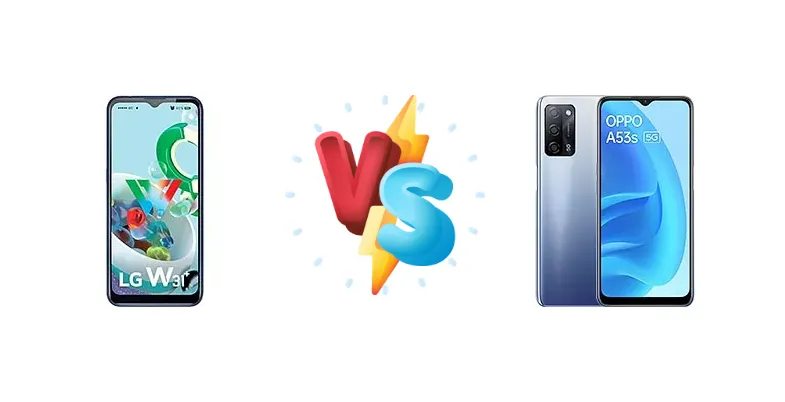
The LG W31+ and Oppo A53s 5G represent two approaches to the budget 5G smartphone market. The LG, utilizing an older Mediatek Helio P22 chipset, aims for affordability, while the Oppo leverages the more modern Dimensity 700 to deliver a noticeable performance boost. This comparison dissects the key differences to help you determine which device best suits your needs.
🏆 Quick Verdict
For the average user prioritizing responsiveness and future-proofing, the Oppo A53s 5G is the clear winner. Its Dimensity 700 chipset offers a substantial performance advantage over the LG W31+'s Helio P22. However, if your needs are extremely basic and budget is the absolute primary concern, the LG W31+ remains a viable option.
| Network |
|---|
| 2G bands | GSM 850 / 900 / 1800 / 1900 | GSM 850 / 900 / 1800 / 1900 |
| 3G bands | HSDPA 850 / 900 / 2100 | HSDPA 800 / 850 / 900 / 2100 |
| 4G bands | 1, 3, 5, 8, 40, 41 | 1, 3, 5, 8, 34, 38, 39, 40, 41 |
| 5G bands | - | 1, 28, 41, 77, 78 SA/NSA |
| Speed | HSPA, LTE | HSPA, LTE, 5G |
| Technology | GSM / HSPA / LTE | GSM / HSPA / LTE / 5G |
| Launch |
|---|
| Announced | 2020, November 06. Released 2020, December 23 | 2021, April 27 |
| Status | Discontinued | Available. Released 2021, May 07 |
| Body |
|---|
| Dimensions | 166.2 x 76.3 x 8.4 mm (6.54 x 3.00 x 0.33 in) | 164 x 75.7 x 8.4 mm (6.46 x 2.98 x 0.33 in) |
| SIM | Nano-SIM + Nano-SIM | Nano-SIM + Nano-SIM |
| Weight | 173.6 g (6.14 oz) | 189.6 g (6.70 oz) |
| Display |
|---|
| Resolution | 720 x 1600 pixels, 20:9 ratio (~269 ppi density) | 720 x 1600 pixels, 20:9 ratio (~269 ppi density) |
| Size | 6.52 inches, 102.6 cm2 (~80.9% screen-to-body ratio) | 6.52 inches, 102.6 cm2 (~82.7% screen-to-body ratio) |
| Type | IPS LCD | IPS LCD, 480 nits (typ) |
| Platform |
|---|
| CPU | Octa-core 2.0 GHz Cortex-A53 | Octa-core (2x2.2 GHz Cortex-A76 & 6x2.0 GHz Cortex-A55) |
| Chipset | Mediatek MT6762 Helio P22 (12 nm) | Mediatek Dimensity 700 (7 nm) |
| GPU | PowerVR GE8320 | Mali-G57 MC2 |
| OS | Android 10 | Android 11, ColorOS 11.1 |
| Memory |
|---|
| Card slot | microSDXC (dedicated slot) | microSDXC (dedicated slot) |
| Internal | 128GB 4GB RAM | 128GB 6GB RAM, 128GB 8GB RAM |
| | eMMC 5.1 | UFS 2.2 |
| Main Camera |
|---|
| Features | LED flash, panorama, HDR | LED flash, HDR, panorama |
| Single | - | 8 MP, f/2.0, 26mm (wide) |
| Triple | 13 MP, (wide), 1/3.0", 1.12µm, PDAF
5 MP, (ultrawide)
Auxiliary lens | 13 MP, f/2.2, 25mm (wide), 1/3.06", 1.12µm, PDAF
2 MP (macro)
Auxiliary lens |
| Video | 1080p@30fps | 1080p@30fps |
| Selfie camera |
|---|
| Features | - | HDR |
| Single | 8 MP, (wide) | 8 MP, f/2.0, 26mm (wide) |
| Video | 1080p@30fps | 1080p@30fps |
| Sound |
|---|
| 3.5mm jack | Yes | Yes |
| 35mm jack | Yes | Yes |
| Loudspeaker | Yes | Yes |
| Comms |
|---|
| Bluetooth | 4.2, A2DP, LE | 5.0, A2DP, LE, aptX HD |
| NFC | No | No |
| Positioning | GPS, GLONASS | GPS, GLONASS, GALILEO, BDS, QZSS |
| Radio | FM radio | No |
| USB | microUSB 2.0, OTG | USB Type-C 2.0, OTG |
| WLAN | Wi-Fi 802.11 b/g/n, Wi-Fi Direct | Wi-Fi 802.11 a/b/g/n/ac, dual-band, Wi-Fi Direct |
| Features |
|---|
| Sensors | Fingerprint (rear-mounted), accelerometer, proximity | Fingerprint (side-mounted), accelerometer, gyro, proximity, compass |
| Battery |
|---|
| Charging | - | 10W wired |
| Type | Li-Po 4000 mAh | Li-Po 5000 mAh |
| Misc |
|---|
| Colors | Midnight Blue | Crystal Blue, Ink Black |
| Models | LMK315IM, LM-K315, LM-K315IM | CPH2321 |
| Price | About 140 EUR | About 170 EUR |
LG W31+
- Potentially lower price point
- May have larger battery capacity (unconfirmed)
- Simple and straightforward user experience
- Significantly slower performance
- No 5G connectivity
- Outdated chipset
Oppo A53s 5G
- Faster and more responsive performance
- 5G connectivity for faster data speeds
- More power-efficient chipset
- Slow 10W charging
- Potentially higher price
- May have smaller battery capacity
Display Comparison
Neither device boasts a particularly impressive display. Specifics regarding panel type (IPS vs. LCD) and resolution are missing for the LG W31+, but given its market segment, it's likely a standard 720p+ panel. The Oppo A53s 5G also likely features a 720p+ display. The key difference lies in processing power impacting UI smoothness, not display quality. Both will likely suffer from limited viewing angles and color accuracy compared to higher-end devices.
Camera Comparison
Detailed camera specifications beyond the presence of cameras are unavailable for the LG W31+. The Oppo A53s 5G’s camera setup is also not fully detailed, but the focus should be on the main sensor. Without knowing sensor sizes or apertures, it’s difficult to make a definitive judgment. However, the Dimensity 700’s integrated image signal processor (ISP) is more advanced than the Helio P22’s, potentially leading to better image processing and low-light performance on the Oppo. Expect both phones to struggle in challenging lighting conditions.
Performance
The performance gap between these two devices is significant. The Oppo A53s 5G’s Mediatek Dimensity 700, fabricated on a 7nm process, represents a substantial leap over the LG W31+'s 12nm Mediatek Helio P22. The Dimensity 700’s CPU configuration – with 2x 2.2 GHz Cortex-A76 cores and 6x 2.0 GHz Cortex-A55 cores – provides significantly more processing power than the Helio P22’s octa-core 2.0 GHz Cortex-A53 setup. The A76 cores are architecturally superior, offering better single-core performance crucial for app launch times and general responsiveness. This translates to a noticeably smoother user experience on the Oppo, especially when multitasking or running demanding applications. The Oppo also benefits from 5G connectivity, a feature absent in the LG.
Battery Life
Battery capacity details are missing for the LG W31+. The Oppo A53s 5G features 10W wired charging, which is slow by modern standards. While the LG may have a larger battery, the Helio P22’s inefficiency will likely negate any capacity advantage. The Dimensity 700’s 7nm process is far more power-efficient, meaning the Oppo A53s 5G will likely offer comparable or even better battery life despite potentially having a smaller battery capacity. The slow charging speed on the Oppo will require longer periods plugged into a power source.
Buying Guide
Buy the LG W31+ if you need a smartphone for extremely light tasks like basic calling, texting, and occasional social media browsing, and your budget is severely constrained. Buy the Oppo A53s 5G if you prefer a smoother, more responsive experience for everyday use, including moderate multitasking, streaming, and occasional gaming, and want the benefits of 5G connectivity.
Frequently Asked Questions
❓ Will the Oppo A53s 5G handle popular games like PUBG Mobile smoothly?
The Dimensity 700 in the Oppo A53s 5G is capable of running PUBG Mobile, but expect to play at medium settings for a consistently smooth experience. The Helio P22 in the LG W31+ will struggle significantly with PUBG, likely requiring the lowest settings and still experiencing frame drops.
❓ How much faster is 5G on the Oppo A53s 5G compared to 4G?
5G speeds on the Oppo A53s 5G can be significantly faster than 4G, potentially offering download speeds several times higher, depending on network availability and coverage. However, real-world 5G performance varies greatly based on location and carrier.
❓ Is the 10W charging on the Oppo A53s 5G a major drawback?
Yes, 10W charging is quite slow compared to modern standards. Expect a full charge to take over 2 hours. This is a significant inconvenience if you frequently need to top up your battery quickly.
❓ Can I expect noticeable lag when multitasking on the LG W31+?
Yes, the Helio P22's limited processing power will result in noticeable lag when switching between apps or running multiple applications simultaneously on the LG W31+. The Oppo A53s 5G will handle multitasking much more smoothly.