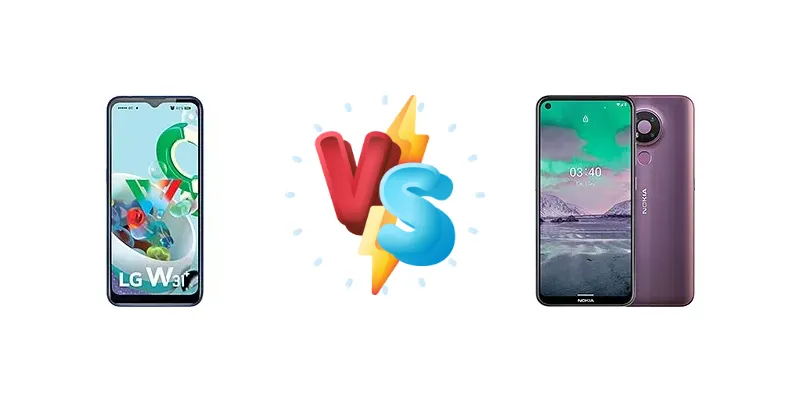
The LG W31+ and Nokia 3.4 represent two approaches to the ultra-budget smartphone market. The W31+ aims for a balance of features, while the Nokia 3.4 leverages Qualcomm's Snapdragon series for a potentially smoother experience. This comparison dives deep into their specifications to determine which device delivers the best value for users seeking an affordable Android experience.
🏆 Quick Verdict
For most users, the Nokia 3.4 is the better choice. Its Snapdragon 460 chipset, built on an 11nm process, offers a noticeable performance advantage over the LG W31+'s 12nm Helio P22, translating to snappier app loading and multitasking. While the W31+ may offer slightly more storage in some configurations, the Nokia 3.4’s superior processing power is more impactful for daily use.
| Network |
|---|
| 2G bands | GSM 850 / 900 / 1800 / 1900 | GSM 850 / 900 / 1800 / 1900 |
| 3G bands | HSDPA 850 / 900 / 2100 | HSDPA 850 / 900 / 1700(AWS) / 1900 / 2100 |
| 4G bands | 1, 3, 5, 8, 40, 41 | 1, 2, 3, 4, 5, 7, 8, 12, 17, 13, 28, 66 |
| Speed | HSPA, LTE | HSPA, LTE |
| Technology | GSM / HSPA / LTE | GSM / HSPA / LTE |
| Launch |
|---|
| Announced | 2020, November 06. Released 2020, December 23 | 2020, September 22. Released 2020, October 26 |
| Status | Discontinued | Discontinued |
| Body |
|---|
| Dimensions | 166.2 x 76.3 x 8.4 mm (6.54 x 3.00 x 0.33 in) | 161 x 76 x 8.7 mm (6.34 x 2.99 x 0.34 in) |
| SIM | Nano-SIM + Nano-SIM | · Nano-SIM· Nano-SIM + Nano-SIM |
| Weight | 173.6 g (6.14 oz) | 180 g (6.35 oz) |
| Display |
|---|
| Resolution | 720 x 1600 pixels, 20:9 ratio (~269 ppi density) | 720 x 1560 pixels, 19.5:9 ratio (~269 ppi density) |
| Size | 6.52 inches, 102.6 cm2 (~80.9% screen-to-body ratio) | 6.39 inches, 100.2 cm2 (~81.9% screen-to-body ratio) |
| Type | IPS LCD | IPS LCD, 400 nits (typ) |
| Platform |
|---|
| CPU | Octa-core 2.0 GHz Cortex-A53 | Octa-core (4x1.8 GHz Cortex-A73 & 4x1.8 GHz Cortex-A53) |
| Chipset | Mediatek MT6762 Helio P22 (12 nm) | Qualcomm SM4250 Snapdragon 460 (11 nm) |
| GPU | PowerVR GE8320 | Adreno 610 |
| OS | Android 10 | Android 10, upgradable to Android 11 |
| Memory |
|---|
| Card slot | microSDXC (dedicated slot) | microSDXC (dedicated slot) |
| Internal | 128GB 4GB RAM | 32GB 3GB RAM, 64GB 3GB RAM, 64GB 4GB RAM |
| | eMMC 5.1 | eMMC 5.1 |
| Main Camera |
|---|
| Features | LED flash, panorama, HDR | LED flash, HDR, panorama |
| Triple | 13 MP, (wide), 1/3.0", 1.12µm, PDAF
5 MP, (ultrawide)
Auxiliary lens | 13 MP, (wide), PDAF
5 MP, (ultrawide)
Auxiliary lens |
| Video | 1080p@30fps | 1080p@30fps |
| Selfie camera |
|---|
| Single | 8 MP, (wide) | 8 MP, (wide) |
| Video | 1080p@30fps | 1080p@30fps |
| Sound |
|---|
| 3.5mm jack | Yes | Yes |
| 35mm jack | Yes | Yes |
| Loudspeaker | Yes | Yes |
| Comms |
|---|
| Bluetooth | 4.2, A2DP, LE | 4.2, A2DP, aptX |
| NFC | No | Yes (market/region dependent) |
| Positioning | GPS, GLONASS | GPS, GLONASS, GALILEO, BDS |
| Radio | FM radio | FM radio |
| USB | microUSB 2.0, OTG | USB Type-C 2.0 |
| WLAN | Wi-Fi 802.11 b/g/n, Wi-Fi Direct | Wi-Fi 802.11 b/g/n |
| Features |
|---|
| Sensors | Fingerprint (rear-mounted), accelerometer, proximity | Fingerprint (rear-mounted), accelerometer, gyro, proximity |
| Battery |
|---|
| Charging | - | 10W wired |
| Type | Li-Po 4000 mAh | Li-Po 4000 mAh |
| Misc |
|---|
| Colors | Midnight Blue | Fjord, Dusk, Charcoal |
| Models | LMK315IM, LM-K315, LM-K315IM | TA-1288, TA-1285, TA-1283 |
| Price | About 140 EUR | About 100 EUR |
| SAR | - | 0.83 W/kg (head) 1.05 W/kg (body) |
| SAR EU | - | 0.36 W/kg (head) 1.56 W/kg (body) |
LG W31+
- Potentially larger storage options available.
- May offer a slightly larger battery capacity (unconfirmed).
- LG's software features (though update support is a concern).
- Inferior chipset performance (Helio P22).
- Less efficient 12nm process.
- Potentially slower app loading and multitasking.
Nokia 3.4
- Superior chipset performance (Snapdragon 460).
- More efficient 11nm process.
- Better long-term software support from Nokia.
- Smoother user experience.
- Slower 10W charging.
- Potentially less internal storage in base configurations.
- May lack some of LG's software customizations.
Display Comparison
Neither device boasts a standout display. Both likely feature LCD panels, common in this price bracket. The lack of detailed display specifications necessitates focusing on the chipset's impact on UI smoothness. A more powerful chipset like the Snapdragon 460 in the Nokia 3.4 will contribute to a more fluid scrolling experience, even if the panel itself is basic.
Camera Comparison
Without detailed camera sensor information, a direct comparison is difficult. However, the market segment suggests both phones will feature basic camera systems. The Nokia 3.4’s image signal processor (ISP) within the Snapdragon 460 likely offers more advanced image processing capabilities than the Helio P22’s ISP, potentially resulting in better dynamic range and noise reduction. Focusing on the primary sensor resolution is key, as auxiliary sensors (like 2MP macros) are typically of limited utility.
Performance
The core difference lies in the chipsets. The Nokia 3.4’s Qualcomm Snapdragon 460, fabricated on an 11nm process, is a clear upgrade over the LG W31+'s Mediatek Helio P22 (12nm). The Snapdragon 460’s CPU configuration – 4x1.8 GHz Cortex-A73 and 4x1.8 GHz Cortex-A53 cores – provides a significant boost in performance compared to the W31+'s all-Cortex-A53 setup at 2.0 GHz. The A73 cores offer substantially higher single-core performance, crucial for app responsiveness. This translates to faster app launch times and smoother multitasking on the Nokia 3.4.
Battery Life
The Nokia 3.4 includes 10W wired charging, a standard offering in this price range. The LG W31+’s charging speed is not specified, but is likely similar. Battery life will depend heavily on usage patterns, but the Snapdragon 460’s improved efficiency could offset any potential capacity differences between the two devices. The 11nm process node contributes to lower power consumption compared to the 12nm Helio P22.
Buying Guide
Buy the LG W31+ if you prioritize maximum storage capacity and are primarily focused on basic tasks like calling, texting, and light social media use. The Helio P22 is sufficient for these workloads. Buy the Nokia 3.4 if you value a more responsive user experience, smoother multitasking, and the potential for better long-term software support, thanks to Qualcomm’s chipset and Nokia’s commitment to Android updates.
Frequently Asked Questions
❓ Will the Nokia 3.4 struggle with demanding games like PUBG Mobile?
While the Snapdragon 460 isn't a gaming powerhouse, it can handle PUBG Mobile at lower settings. Expect frame rate dips during intense action, but it's playable. The LG W31+'s Helio P22 will likely offer a less consistent experience, even at minimum settings.
❓ How important is the difference between the 12nm and 11nm process nodes?
The 11nm process (Snapdragon 460) is more efficient than the 12nm process (Helio P22). This means the Snapdragon 460 consumes less power for the same level of performance, leading to better battery life and potentially less heat generation.
❓ Does the Nokia 3.4 receive regular Android updates?
Nokia is known for providing relatively timely Android updates, even on its budget devices. The Nokia 3.4 is eligible for at least two major Android version upgrades and three years of security patches, offering better long-term software support than the LG W31+.