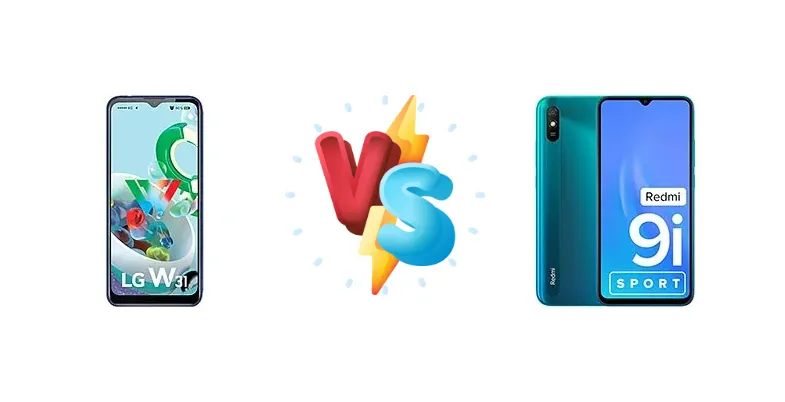
The LG W31 and Xiaomi Redmi 9i Sport represent the fiercely competitive entry-level smartphone market. Both devices aim to deliver essential functionality at an accessible price point, but they differ in their core processing power. This comparison dissects the nuances between the Mediatek Helio P22 in the LG W31 and the Helio G25 in the Redmi 9i Sport, revealing which phone offers the best experience for everyday tasks and light gaming.
🏆 Quick Verdict
For the average user prioritizing slightly smoother multitasking and potentially better sustained performance, the Xiaomi Redmi 9i Sport emerges as the better choice. Its Helio G25 chipset, with its mixed Cortex-A53 configuration, offers a modest but noticeable advantage over the LG W31’s Helio P22, despite the slower 10W charging.
| Network |
|---|
| 2G bands | GSM 850 / 900 / 1800 / 1900 | GSM 850 / 900 / 1800 / 1900 |
| 3G bands | HSDPA 850 / 900 / 2100 | HSDPA 850 / 900 / 2100 |
| 4G bands | 1, 3, 5, 8, 40, 41 | 1, 3, 5, 8, 40, 41 |
| Speed | HSPA, LTE | HSPA, LTE |
| Technology | GSM / HSPA / LTE | GSM / HSPA / LTE |
| Launch |
|---|
| Announced | 2020, November 06. Released 2020, December 23 | 2021, September 28 |
| Status | Discontinued | Available. Released 2021, September 28 |
| Body |
|---|
| Dimensions | 166.2 x 76.3 x 8.4 mm (6.54 x 3.00 x 0.33 in) | 164.9 x 77.1 x 9 mm (6.49 x 3.04 x 0.35 in) |
| SIM | Nano-SIM + Nano-SIM | Nano-SIM + Nano-SIM |
| Weight | 173.6 g (6.14 oz) | 194 g (6.84 oz) |
| | - | Water-repellent coating |
| Display |
|---|
| Resolution | 720 x 1600 pixels, 20:9 ratio (~269 ppi density) | 720 x 1600 pixels, 20:9 ratio (~269 ppi density) |
| Size | 6.52 inches, 102.6 cm2 (~80.9% screen-to-body ratio) | 6.53 inches, 102.9 cm2 (~81.0% screen-to-body ratio) |
| Type | IPS LCD | IPS LCD, 400 nits (typ) |
| Platform |
|---|
| CPU | Octa-core 2.0 GHz Cortex-A53 | Octa-core (4x2.0 GHz Cortex-A53 & 4x1.5 GHz Cortex-A53) |
| Chipset | Mediatek MT6762 Helio P22 (12 nm) | Mediatek MT6762G Helio G25 (12 nm) |
| GPU | PowerVR GE8320 | PowerVR GE8320 |
| OS | Android 10 | Android 10, MIUI 12 |
| Memory |
|---|
| Card slot | microSDXC (dedicated slot) | microSDXC (dedicated slot) |
| Internal | 64GB 4GB RAM, 128GB 4GB RAM | 64GB 4GB RAM, 128GB 4GB RAM |
| | eMMC 5.1 | eMMC 5.1 |
| Main Camera |
|---|
| Features | LED flash, panorama, HDR | LED flash, HDR |
| Single | - | 13 MP, f/2.2, 28mm (wide), 1.0µm, PDAF |
| Triple | 13 MP, (wide), 1/3.0", 1.12µm, PDAF
5 MP, (ultrawide)
Auxiliary lens | - |
| Video | 1080p@30fps | 1080p@30fps |
| Selfie camera |
|---|
| Features | - | HDR |
| Single | 8 MP, (wide) | 5 MP, f/2.2, (wide), 1.12µm |
| Video | 1080p@30fps | 1080p@30fps |
| Sound |
|---|
| 3.5mm jack | Yes | Yes |
| 35mm jack | Yes | Yes |
| Loudspeaker | Yes | Yes |
| Comms |
|---|
| Bluetooth | 4.2, A2DP, LE | 5.0, A2DP, LE |
| NFC | No | No |
| Positioning | GPS, GLONASS | GPS, GLONASS, BDS |
| Radio | FM radio | FM radio |
| USB | microUSB 2.0, OTG | microUSB 2.0, OTG |
| WLAN | Wi-Fi 802.11 b/g/n, Wi-Fi Direct | Wi-Fi 802.11 а/b/g/n, Wi-Fi Direct |
| Features |
|---|
| Sensors | Fingerprint (rear-mounted), accelerometer, proximity | Accelerometer, proximity, compass |
| Battery |
|---|
| Charging | - | 10W wired |
| Type | Li-Po 4000 mAh | Li-Po 5000 mAh |
| Misc |
|---|
| Colors | Midnight Blue | Carbon Black, Coral Green, Metallic Blue |
| Models | LMK315IM, LM-K315, LM-K315IM | - |
| Price | About 130 EUR | About 100 EUR |
LG W31
- Potential for longer software support (though diminishing with LG's exit)
- Reliable Mediatek Helio P22 chipset for basic tasks
- Likely similar battery life to the Redmi 9i Sport
- Less efficient chipset architecture compared to the Helio G25
- Potentially slower performance in multitasking and light gaming
- Charging speed unknown, likely similar to Redmi 9i Sport
Xiaomi Redmi 9i Sport
- Helio G25 chipset offers a slight performance advantage
- More efficient CPU architecture for better multitasking
- Competitive price point
- Slower 10W charging
- Xiaomi’s MIUI software can be resource-intensive
- Potentially shorter software support lifecycle
Display Comparison
Neither device boasts a standout display. Both utilize panels with resolutions likely around 720p+ (data not provided), typical for this price bracket. The focus here isn't on visual fidelity, but rather on basic usability. Without specific brightness or color accuracy data, it's safe to assume both offer adequate, but not exceptional, viewing experiences. Bezels are likely to be substantial on both devices, reflecting their budget positioning.
Camera Comparison
Camera performance is likely to be similar on both devices, relying heavily on software processing. Without sensor size or aperture data, it’s difficult to make definitive claims. Both phones likely feature a primary camera accompanied by auxiliary sensors (often 2MP depth or macro lenses, which offer limited utility). Image quality will be acceptable in good lighting conditions, but expect significant noise and detail loss in low light. The Redmi 9i Sport’s image processing might be slightly more aggressive, typical of Xiaomi’s software tuning.
Performance
The core difference lies in the chipsets. The LG W31’s Mediatek Helio P22 features an octa-core configuration of Cortex-A53 cores clocked at 2.0 GHz. The Redmi 9i Sport’s Helio G25, while also octa-core, employs a heterogeneous architecture: four Cortex-A53 cores at 2.0 GHz paired with four slower Cortex-A53 cores at 1.5 GHz. This 'big.LITTLE' approach allows the G25 to dynamically allocate tasks, potentially improving efficiency and sustained performance under load. While both are 12nm chips, the G25’s architecture gives it a slight edge in handling multitasking and less demanding games. The lack of RAM specifications makes a direct comparison difficult, but the chipset difference is the primary performance differentiator.
Battery Life
Battery capacity is not specified for either device, but both likely house batteries in the 4000-5000 mAh range, common for this segment. However, the Redmi 9i Sport is limited to 10W wired charging, while the LG W31’s charging speed is unknown but likely similar. This means the Redmi 9i Sport will take longer to fully charge, a trade-off for its slightly more capable chipset. Real-world battery life will depend heavily on usage patterns, but both should comfortably last a full day with moderate use.
Buying Guide
Buy the LG W31 if you prioritize a potentially longer software support lifecycle from LG (though this is becoming less of a factor given LG's exit from the smartphone market) and aren't heavily reliant on demanding applications. Buy the Xiaomi Redmi 9i Sport if you prefer a device capable of handling slightly more demanding multitasking and light gaming, and are comfortable with the slower 10W charging speed. Both phones are ideal for first-time smartphone users or those needing a reliable secondary device.
Frequently Asked Questions
❓ Will the Redmi 9i Sport struggle with popular apps like WhatsApp and Facebook?
No, both the LG W31 and Redmi 9i Sport are perfectly capable of running everyday apps like WhatsApp, Facebook, and YouTube. However, the Redmi 9i Sport’s Helio G25 chipset will handle switching between these apps more smoothly due to its more efficient architecture.
❓ Is the 10W charging on the Redmi 9i Sport a significant drawback?
While 10W charging is slower than faster charging standards, it’s typical for phones in this price range. Expect a full charge to take around 2-3 hours. If you primarily charge your phone overnight, the slower charging speed shouldn’t be a major inconvenience.
❓ Can the Redmi 9i Sport handle basic mobile games like PUBG Mobile or Call of Duty Mobile?
The Redmi 9i Sport can run PUBG Mobile and Call of Duty Mobile, but you’ll need to lower the graphics settings to the lowest possible levels to achieve playable frame rates. The Helio G25 provides a slight advantage over the Helio P22 in the LG W31 for gaming, but neither phone is designed for demanding gaming experiences.