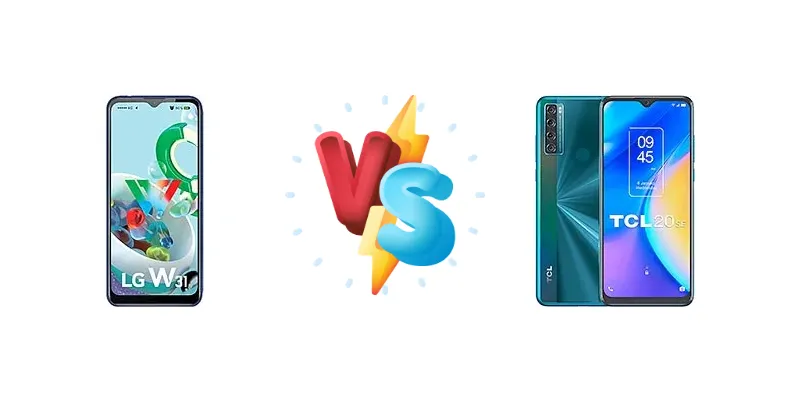
The LG W31 and TCL 20 SE represent two approaches to the ultra-budget smartphone market. The LG W31, leveraging Mediatek's Helio P22, aims for efficiency, while the TCL 20 SE, powered by Qualcomm's Snapdragon 460, prioritizes a more modern architecture. This comparison dissects their key differences to determine which device delivers the best experience for the price.
🏆 Quick Verdict
For most users, the TCL 20 SE emerges as the better choice. Its Snapdragon 460 chipset, built on an 11nm process, offers a noticeable performance advantage over the LG W31’s Helio P22, and the inclusion of 18W fast charging is a significant convenience. While the LG W31 may offer slightly better software support depending on region, the TCL 20 SE’s hardware edge is more impactful.
| Network |
|---|
| 2G bands | GSM 850 / 900 / 1800 / 1900 | GSM 850 / 900 / 1800 / 1900 |
| 3G bands | HSDPA 850 / 900 / 2100 | HSDPA 850 / 900 / 1900 / 2100 - EMEA, SEA, APAC |
| 4G bands | 1, 3, 5, 8, 40, 41 | 1, 3, 5, 7, 8, 20, 28, 38, 40, 41 - EMEA, SEA, APAC |
| Speed | HSPA, LTE | HSPA, LTE |
| Technology | GSM / HSPA / LTE | GSM / HSPA / LTE |
| | - | 1, 2, 3, 4, 5, 7, 8, 12, 13, 17, 26, 28, 66 - LATAM |
| Launch |
|---|
| Announced | 2020, November 06. Released 2020, December 23 | 2021, January 11 |
| Status | Discontinued | Available. Released 2021, April 26 |
| Body |
|---|
| Dimensions | 166.2 x 76.3 x 8.4 mm (6.54 x 3.00 x 0.33 in) | 172.1 x 77.1 x 9.1 mm (6.78 x 3.04 x 0.36 in) |
| SIM | Nano-SIM + Nano-SIM | · Nano-SIM· Nano-SIM + Nano-SIM |
| Weight | 173.6 g (6.14 oz) | 206 g (7.27 oz) |
| Display |
|---|
| Resolution | 720 x 1600 pixels, 20:9 ratio (~269 ppi density) | 720 x 1640 pixels (~263 ppi density) |
| Size | 6.52 inches, 102.6 cm2 (~80.9% screen-to-body ratio) | 6.82 inches, 110.5 cm2 (~83.2% screen-to-body ratio) |
| Type | IPS LCD | IPS LCD, 450 nits (typ) |
| Platform |
|---|
| CPU | Octa-core 2.0 GHz Cortex-A53 | Octa-core (4x1.8 GHz Kryo 240 & 4x1.6 GHz Kryo 240) |
| Chipset | Mediatek MT6762 Helio P22 (12 nm) | Qualcomm SM4250 Snapdragon 460 (11 nm) |
| GPU | PowerVR GE8320 | Adreno 610 |
| OS | Android 10 | Android 11, upgradable to Android 12, TCL UI |
| Memory |
|---|
| Card slot | microSDXC (dedicated slot) | microSDXC (uses shared SIM slot) |
| Internal | 64GB 4GB RAM, 128GB 4GB RAM | 64GB 4GB RAM, 128GB 4GB RAM |
| | eMMC 5.1 | UFS 2.1 (128GB only) |
| Main Camera |
|---|
| Features | LED flash, panorama, HDR | Dual-LED flash, HDR, panorama |
| Quad | - | 16 MP, f/1.8, 27mm (wide), 1/2.0", 1.12µm, PDAF
5 MP, f/2.2, 14mm, 115˚ (ultrawide), 1/5.0", 1.12µm
Auxiliary lens
2 MP (macro)
or
48 MP, f/2.0, 27mm (wide), 1/2.0", 0.8µm, PDAF
5 MP, f/2.2, 14mm, 115˚ (ultrawide), 1/5.0", 1.12µm
Auxiliary lens
2 MP (macro) |
| Triple | 13 MP, (wide), 1/3.0", 1.12µm, PDAF
5 MP, (ultrawide)
Auxiliary lens | - |
| Video | 1080p@30fps | 1080p@30fps |
| Selfie camera |
|---|
| Features | - | HDR |
| Single | 8 MP, (wide) | 8 MP, f/2.0, 26mm (wide), 1/4.0", 1.12µm
or
13 MP, f/2.2, 26mm (wide), 1/3.0", 1.12µm |
| Video | 1080p@30fps | 1080p@30fps |
| Sound |
|---|
| 3.5mm jack | Yes | Yes |
| 35mm jack | Yes | Yes |
| Loudspeaker | Yes | Yes, with dual speakers |
| | - | 24-bit/192kHz audio |
| Comms |
|---|
| Bluetooth | 4.2, A2DP, LE | 5.0, A2DP, LE, aptX |
| NFC | No | Yes |
| Positioning | GPS, GLONASS | GPS, GLONASS, GALILEO, BDS |
| Radio | FM radio | FM radio |
| USB | microUSB 2.0, OTG | USB Type-C 2.0, OTG |
| WLAN | Wi-Fi 802.11 b/g/n, Wi-Fi Direct | Wi-Fi 802.11 b/g/n, Wi-Fi Direct |
| Features |
|---|
| Sensors | Fingerprint (rear-mounted), accelerometer, proximity | Fingerprint (rear-mounted), accelerometer, proximity, compass |
| Battery |
|---|
| Charging | - | 18W wired |
| Type | Li-Po 4000 mAh | Li-Po 5000 mAh |
| Misc |
|---|
| Colors | Midnight Blue | Aurora Green, Nuit Black |
| Models | LMK315IM, LM-K315, LM-K315IM | T671H, T671F, T671O, T671E |
| Price | About 130 EUR | About 150 EUR |
LG W31
- Potentially longer software support (region dependent)
- May be more readily available in certain markets
- Simple, straightforward user experience
- Older, less efficient Helio P22 chipset
- Slower charging speeds
- Likely struggles with demanding apps
TCL 20 SE
- More powerful Snapdragon 460 chipset
- Faster 18W wired charging
- Improved multitasking and gaming performance
- Software support may be limited
- Build quality may be less premium
- Potential for more bloatware
Display Comparison
Neither device boasts a standout display. Both likely utilize LCD panels, common in this price bracket. The key difference lies under the hood. Without specific display specs, we can infer that the TCL 20 SE’s more modern chipset may allow for slightly better image processing, potentially resulting in more vibrant colors. However, both will likely struggle with outdoor visibility due to limited peak brightness.
Camera Comparison
Without detailed camera specs beyond the presence of a camera, a direct comparison is difficult. However, it’s safe to assume both devices feature basic camera setups geared towards casual photography. The TCL 20 SE’s more powerful chipset could potentially enable slightly better image processing, leading to improved dynamic range and noise reduction. The prevalence of 2MP macro lenses on both devices suggests they are largely marketing features with limited practical utility. Focusing on the main sensor’s quality (which is unknown) will be crucial for real-world image quality.
Performance
The TCL 20 SE’s Qualcomm Snapdragon 460 (11nm) represents a clear architectural advantage over the LG W31’s Mediatek Helio P22 (12nm). The 11nm process generally translates to better power efficiency and thermal performance. While both are octa-core CPUs, the Snapdragon 460’s Kryo 240 cores, with a split clock speed of 1.8GHz and 1.6GHz, are more efficient than the Helio P22’s uniform 2.0GHz Cortex-A53 cores. This means the TCL 20 SE will handle multitasking and moderately demanding apps with less lag. The GPU within the Snapdragon 460 will also provide a smoother gaming experience, even if limited to lower settings.
Battery Life
Battery capacity is not provided for either device. However, the TCL 20 SE’s 18W wired charging is a significant advantage. The LG W31 likely supports standard 10W or 15W charging, resulting in considerably longer charge times. Even with a similar battery capacity, the TCL 20 SE’s faster charging will provide more convenient top-ups throughout the day. The Snapdragon 460’s improved power efficiency may also contribute to slightly longer battery life during typical usage.
Buying Guide
Buy the LG W31 if you prioritize a potentially longer software support lifecycle (depending on your region) and are primarily focused on basic tasks like calling, texting, and light social media use. Buy the TCL 20 SE if you value smoother multitasking, slightly better gaming performance, and the convenience of faster charging, making it ideal for users who consume more media and demand a more responsive experience.
Frequently Asked Questions
❓ Will the TCL 20 SE be able to run popular games like PUBG Mobile or Call of Duty Mobile?
The TCL 20 SE’s Snapdragon 460 can run PUBG Mobile and Call of Duty Mobile, but expect to play at lower graphics settings (Low or Medium) and frame rates to maintain a stable experience. The Helio P22 in the LG W31 will struggle significantly with these titles, even at the lowest settings.
❓ How long will it take to fully charge the TCL 20 SE with the 18W charger?
While a precise time isn't available, the TCL 20 SE should fully charge from 0% to 100% in approximately 2 to 2.5 hours with the included 18W charger. The LG W31, with its slower charging, will likely take over 4 hours.
❓ Is the software experience significantly different between the LG W31 and TCL 20 SE?
Both devices likely run a customized version of Android. TCL’s software tends to include more pre-installed apps (bloatware), while LG’s software is generally cleaner. However, software updates and long-term support are uncertain for both models, varying by region.