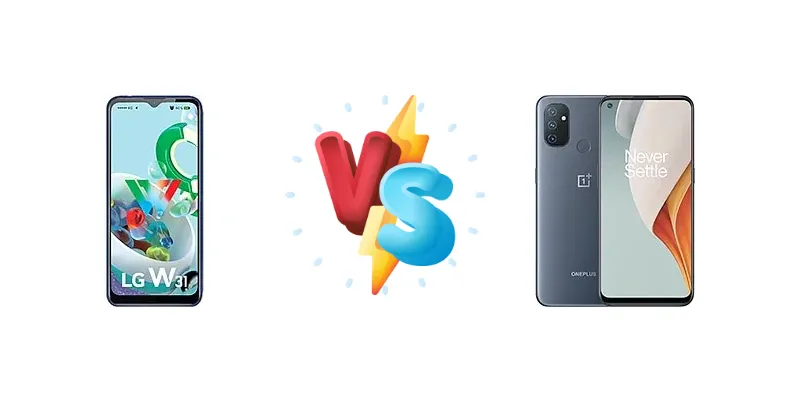
The sub-$150 smartphone market is fiercely competitive. The LG W31 and OnePlus Nord N100 represent two distinct approaches to delivering value. The W31 relies on MediaTek’s Helio P22, while the Nord N100 opts for Qualcomm’s Snapdragon 460. This comparison dissects their key differences to determine which device offers the best experience for budget-conscious consumers.
🏆 Quick Verdict
For most users, the OnePlus Nord N100 is the better choice. Its Snapdragon 460, built on an 11nm process, provides a noticeable performance advantage over the LG W31’s 12nm Helio P22. The inclusion of 18W fast charging further sweetens the deal, making it a more practical daily driver despite similar RAM configurations.
| Network |
|---|
| 2G bands | GSM 850 / 900 / 1800 / 1900 | GSM 850 / 900 / 1800 / 1900 |
| 3G bands | HSDPA 850 / 900 / 2100 | HSDPA 850 / 900 / 1700(AWS) / 1900 / 2100 |
| 4G bands | 1, 3, 5, 8, 40, 41 | 1, 2, 3, 4, 5, 7, 8, 12, 17, 20, 28, 38, 40, 41 - International |
| Speed | HSPA, LTE | HSPA 42.2/5.76 Mbps, LTE Cat13 400/50 Mbps |
| Technology | GSM / HSPA / LTE | GSM / CDMA / HSPA / LTE |
| | - | 1, 2, 3, 4, 5, 7, 8, 12, 13, 17, 20, 25, 26, 28, 38, 41, 66, 71 - USA |
| Launch |
|---|
| Announced | 2020, November 06. Released 2020, December 23 | 2020, October 26 |
| Status | Discontinued | Available. Released 2020, November 11 |
| Body |
|---|
| Build | - | Glass front (Gorilla Glass 3), plastic frame |
| Dimensions | 166.2 x 76.3 x 8.4 mm (6.54 x 3.00 x 0.33 in) | 164.9 x 75.1 x 8.5 mm (6.49 x 2.96 x 0.33 in) |
| SIM | Nano-SIM + Nano-SIM | Nano-SIM + Nano-SIM |
| Weight | 173.6 g (6.14 oz) | 188 g (6.63 oz) |
| Display |
|---|
| Protection | - | Corning Gorilla Glass 3 |
| Resolution | 720 x 1600 pixels, 20:9 ratio (~269 ppi density) | 720 x 1600 pixels, 20:9 ratio (~269 ppi density) |
| Size | 6.52 inches, 102.6 cm2 (~80.9% screen-to-body ratio) | 6.52 inches, 102.6 cm2 (~82.9% screen-to-body ratio) |
| Type | IPS LCD | IPS LCD, 90Hz |
| Platform |
|---|
| CPU | Octa-core 2.0 GHz Cortex-A53 | Octa-core (4x1.8 GHz Kryo 240 & 4x1.6 GHz Kryo 240) |
| Chipset | Mediatek MT6762 Helio P22 (12 nm) | Qualcomm SM4250 Snapdragon 460 (11 nm) |
| GPU | PowerVR GE8320 | Adreno 610 |
| OS | Android 10 | Android 10, OxygenOS 10.5.9 |
| Memory |
|---|
| Card slot | microSDXC (dedicated slot) | microSDXC |
| Internal | 64GB 4GB RAM, 128GB 4GB RAM | 64GB 4GB RAM |
| | eMMC 5.1 | UFS 2.1 |
| Main Camera |
|---|
| Features | LED flash, panorama, HDR | LED flash, HDR, panorama |
| Triple | 13 MP, (wide), 1/3.0", 1.12µm, PDAF
5 MP, (ultrawide)
Auxiliary lens | 13 MP, f/2.2, (wide), PDAF
2 MP (macro)
Auxiliary lens |
| Video | 1080p@30fps | 1080p@30fps, gyro-EIS |
| Selfie camera |
|---|
| Features | - | HDR |
| Single | 8 MP, (wide) | 8 MP, f/2.0 |
| Video | 1080p@30fps | 1080p@30fps |
| Sound |
|---|
| 3.5mm jack | Yes | Yes |
| 35mm jack | Yes | Yes |
| Loudspeaker | Yes | Yes, with stereo speakers |
| Comms |
|---|
| Bluetooth | 4.2, A2DP, LE | 5.0, A2DP, LE |
| NFC | No | - |
| Positioning | GPS, GLONASS | GPS, GLONASS, GALILEO, BDS |
| Radio | FM radio | FM radio |
| USB | microUSB 2.0, OTG | USB Type-C 2.0, OTG |
| WLAN | Wi-Fi 802.11 b/g/n, Wi-Fi Direct | Wi-Fi 802.11 a/b/g/n/ac, dual-band, Wi-Fi Direct |
| Features |
|---|
| Sensors | Fingerprint (rear-mounted), accelerometer, proximity | Fingerprint (rear-mounted), accelerometer, gyro, proximity, compass |
| Battery |
|---|
| Charging | - | 18W wired |
| Type | Li-Po 4000 mAh | Li-Po 5000 mAh |
| Misc |
|---|
| Colors | Midnight Blue | Midnight Frost |
| Models | LMK315IM, LM-K315, LM-K315IM | BE2013, BE2015, BE2011, BE2012 |
| Price | About 130 EUR | About 80 EUR |
| Pricing |
|---|
| 64GB 4GB RAM | - | $ 125.00 |
| RENEWED | - | $ 129.00 |
LG W31
- Potential for longer software support from LG.
- May be available at a slightly lower price point.
- Adequate for basic smartphone tasks.
- Older, less efficient Helio P22 chipset.
- Likely slower performance compared to the Nord N100.
- Missing charging speed information suggests slower charging.
OnePlus Nord N100
- More powerful and efficient Snapdragon 460 chipset.
- 18W fast charging for quicker top-ups.
- Smoother multitasking and app loading.
- May be slightly more expensive than the LG W31.
- Software support timeline from OnePlus is not always guaranteed.
- Display quality is likely similar to the LG W31.
Display Comparison
Neither device boasts a standout display. Both likely utilize LCD panels, common in this price bracket. The absence of display specifications beyond the chipsets makes a direct comparison difficult. However, the Nord N100’s slightly higher price point *suggests* a potentially better panel, perhaps with slightly improved color accuracy or brightness. The LG W31’s display is likely adequate for everyday use, but won’t impress.
Camera Comparison
Camera performance is likely similar, with both devices targeting the entry-level segment. Without detailed sensor information, it’s difficult to make definitive claims. However, the market trend suggests the Nord N100 may have a slightly more capable main sensor. Both devices likely include multiple rear cameras, but the inclusion of low-resolution sensors (often 2MP) for macro or depth sensing is common and offers limited real-world benefit. Image processing will be a key differentiator, and OnePlus generally offers more refined software algorithms.
Performance
The core difference lies in the chipsets. The OnePlus Nord N100’s Qualcomm Snapdragon 460 (11nm) is architecturally superior to the LG W31’s MediaTek Helio P22 (12nm). The 11nm process allows for greater transistor density and improved power efficiency, translating to better sustained performance and potentially less thermal throttling. While both CPUs are octa-core, the Snapdragon 460’s Kryo 240 cores, with a split clock speed (1.8GHz & 1.6GHz), offer a more refined performance profile than the W31’s uniform 2.0GHz Cortex-A53 cores. This means the Nord N100 will handle multitasking and app loading more smoothly.
Battery Life
Battery capacity is not provided for the LG W31, making a direct comparison challenging. However, the OnePlus Nord N100’s 18W wired charging is a significant advantage. While neither phone will offer exceptional battery life, the faster charging speed on the Nord N100 means less downtime and a more convenient user experience. The Snapdragon 460’s improved power efficiency also contributes to potentially longer real-world usage on the Nord N100.
Buying Guide
Buy the LG W31 if you prioritize a potentially longer software support lifecycle from LG (though this is not guaranteed) and are primarily focused on basic tasks like calling, texting, and light social media use. Buy the OnePlus Nord N100 if you value smoother multitasking, slightly better gaming performance, and faster charging, making it ideal for users who consume more media and occasionally play mobile games.
Frequently Asked Questions
❓ Will the Snapdragon 460 in the Nord N100 handle popular games like PUBG Mobile?
The Snapdragon 460 can run PUBG Mobile, but expect to play at lower graphics settings (balanced or low) to maintain a stable frame rate. It’s not a gaming powerhouse, but it’s significantly more capable than the Helio P22 in the LG W31 for gaming.
❓ Is the software experience significantly different between LG and OnePlus?
Yes. LG’s software is generally more feature-rich but can be heavier and include more pre-installed apps. OnePlus’s OxygenOS is known for its clean, near-stock Android experience with useful customizations. This difference in software philosophy is a key consideration for many users.
❓ How does the 4GB of RAM impact multitasking on both devices?
4GB of RAM is the bare minimum for modern Android. The Snapdragon 460’s more efficient memory management will allow the Nord N100 to handle more apps in the background and switch between them more smoothly than the LG W31 with the Helio P22.