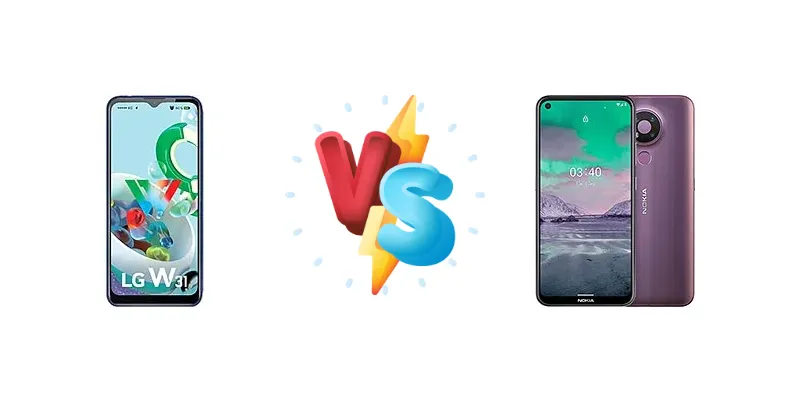
The LG W31 and Nokia 3.4 represent two approaches to the ultra-budget smartphone market. The W31, while older, offers a larger display, while the Nokia 3.4 brings a more modern chipset and cleaner software experience. This comparison dives deep into the hardware and software differences to determine which phone delivers the best value for users prioritizing affordability.
🏆 Quick Verdict
For most users, the Nokia 3.4 is the better choice. Its Qualcomm Snapdragon 460 chipset, built on an 11nm process, provides a noticeable performance uplift over the LG W31’s Mediatek Helio P22, resulting in smoother multitasking and app loading. While the W31 may have a slightly larger screen, the Nokia 3.4’s efficiency and software support make it the more compelling option.
| Network |
|---|
| 2G bands | GSM 850 / 900 / 1800 / 1900 | GSM 850 / 900 / 1800 / 1900 |
| 3G bands | HSDPA 850 / 900 / 2100 | HSDPA 850 / 900 / 1700(AWS) / 1900 / 2100 |
| 4G bands | 1, 3, 5, 8, 40, 41 | 1, 2, 3, 4, 5, 7, 8, 12, 17, 13, 28, 66 |
| Speed | HSPA, LTE | HSPA, LTE |
| Technology | GSM / HSPA / LTE | GSM / HSPA / LTE |
| Launch |
|---|
| Announced | 2020, November 06. Released 2020, December 23 | 2020, September 22. Released 2020, October 26 |
| Status | Discontinued | Discontinued |
| Body |
|---|
| Dimensions | 166.2 x 76.3 x 8.4 mm (6.54 x 3.00 x 0.33 in) | 161 x 76 x 8.7 mm (6.34 x 2.99 x 0.34 in) |
| SIM | Nano-SIM + Nano-SIM | · Nano-SIM· Nano-SIM + Nano-SIM |
| Weight | 173.6 g (6.14 oz) | 180 g (6.35 oz) |
| Display |
|---|
| Resolution | 720 x 1600 pixels, 20:9 ratio (~269 ppi density) | 720 x 1560 pixels, 19.5:9 ratio (~269 ppi density) |
| Size | 6.52 inches, 102.6 cm2 (~80.9% screen-to-body ratio) | 6.39 inches, 100.2 cm2 (~81.9% screen-to-body ratio) |
| Type | IPS LCD | IPS LCD, 400 nits (typ) |
| Platform |
|---|
| CPU | Octa-core 2.0 GHz Cortex-A53 | Octa-core (4x1.8 GHz Cortex-A73 & 4x1.8 GHz Cortex-A53) |
| Chipset | Mediatek MT6762 Helio P22 (12 nm) | Qualcomm SM4250 Snapdragon 460 (11 nm) |
| GPU | PowerVR GE8320 | Adreno 610 |
| OS | Android 10 | Android 10, upgradable to Android 11 |
| Memory |
|---|
| Card slot | microSDXC (dedicated slot) | microSDXC (dedicated slot) |
| Internal | 64GB 4GB RAM, 128GB 4GB RAM | 32GB 3GB RAM, 64GB 3GB RAM, 64GB 4GB RAM |
| | eMMC 5.1 | eMMC 5.1 |
| Main Camera |
|---|
| Features | LED flash, panorama, HDR | LED flash, HDR, panorama |
| Triple | 13 MP, (wide), 1/3.0", 1.12µm, PDAF
5 MP, (ultrawide)
Auxiliary lens | 13 MP, (wide), PDAF
5 MP, (ultrawide)
Auxiliary lens |
| Video | 1080p@30fps | 1080p@30fps |
| Selfie camera |
|---|
| Single | 8 MP, (wide) | 8 MP, (wide) |
| Video | 1080p@30fps | 1080p@30fps |
| Sound |
|---|
| 3.5mm jack | Yes | Yes |
| 35mm jack | Yes | Yes |
| Loudspeaker | Yes | Yes |
| Comms |
|---|
| Bluetooth | 4.2, A2DP, LE | 4.2, A2DP, aptX |
| NFC | No | Yes (market/region dependent) |
| Positioning | GPS, GLONASS | GPS, GLONASS, GALILEO, BDS |
| Radio | FM radio | FM radio |
| USB | microUSB 2.0, OTG | USB Type-C 2.0 |
| WLAN | Wi-Fi 802.11 b/g/n, Wi-Fi Direct | Wi-Fi 802.11 b/g/n |
| Features |
|---|
| Sensors | Fingerprint (rear-mounted), accelerometer, proximity | Fingerprint (rear-mounted), accelerometer, gyro, proximity |
| Battery |
|---|
| Charging | - | 10W wired |
| Type | Li-Po 4000 mAh | Li-Po 4000 mAh |
| Misc |
|---|
| Colors | Midnight Blue | Fjord, Dusk, Charcoal |
| Models | LMK315IM, LM-K315, LM-K315IM | TA-1288, TA-1285, TA-1283 |
| Price | About 130 EUR | About 100 EUR |
| SAR | - | 0.83 W/kg (head) 1.05 W/kg (body) |
| SAR EU | - | 0.36 W/kg (head) 1.56 W/kg (body) |
LG W31
- Potentially larger display size
- May offer more secondary camera sensors
- Lower price point (potentially)
- Inferior chipset performance (Helio P22)
- Less efficient processor
- Likely slower software updates
Nokia 3.4
- More powerful and efficient Snapdragon 460 chipset
- Better long-term software support from Nokia
- Improved multitasking and app loading speeds
- Slightly smaller display
- Slow 10W charging
- Potentially higher price
Display Comparison
Neither device boasts a standout display. Both likely utilize IPS LCD panels, common in this price bracket. The LG W31’s larger size is its primary advantage, though specific dimensions aren’t provided. The Nokia 3.4’s display quality will likely be sharper due to its higher pixel density, assuming a similar resolution. Neither manufacturer specifies peak brightness or color gamut coverage, suggesting both displays are geared towards basic usability rather than media consumption.
Camera Comparison
Camera performance is likely to be similar on both devices, given their market segment. Both will likely feature a primary camera and depth sensor, with the LG W31 potentially including a wider array of secondary sensors. However, sensor size and aperture are critical factors not provided. The Snapdragon 460’s image signal processor (ISP) is likely more advanced, potentially leading to better image processing and low-light performance on the Nokia 3.4. The absence of Optical Image Stabilization (OIS) on either device suggests reliance on software stabilization.
Performance
The Nokia 3.4’s Qualcomm Snapdragon 460 represents a significant architectural advantage over the LG W31’s Mediatek Helio P22. The Snapdragon 460 utilizes a combination of Cortex-A73 and A53 cores clocked at 1.8GHz, offering superior single-core and multi-core performance compared to the W31’s all-Cortex-A53 setup at 2.0GHz. The 11nm fabrication process of the Snapdragon 460 also contributes to better power efficiency. This translates to snappier app launches, smoother scrolling, and a more responsive overall experience on the Nokia 3.4. The W31 will struggle with demanding tasks and multitasking.
Battery Life
Battery life will depend heavily on usage patterns. While the LG W31’s battery capacity isn’t specified, it’s likely comparable to the Nokia 3.4’s. However, the Snapdragon 460’s superior power efficiency gives the Nokia 3.4 an edge. The Nokia 3.4’s 10W charging is slow by modern standards, but the more efficient chipset means it won’t need to be charged as frequently. The LG W31’s charging speed is unknown, but likely similar or slower.
Buying Guide
Buy the LG W31 if you absolutely need the largest possible screen on a minimal budget and are comfortable with potentially slower performance and less frequent software updates. Buy the Nokia 3.4 if you prioritize a more responsive user experience, better long-term software support, and a more efficient chipset, even if it means a slightly smaller display.
Frequently Asked Questions
❓ Will the Nokia 3.4 struggle with popular games like PUBG Mobile?
While the Snapdragon 460 isn't a gaming powerhouse, it can handle PUBG Mobile at lower settings. Expect frame rate drops during intense action, but it's playable. The LG W31's Helio P22 will likely offer a significantly less smooth gaming experience.
❓ How important is the software support difference between LG and Nokia?
Nokia is committed to providing regular security updates and software upgrades for its phones, even in the budget segment. LG has largely exited the smartphone market, meaning the W31 is unlikely to receive further software support. This makes the Nokia 3.4 a more secure and future-proof option.
❓ Does the Nokia 3.4 support fast charging, and how long does it take to charge?
The Nokia 3.4 only supports 10W wired charging, which is relatively slow. A full charge from 0% to 100% will likely take around 2.5 to 3 hours. While not ideal, the Snapdragon 460's efficiency means you won't need to charge it as often.