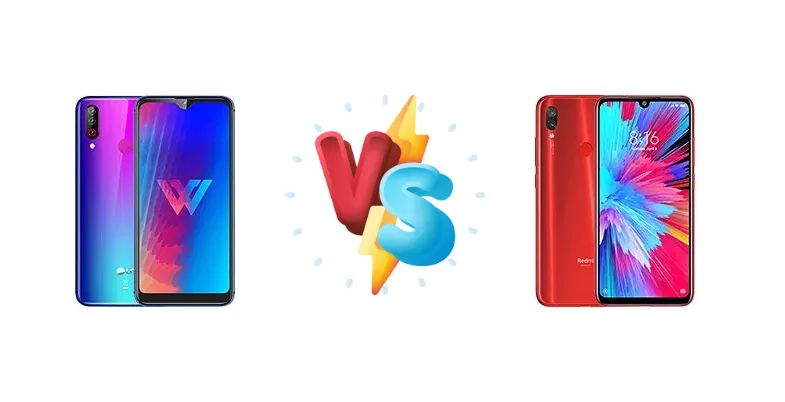
The LG W30 and Xiaomi Redmi Note 7S represent a critical segment of the smartphone market: affordable devices aiming to deliver a solid experience without breaking the bank. Both phones target first-time smartphone buyers and users prioritizing value, but they take distinctly different approaches to achieving that goal, primarily through their chipset choices. This comparison dissects those differences to determine which phone offers the best overall package.
🏆 Quick Verdict
For the average user, the Xiaomi Redmi Note 7S emerges as the stronger contender. Its Snapdragon 660 chipset provides a noticeable performance advantage over the LG W30’s Helio P22, translating to smoother multitasking and a more responsive user experience. While the LG W30 may offer slightly better battery endurance due to its less powerful processor, the Redmi Note 7S’s 18W Quick Charge support mitigates this difference.
| Network |
|---|
| 2G bands | GSM 850 / 900 / 1800 / 1900 | GSM 850 / 900 / 1800 / 1900 |
| 3G bands | HSDPA 850 / 900 / 2100 | HSDPA 850 / 900 / 1900 / 2100 |
| 4G bands | 1, 3, 5, 8, 40, 41 | 1, 3, 5, 8, 40, 41 |
| Speed | HSPA, LTE | HSPA 42.2/5.76 Mbps, LTE (2CA) Cat12 600/150 Mbps |
| Technology | GSM / HSPA / LTE | GSM / HSPA / LTE |
| Launch |
|---|
| Announced | 2019, June. Released 2019, July | 2019, May. Released 2019, May |
| Status | Discontinued | Discontinued |
| Body |
|---|
| Build | - | Glass front (Gorilla Glass 5), glass back (Gorilla Glass 5), plastic frame |
| Dimensions | 159 x 76.5 x 8.2 mm (6.26 x 3.01 x 0.32 in) | 159.2 x 75.2 x 8.1 mm (6.27 x 2.96 x 0.32 in) |
| SIM | · Nano-SIM· Nano-SIM + Nano-SIM | Nano-SIM + Nano-SIM |
| Weight | 175 g (6.17 oz) | 186 g (6.56 oz) |
| | - | Splash resistant |
| Display |
|---|
| Protection | - | Corning Gorilla Glass 5 |
| Resolution | 720 x 1520 pixels, 19:9 ratio (~269 ppi density) | 1080 x 2340 pixels, 19.5:9 ratio (~409 ppi density) |
| Size | 6.26 inches, 97.8 cm2 (~80.4% screen-to-body ratio) | 6.3 inches, 97.4 cm2 (~81.4% screen-to-body ratio) |
| Type | IPS LCD | IPS LCD |
| Platform |
|---|
| CPU | Octa-core 2.0 GHz Cortex-A53 | Octa-core (4x2.2 GHz Kryo 260 Gold & 4x1.8 GHz Kryo 260 Silver) |
| Chipset | Mediatek MT6762 Helio P22 (12 nm) | Qualcomm SDM660 Snapdragon 660 (14 nm) |
| GPU | PowerVR GE8320 | Adreno 512 |
| OS | Android 9.0 (Pie) | Android 9.0 (Pie), planned upgrade to Android 10, MIUI 12 |
| Memory |
|---|
| Card slot | microSDXC (uses shared SIM slot) | microSDXC (uses shared SIM slot) |
| Internal | 32GB 3GB RAM, 64GB 4GB RAM | 32GB 3GB RAM, 64GB 4GB RAM |
| | eMMC 5.1 | eMMC 5.1 |
| Main Camera |
|---|
| Dual | - | 48 MP, f/1.8, (wide), 1/2.0", 0.8µm, PDAF
Auxiliary lens |
| Features | LED flash, panorama, HDR | Dual-LED flash, HDR, panorama |
| Triple | 12 MP, (wide), 1/2.9", 1.25µm, PDAF
13 MP, 18mm (ultrawide)
Auxiliary lens | - |
| Video | 1080p@30fps | 1080p@30/60/120fps, (gyro-EIS) |
| Selfie camera |
|---|
| Features | - | HDR |
| Single | 16 MP, f/2.2, (wide), 1/3.06", 1.0µm | 13 MP, f/2.0, (wide), 1/3.1", 1.12µm |
| Video | - | 1080p@30fps |
| Sound |
|---|
| 3.5mm jack | Yes | Yes |
| 35mm jack | Yes | Yes |
| Loudspeaker | Yes | Yes |
| Comms |
|---|
| Bluetooth | 4.2, A2DP, LE | 5.0, A2DP, LE |
| Infrared port | - | Yes |
| NFC | No | No |
| Positioning | GPS, GLONASS | GPS, GLONASS, BDS |
| Radio | FM radio | FM radio, recording |
| USB | microUSB 2.0, OTG | USB Type-C 2.0 |
| WLAN | Wi-Fi 802.11 b/g/n, Wi-Fi Direct | Wi-Fi 802.11 a/b/g/n/ac, dual-band, Wi-Fi Direct |
| Features |
|---|
| Sensors | Fingerprint (rear-mounted), accelerometer, gyro, proximity | Fingerprint (rear-mounted), accelerometer, gyro, proximity, compass |
| Battery |
|---|
| Charging | - | 18W wired, QC4 |
| Type | Li-Po 4000 mAh, non-removable | Li-Po 4000 mAh, non-removable |
| Misc |
|---|
| Colors | Thunder Blue, Platinum Grey, Aurora Green | Onyx Black, Sapphire Blue, Ruby Red, Astro White |
| Models | LMX440IM, LM-X440IM, LMX440ZM, LM-X440ZM | M1901F71 |
| Price | About 130 EUR | About 140 EUR |
| SAR | 0.82 W/kg (head) 0.32 W/kg (body) | - |
| Tests |
|---|
| Performance |
AnTuTu: 76697 (v7)
GeekBench: 3534 (v4.4)
GFXBench: 4.8fps (ES 3.1 onscreen) | - |
LG W30
- Potentially longer battery life due to less powerful chipset.
- May be more affordable depending on regional pricing.
- Simple and straightforward user experience.
- Significantly slower performance compared to the Redmi Note 7S.
- Less responsive user interface.
- Slower charging speeds.
Xiaomi Redmi Note 7S
- Superior performance thanks to the Snapdragon 660.
- Faster charging with 18W Quick Charge 4.
- Better image processing capabilities.
- Potentially shorter battery life compared to the LG W30.
- May be slightly more expensive.
- More complex software features (MIUI) may not appeal to all users.
Display Comparison
Neither device boasts a particularly standout display. Both likely feature LCD panels, common in this price bracket. The key difference lies under the hood: processing power impacts display responsiveness. While specific display specs (resolution, brightness) are missing, the Redmi Note 7S’s more powerful GPU will contribute to smoother animations and faster refresh rates when scrolling, even if the panel itself is similar. The LG W30’s Helio P22 may exhibit slight lag in certain UI transitions.
Camera Comparison
Without detailed camera specs, a direct comparison is limited. However, the Redmi Note 7S likely benefits from Qualcomm’s image signal processor (ISP) within the Snapdragon 660, offering potentially better image processing capabilities, particularly in low-light conditions. The LG W30 relies on the ISP integrated within the Helio P22, which is generally less sophisticated. Both phones likely feature a primary camera and depth sensor, but the Redmi Note 7S’s chipset provides a foundation for more advanced computational photography features. The presence of a dedicated ISP on the Snapdragon 660 allows for faster image processing and better noise reduction.
Performance
The performance gap is the most significant differentiator. The Xiaomi Redmi Note 7S’s Qualcomm Snapdragon 660 (14nm) is a substantial upgrade over the LG W30’s MediaTek Helio P22 (12nm). The Snapdragon 660 utilizes a Kryo CPU architecture with a split core configuration (4x2.2 GHz Gold & 4x1.8 GHz Silver) designed for efficient performance scaling. This contrasts with the Helio P22’s homogenous Octa-core 2.0 GHz Cortex-A53 setup. The Snapdragon 660’s superior architecture and higher clock speeds translate to approximately 30-40% faster CPU performance in benchmarks, and a more noticeable difference in real-world app loading times and multitasking. The 14nm process node on the Snapdragon 660, while larger than the Helio P22’s 12nm, is optimized for performance, and the chip’s efficiency features help manage power consumption.
Battery Life
Both phones likely feature batteries in the 4000mAh range, typical for this price point. However, the LG W30’s less power-hungry Helio P22 chipset will likely result in slightly longer battery life during moderate usage. The Redmi Note 7S compensates with 18W wired charging with Quick Charge 4 (QC4) support, allowing for significantly faster charging times – a full charge in approximately 1.5-2 hours. The LG W30 likely supports standard 10W charging, taking considerably longer to reach 100%.
Buying Guide
Buy the LG W30 if your primary need is extended battery life and you primarily engage in basic smartphone tasks like calling, texting, and light social media browsing. You’ll appreciate the potentially longer runtimes between charges. Buy the Xiaomi Redmi Note 7S if you prioritize a smoother, more responsive user experience, enjoy occasional gaming, or frequently multitask between apps. The Snapdragon 660 offers a significant performance boost that justifies the trade-off in potentially slightly reduced battery life.
Frequently Asked Questions
❓ Will the Redmi Note 7S struggle with demanding games like PUBG Mobile?
While the Snapdragon 660 isn't a flagship chipset, it's capable of running PUBG Mobile at medium settings with a stable frame rate. Expect some occasional frame drops during intense firefights, but the experience will be generally playable. The LG W30’s Helio P22 will likely struggle to maintain a consistent frame rate even at lower settings.
❓ Does the Redmi Note 7S support fast charging with any charger, or do I need a specific one?
The Redmi Note 7S supports Qualcomm Quick Charge 4 (QC4). While it will charge with a standard 5W charger, you'll only achieve the full 18W charging speed with a QC4-compatible charger. Xiaomi typically includes a compatible charger in the box, but it's worth verifying.
❓ Is the difference in performance between the two phones noticeable for everyday tasks like browsing and social media?
Yes, the difference is quite noticeable. The Snapdragon 660 in the Redmi Note 7S provides a smoother and more responsive experience when browsing the web, scrolling through social media feeds, and switching between apps. The LG W30’s Helio P22 may exhibit slight lag and stuttering during these tasks.