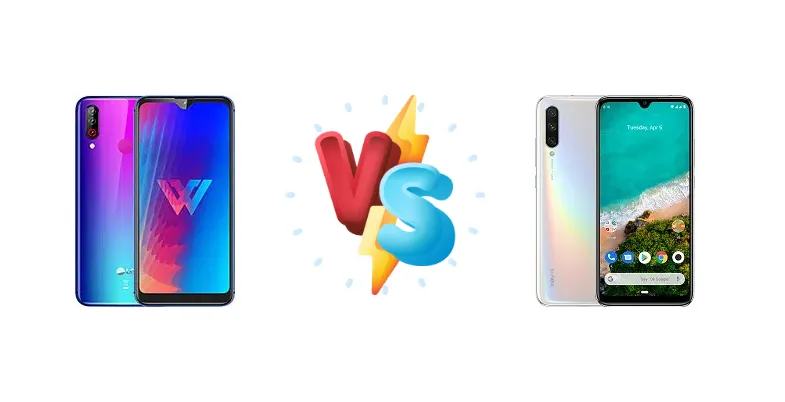
The sub-$200 smartphone market is fiercely competitive. Both the LG W30 and Xiaomi Mi A3 aim to deliver a solid experience without breaking the bank. However, they take different approaches – the LG W30 focuses on a simple, stock-Android experience, while the Mi A3 leverages Qualcomm’s Snapdragon series for a performance edge. This comparison dives deep into the specifics to determine which device offers the best value.
🏆 Quick Verdict
For most users, the Xiaomi Mi A3 is the better choice. Its Snapdragon 665 chipset provides a noticeable performance boost over the LG W30’s Helio P22, translating to smoother multitasking and a more responsive user experience. While both phones offer similar battery endurance, the Mi A3’s 18W Quick Charge support is a significant advantage.
| Network |
|---|
| 2G bands | GSM 850 / 900 / 1800 / 1900 | GSM 850 / 900 / 1800 / 1900 |
| 3G bands | HSDPA 850 / 900 / 2100 | HSDPA 850 / 900 / 1700 / 1900 / 2100 |
| 4G bands | 1, 3, 5, 8, 40, 41 | 1, 2, 3, 4, 5, 7, 8, 20, 28, 38, 40 |
| Speed | HSPA, LTE | HSPA 42.2/5.76 Mbps, LTE (2CA) Cat6 400/50 Mbps |
| Technology | GSM / HSPA / LTE | GSM / HSPA / LTE |
| Launch |
|---|
| Announced | 2019, June. Released 2019, July | 2019, July 17. Released 2019, July 24 |
| Status | Discontinued | Discontinued |
| Body |
|---|
| Build | - | Glass front (Gorilla Glass 5), glass back (Gorilla Glass 5), plastic frame |
| Dimensions | 159 x 76.5 x 8.2 mm (6.26 x 3.01 x 0.32 in) | 153.5 x 71.9 x 8.5 mm (6.04 x 2.83 x 0.33 in) |
| SIM | · Nano-SIM· Nano-SIM + Nano-SIM | Nano-SIM + Nano-SIM |
| Weight | 175 g (6.17 oz) | 173.8 g (6.14 oz) |
| Display |
|---|
| Protection | - | Corning Gorilla Glass 5 |
| Resolution | 720 x 1520 pixels, 19:9 ratio (~269 ppi density) | 720 x 1560 pixels, 19.5:9 ratio (~282 ppi density) |
| Size | 6.26 inches, 97.8 cm2 (~80.4% screen-to-body ratio) | 6.09 inches, 91.0 cm2 (~82.5% screen-to-body ratio) |
| Type | IPS LCD | Super AMOLED |
| Platform |
|---|
| CPU | Octa-core 2.0 GHz Cortex-A53 | Octa-core (4x2.0 GHz Kryo 260 Gold & 4x1.8 GHz Kryo 260 Silver) |
| Chipset | Mediatek MT6762 Helio P22 (12 nm) | Qualcomm SDM665 Snapdragon 665 (11 nm) |
| GPU | PowerVR GE8320 | Adreno 610 |
| OS | Android 9.0 (Pie) | Android 9.0 (Pie), upgradable to Android 11, Android One |
| Memory |
|---|
| Card slot | microSDXC (uses shared SIM slot) | microSDXC (uses shared SIM slot) |
| Internal | 32GB 3GB RAM, 64GB 4GB RAM | 64GB 4GB RAM, 128GB 4GB RAM, 128GB 6GB RAM |
| | eMMC 5.1 | UFS 2.1 |
| Main Camera |
|---|
| Features | LED flash, panorama, HDR | LED flash, HDR, panorama |
| Triple | 12 MP, (wide), 1/2.9", 1.25µm, PDAF
13 MP, 18mm (ultrawide)
Auxiliary lens | 48 MP, f/1.8, (wide), 1/2.0", 0.8µm, PDAF
8 MP, f/2.2, 13mm (ultrawide), 1/4.0", 1.12µm
Auxiliary lens |
| Video | 1080p@30fps | 4K@30fps, 1080p@30/60/120fps |
| Selfie camera |
|---|
| Features | - | HDR |
| Single | 16 MP, f/2.2, (wide), 1/3.06", 1.0µm | 32 MP, f/2.0, 26mm (wide), 1/2.8", 0.8µm |
| Video | - | 1080p@30fps |
| Sound |
|---|
| 3.5mm jack | Yes | Yes |
| 35mm jack | Yes | Yes |
| Loudspeaker | Yes | Yes |
| Comms |
|---|
| Bluetooth | 4.2, A2DP, LE | 5.0, A2DP, LE, aptX HD |
| Infrared port | - | Yes |
| NFC | No | No |
| Positioning | GPS, GLONASS | GPS, GLONASS, BDS |
| Radio | FM radio | FM radio |
| USB | microUSB 2.0, OTG | USB Type-C 2.0 |
| WLAN | Wi-Fi 802.11 b/g/n, Wi-Fi Direct | Wi-Fi 802.11 a/b/g/n/ac, dual-band, Wi-Fi Direct |
| Features |
|---|
| Sensors | Fingerprint (rear-mounted), accelerometer, gyro, proximity | Fingerprint (under display, optical), accelerometer, gyro, proximity, compass |
| Battery |
|---|
| Charging | - | 18W wired, QC3 |
| Type | Li-Po 4000 mAh, non-removable | Li-Po 4030 mAh, non-removable |
| Misc |
|---|
| Colors | Thunder Blue, Platinum Grey, Aurora Green | Kind of Gray, Not just Blue, More than White |
| Models | LMX440IM, LM-X440IM, LMX440ZM, LM-X440ZM | M1906F9SH, M1906F9SI |
| Price | About 130 EUR | About 230 EUR |
| SAR | 0.82 W/kg (head) 0.32 W/kg (body) | 0.53 W/kg (head) 0.72 W/kg (body) |
| SAR EU | - | 0.30 W/kg (head) 1.10 W/kg (body) |
| Tests |
|---|
| Audio quality | - |
Noise -93.7dB / Crosstalk -93.0dB |
| Battery life | - |
Endurance rating 101h
|
| Camera | - |
Photo / Video |
| Display | - |
Contrast ratio: Infinite (nominal) |
| Loudspeaker | - |
Voice 74dB / Noise 74dB / Ring 81dB
|
| Performance |
AnTuTu: 76697 (v7)
GeekBench: 3534 (v4.4)
GFXBench: 4.8fps (ES 3.1 onscreen) |
Basemark OS II 2.0: 2345Basemark X: 17948 |
LG W30
- Potentially lower price point
- Simple, stock-like Android experience
- Decent battery endurance
- Significantly weaker performance due to Helio P22
- Lacks fast charging support
- Display brightness likely inferior to Mi A3
Xiaomi Mi A3
- Superior performance with Snapdragon 665
- 18W Quick Charge 3 support for faster charging
- Brighter display for better outdoor visibility
- May be slightly more expensive than LG W30
- Software experience may include more pre-installed apps (depending on region)
- Similar battery endurance to LG W30 despite faster charging
Display Comparison
The Xiaomi Mi A3 boasts a measured peak brightness of 363 nits, a figure the LG W30’s display specifications don’t directly address. This suggests the Mi A3 will offer better visibility outdoors in bright sunlight. While both displays are described as having an 'infinite' contrast ratio (a common marketing term), the Mi A3’s higher brightness contributes to a more vibrant and engaging viewing experience. We lack information on panel technology (IPS vs AMOLED) for the W30, but the Mi A3’s display is likely to be more color accurate due to its higher brightness and potentially better calibration.
Camera Comparison
Both phones are listed as having photo and video capabilities, but detailed sensor information is missing for both. However, the chipset difference suggests the Mi A3 will have a more capable image signal processor (ISP), leading to better image processing, noise reduction, and dynamic range. The Snapdragon 665 supports more advanced camera features, potentially enabling features like AI scene detection and improved low-light performance. Without specific sensor details, it’s difficult to make a definitive judgment, but the Mi A3’s processing power gives it a clear advantage.
Performance
The core difference lies in the chipsets. The Xiaomi Mi A3’s Qualcomm Snapdragon 665 (11nm) is a significant upgrade over the LG W30’s MediaTek Helio P22 (12nm). The Snapdragon 665 utilizes a Kryo CPU architecture with a mix of performance (Kryo 260 Gold) and efficiency (Kryo 260 Silver) cores, offering a more balanced and responsive experience. The Helio P22, with its all Cortex-A53 cores, is geared towards efficiency but struggles with demanding tasks. The 11nm process node of the Snapdragon 665 also contributes to better thermal efficiency, reducing the likelihood of throttling during prolonged use. This translates to smoother gaming and faster app loading times on the Mi A3.
Battery Life
Both the LG W30 and Xiaomi Mi A3 achieve an endurance rating of 101 hours, indicating similar overall battery life. However, the Mi A3’s 18W wired charging with Quick Charge 3 (QC3) support is a crucial advantage. This allows for significantly faster charging times compared to the LG W30, which lacks fast charging capabilities. While both phones will likely last a full day on a single charge with moderate use, the Mi A3’s faster charging means less downtime.
Buying Guide
Buy the LG W30 if you prioritize a simple, uncluttered Android experience and are primarily focused on basic smartphone tasks like calling, texting, and light social media use. Its lower price point may also be attractive. Buy the Xiaomi Mi A3 if you value performance for gaming, streaming, or running demanding apps, and appreciate faster charging capabilities. The Mi A3 is the better option for users who want a phone that can handle more than just the essentials.
Frequently Asked Questions
❓ Will the Xiaomi Mi A3 handle demanding games like PUBG Mobile smoothly?
The Snapdragon 665 in the Mi A3 is capable of running PUBG Mobile, but you’ll likely need to use medium graphics settings for a consistently smooth experience. The LG W30’s Helio P22 will struggle with PUBG, even on the lowest settings.
❓ Does the lack of detailed camera specs on both phones mean the camera quality is similar?
Not necessarily. While the megapixel count and sensor size are important, the image signal processor (ISP) within the chipset plays a crucial role. The Mi A3’s Snapdragon 665 has a more advanced ISP, leading to better image processing and overall camera performance, even with similar sensors.
❓ Is the Android One software on the Xiaomi Mi A3 guaranteed to receive updates for a long period?
Xiaomi Mi A3 was part of the Android One program, promising at least two years of OS updates and three years of security patches. However, update support has been inconsistent. Check Xiaomi's official website for the latest update information.
❓ How long will it take to fully charge the Xiaomi Mi A3 with the 18W charger?
Using the included 18W charger, the Xiaomi Mi A3 should fully charge from 0% to 100% in approximately 1 hour and 45 minutes to 2 hours, depending on usage during charging.