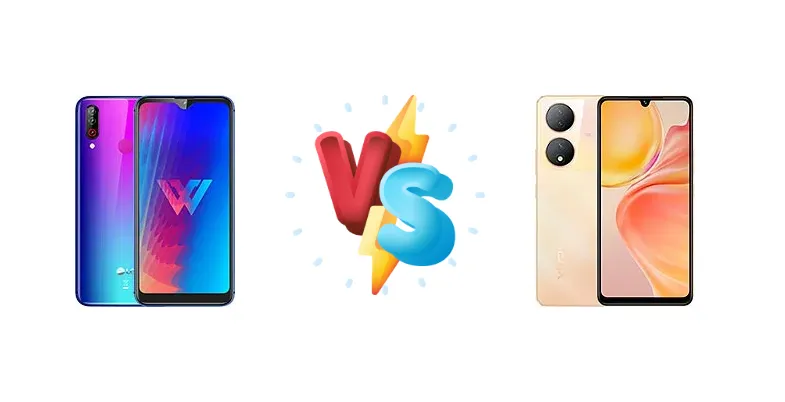
The LG W30 and vivo Y100 represent different approaches to the budget smartphone market. The W30, an older model, aims for affordability, while the Y100 brings a more modern chipset and faster charging to the table. This comparison dissects their key differences to help you determine which device offers the best value.
🏆 Quick Verdict
For most users, the vivo Y100 is the clear winner. Its Mediatek Dimensity 900 chipset delivers significantly faster performance and smoother multitasking compared to the LG W30’s Helio P22. The 44W charging is a substantial convenience, making it ideal for users on the go. While the W30 is cheaper, the Y100’s improvements justify the price premium.
| Network |
|---|
| 2G bands | GSM 850 / 900 / 1800 / 1900 | GSM 850 / 900 / 1800 / 1900 |
| 3G bands | HSDPA 850 / 900 / 2100 | HSDPA 850 / 900 / 2100 |
| 4G bands | 1, 3, 5, 8, 40, 41 | 1, 3, 5, 8, 38, 40, 41 |
| 5G bands | - | 1, 3, 8, 28, 77, 78 SA/NSA |
| Speed | HSPA, LTE | HSPA, LTE, 5G |
| Technology | GSM / HSPA / LTE | GSM / HSPA / LTE / 5G |
| Launch |
|---|
| Announced | 2019, June. Released 2019, July | 2023, February 16 |
| Status | Discontinued | Available. Released 2023, February 16 |
| Body |
|---|
| Build | - | Glass front, glass back |
| Dimensions | 159 x 76.5 x 8.2 mm (6.26 x 3.01 x 0.32 in) | 158.9 x 73.5 x 7.7 mm (6.26 x 2.89 x 0.30 in) |
| SIM | · Nano-SIM· Nano-SIM + Nano-SIM | Nano-SIM + Nano-SIM |
| Weight | 175 g (6.17 oz) | 181 g (6.38 oz) |
| | - | IP54, dust and water resistant
Color changing back panel color |
| Display |
|---|
| Resolution | 720 x 1520 pixels, 19:9 ratio (~269 ppi density) | 1080 x 2400 pixels, 20:9 ratio (~413 ppi density) |
| Size | 6.26 inches, 97.8 cm2 (~80.4% screen-to-body ratio) | 6.38 inches, 98.3 cm2 (~84.1% screen-to-body ratio) |
| Type | IPS LCD | AMOLED, 90Hz, HDR10+, 1300 nits (peak) |
| Platform |
|---|
| CPU | Octa-core 2.0 GHz Cortex-A53 | Octa-core (2x2.4 GHz Cortex-A78 & 6x2.0 GHz Cortex-A55) |
| Chipset | Mediatek MT6762 Helio P22 (12 nm) | Mediatek Dimensity 900 (6 nm) |
| GPU | PowerVR GE8320 | Mali-G68 MC4 |
| OS | Android 9.0 (Pie) | Android 13, Funtouch 13 |
| Memory |
|---|
| Card slot | microSDXC (uses shared SIM slot) | microSDXC (uses shared SIM slot) |
| Internal | 32GB 3GB RAM, 64GB 4GB RAM | 128GB 8GB RAM |
| | eMMC 5.1 | - |
| Main Camera |
|---|
| Features | LED flash, panorama, HDR | LED flash, HDR, panorama |
| Single | - | 16 MP, f/2.0, (wide) |
| Triple | 12 MP, (wide), 1/2.9", 1.25µm, PDAF
13 MP, 18mm (ultrawide)
Auxiliary lens | 64 MP, f/1.8, (wide), 0.7µm, PDAF, OIS
2 MP (macro)
Auxiliary lens |
| Video | 1080p@30fps | 4K@30fps, 1080p@30fps |
| Selfie camera |
|---|
| Single | 16 MP, f/2.2, (wide), 1/3.06", 1.0µm | 16 MP, f/2.0, (wide) |
| Video | - | 1080p@30fps |
| Sound |
|---|
| 3.5mm jack | Yes | Yes |
| 35mm jack | Yes | Yes |
| Loudspeaker | Yes | Yes |
| | - | 24-bit/192kHz audio |
| Comms |
|---|
| Bluetooth | 4.2, A2DP, LE | 5.2, A2DP, LE |
| NFC | No | - |
| Positioning | GPS, GLONASS | GPS, GLONASS, BDS, GALILEO, QZSS |
| Radio | FM radio | No |
| USB | microUSB 2.0, OTG | USB Type-C 2.0, OTG |
| WLAN | Wi-Fi 802.11 b/g/n, Wi-Fi Direct | Wi-Fi 802.11 a/b/g/n/ac, dual-band |
| Features |
|---|
| Sensors | Fingerprint (rear-mounted), accelerometer, gyro, proximity | Fingerprint (under display, optical), accelerometer, gyro, proximity, compass |
| Battery |
|---|
| Charging | - | 44W wired, 60% in 30 min |
| Type | Li-Po 4000 mAh, non-removable | 4500 mAh |
| Misc |
|---|
| Colors | Thunder Blue, Platinum Grey, Aurora Green | Metal Black, Twilight Gold, Pacific Blue |
| Models | LMX440IM, LM-X440IM, LMX440ZM, LM-X440ZM | V2239 |
| Price | About 130 EUR | € 97.26 |
| SAR | 0.82 W/kg (head) 0.32 W/kg (body) | - |
| Tests |
|---|
| Performance |
AnTuTu: 76697 (v7)
GeekBench: 3534 (v4.4)
GFXBench: 4.8fps (ES 3.1 onscreen) | - |
LG W30
- Lower price point
- Potentially longer battery life (if capacity is higher)
- Simple and straightforward user experience
- Significantly slower performance
- Outdated chipset
- Slower charging speeds
vivo Y100
- Much faster performance with Dimensity 900
- 44W fast charging
- More modern chipset and features
- Higher price
- Potentially shorter battery life (depending on capacity)
- May include bloatware
Display Comparison
Neither device's display specifications are provided, so a direct comparison is limited. However, given the W30's age, it likely features a lower resolution and less color accuracy than a modern display. The Y100, benefiting from newer panel technology, likely offers a more vibrant and sharper viewing experience. Bezels on the W30 are expected to be thicker, contributing to a less immersive design.
Camera Comparison
Without detailed camera specifications, a precise comparison is difficult. However, the Y100 likely benefits from a more advanced image signal processor (ISP) integrated within the Dimensity 900 chipset, leading to better image processing and noise reduction. The W30, relying on the Helio P22, will likely struggle in low-light conditions. It's reasonable to assume the Y100 has a more capable main sensor, potentially with features like phase detection autofocus, which the W30 may lack. The prevalence of 2MP macro lenses on budget phones suggests both devices may include one, but their utility is limited.
Performance
The performance gap between these two devices is substantial. The LG W30’s Mediatek Helio P22, built on a 12nm process, utilizes eight Cortex-A53 cores clocked at 2.0 GHz. This is a relatively basic configuration. In contrast, the vivo Y100 boasts a Mediatek Dimensity 900, fabricated on a more efficient 6nm process. Its CPU configuration – two Cortex-A78 cores at 2.4 GHz and six Cortex-A55 cores at 2.0 GHz – provides a significant boost in both single-core and multi-core performance. The A78 cores are architecturally superior to the A53, resulting in faster app loading times, smoother multitasking, and a more responsive overall experience. This translates to a much better experience for gaming and demanding applications.
Battery Life
Battery capacity isn't specified for either device. However, the vivo Y100’s 44W wired charging is a game-changer. The claim of 60% charge in 30 minutes significantly reduces downtime. The LG W30 likely supports a much slower charging rate, potentially taking over two hours to fully charge. Even if the W30 has a slightly larger battery capacity, the Y100’s faster charging offsets this advantage, making it more convenient for users who need a quick power boost.
Buying Guide
Buy the LG W30 if you need a basic smartphone for essential tasks like calls, texts, and light social media use, and your budget is extremely limited. You're prioritizing absolute lowest cost over performance. Buy the vivo Y100 if you prioritize a responsive user experience, enjoy mobile gaming, or frequently find yourself needing to quickly top up your battery. It's the better choice for anyone who wants a phone that can keep up with a modern lifestyle.
Frequently Asked Questions
❓ Is the Mediatek Dimensity 900 in the vivo Y100 capable of handling demanding games like PUBG or Call of Duty?
Yes, the Dimensity 900 is a capable chipset for gaming. Its Cortex-A78 cores provide the processing power needed for smooth gameplay in most popular titles. While it won't match the performance of flagship chipsets, it can comfortably handle PUBG and Call of Duty at medium to high settings.
❓ How long does it realistically take to fully charge the vivo Y100 from 0% with the 44W charger?
While vivo claims 60% in 30 minutes, a full charge from 0% typically takes around 50-60 minutes with the 44W charger. This is still significantly faster than the LG W30, which likely takes over two hours to fully charge.
❓ Does the LG W30 receive software updates and security patches?
Given the LG W30's age, it's unlikely to receive regular software updates or security patches. This poses a security risk and means you'll miss out on new features and improvements.
❓ Is the difference in performance between the Helio P22 and Dimensity 900 noticeable in everyday tasks like browsing and social media?
Absolutely. The Dimensity 900 provides a much smoother and more responsive experience in everyday tasks. App loading times are faster, scrolling is smoother, and multitasking is less laggy. The difference is particularly noticeable when switching between apps.