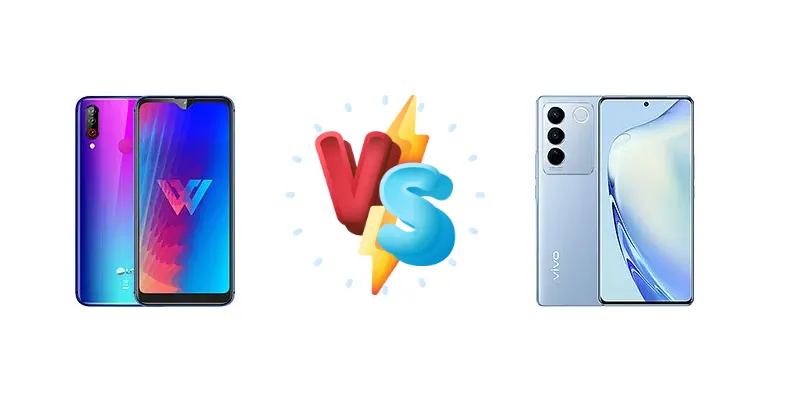
The LG W30 and vivo V27 represent vastly different segments of the smartphone market. The W30, a now older device, focuses on affordability, while the V27 aims to deliver a more modern experience with a powerful chipset and faster charging. This comparison dissects their key differences to help you determine which device best suits your needs and budget.
🏆 Quick Verdict
For the average user prioritizing performance and future-proofing, the vivo V27 is the clear winner. Its Dimensity 7200 chipset provides a substantial upgrade over the LG W30’s Helio P22, enabling smoother multitasking and gaming. However, the W30 remains a functional option for basic tasks at a significantly lower price point.
| Network |
|---|
| 2G bands | GSM 850 / 900 / 1800 / 1900 | GSM 850 / 900 / 1800 / 1900 |
| 3G bands | HSDPA 850 / 900 / 2100 | HSDPA 850 / 900 / 1700(AWS) / 1900 / 2100 - International |
| 4G bands | 1, 3, 5, 8, 40, 41 | 1, 2, 3, 4, 5, 7, 8, 18, 19, 20, 26, 28, 38, 39, 40, 41 - International |
| 5G bands | - | 1, 3, 5, 7, 8, 20, 28, 38, 40, 41, 77, 78 SA/NSA - International |
| Speed | HSPA, LTE | HSPA, LTE, 5G |
| Technology | GSM / HSPA / LTE | GSM / HSPA / LTE / 5G |
| | - | 1, 3, 5, 8, 28, 78 SA/NSA - Asia |
| Launch |
|---|
| Announced | 2019, June. Released 2019, July | 2023, March 01 |
| Status | Discontinued | Available. Released 2023, March 01 |
| Body |
|---|
| Build | - | Glass front, glass back |
| Dimensions | 159 x 76.5 x 8.2 mm (6.26 x 3.01 x 0.32 in) | 164.1 x 74.8 x 7.4 mm (6.46 x 2.94 x 0.29 in) |
| SIM | · Nano-SIM· Nano-SIM + Nano-SIM | Nano-SIM + Nano-SIM |
| Weight | 175 g (6.17 oz) | 180 g (6.35 oz) |
| | - | Color changing back panel color |
| Display |
|---|
| Resolution | 720 x 1520 pixels, 19:9 ratio (~269 ppi density) | 1080 x 2400 pixels, 20:9 ratio (~388 ppi density) |
| Size | 6.26 inches, 97.8 cm2 (~80.4% screen-to-body ratio) | 6.78 inches, 111.0 cm2 (~90.4% screen-to-body ratio) |
| Type | IPS LCD | AMOLED, 1B colors, 120Hz, HDR10+ |
| Platform |
|---|
| CPU | Octa-core 2.0 GHz Cortex-A53 | Octa-core (2x2.8 GHz Cortex-A715 & 6x Cortex-A510) |
| Chipset | Mediatek MT6762 Helio P22 (12 nm) | Mediatek Dimensity 7200 (4 nm) |
| GPU | PowerVR GE8320 | Mali-G610 MC4 |
| OS | Android 9.0 (Pie) | Android 13, Funtouch 13 |
| Memory |
|---|
| Card slot | microSDXC (uses shared SIM slot) | No |
| Internal | 32GB 3GB RAM, 64GB 4GB RAM | 128GB 8GB RAM, 256GB 8GB RAM, 256GB 12GB RAM |
| | eMMC 5.1 | - |
| Main Camera |
|---|
| Features | LED flash, panorama, HDR | Ring-LED flash, panorama, HDR |
| Single | - | 50 MP, f/2.5, (wide), AF |
| Triple | 12 MP, (wide), 1/2.9", 1.25µm, PDAF
13 MP, 18mm (ultrawide)
Auxiliary lens | 50 MP, f/1.9, (wide), 1/1.56", 1.0µm, PDAF, OIS
8 MP, f/2.2, 16mm, 120˚ (ultrawide), 1/4.0", 1.12µm
2 MP (macro) |
| Video | 1080p@30fps | 4K@30/60fps, 1080p@30fps, gyro-EIS |
| Selfie camera |
|---|
| Features | - | Dual-LED flash, HDR |
| Single | 16 MP, f/2.2, (wide), 1/3.06", 1.0µm | 50 MP, f/2.5, (wide), AF |
| Video | - | 4K@30/60fps, 1080p@30fps, gyro-EIS |
| Sound |
|---|
| 3.5mm jack | Yes | No |
| 35mm jack | Yes | No |
| Loudspeaker | Yes | Yes |
| | - | 24-bit/192kHz audio |
| Comms |
|---|
| Bluetooth | 4.2, A2DP, LE | 5.3, A2DP, LE |
| NFC | No | Yes |
| Positioning | GPS, GLONASS | GPS, GLONASS, GALILEO, BDS, QZSS, NavIC |
| Radio | FM radio | No |
| USB | microUSB 2.0, OTG | USB Type-C 2.0, OTG |
| WLAN | Wi-Fi 802.11 b/g/n, Wi-Fi Direct | Wi-Fi 802.11 a/b/g/n/ac, dual-band, Wi-Fi Direct |
| Features |
|---|
| Sensors | Fingerprint (rear-mounted), accelerometer, gyro, proximity | Fingerprint (under display, optical), accelerometer, gyro, proximity, compass |
| Battery |
|---|
| Charging | - | 66W wired, 50% in 19 min |
| Type | Li-Po 4000 mAh, non-removable | 4600 mAh |
| Misc |
|---|
| Colors | Thunder Blue, Platinum Grey, Aurora Green | Magic Blue, Noble Black, Emerald Green, Flowing Gold |
| Models | LMX440IM, LM-X440IM, LMX440ZM, LM-X440ZM | V2231, V2246 |
| Price | About 130 EUR | About 380 EUR |
| SAR | 0.82 W/kg (head) 0.32 W/kg (body) | - |
| Tests |
|---|
| Battery life | - |
Endurance rating 134h
|
| Camera | - |
Photo / Video |
| Display | - |
Contrast ratio: Infinite (nominal) |
| Loudspeaker | - |
-28.2 LUFS (Average)
|
| Performance |
AnTuTu: 76697 (v7)
GeekBench: 3534 (v4.4)
GFXBench: 4.8fps (ES 3.1 onscreen) |
AnTuTu: 613641 (v9)
GeekBench: 2400 (v5.1), 2689 (v6)
GFXBench: 34fps (ES 3.1 onscreen) |
LG W30
- Significantly more affordable
- Functional for basic tasks
- Simple and easy to use
- Outdated processor
- Slow charging
- Poor performance with demanding apps
vivo V27
- Powerful Dimensity 7200 chipset
- Fast 66W charging
- Bright and vibrant display
- Higher price point
- May have bloatware
- Potentially less durable build quality
Display Comparison
The vivo V27 boasts a significantly brighter display, reaching a measured peak brightness of 1055 nits, compared to the LG W30’s unspecified brightness. This difference translates to much better visibility outdoors under direct sunlight. While both devices likely utilize LCD panels (given the W30’s age and the V27’s market positioning), the V27’s higher brightness and infinite (nominal) contrast ratio suggest a more vibrant and engaging viewing experience. Bezels are also likely slimmer on the V27, reflecting more recent design trends.
Camera Comparison
Both devices offer photo and video capabilities, but the specifics are limited for the LG W30. The vivo V27 likely features a more sophisticated camera system, benefiting from advancements in image processing and potentially larger sensor sizes. While details are missing, the V27’s positioning suggests features like optical image stabilization (OIS) are more probable. The LG W30’s camera is likely adequate for basic snapshots, but will fall short in low-light conditions and lack the dynamic range of the V27. We can assume the V27 will offer more versatile shooting modes and better video recording quality.
Performance
The performance gap between these two devices is substantial. The vivo V27’s Mediatek Dimensity 7200, built on a 4nm process, is a modern mid-range powerhouse. Its octa-core configuration, featuring 2x 2.8 GHz Cortex-A715 cores and 6x Cortex-A510 cores, delivers significantly faster processing speeds and improved efficiency compared to the LG W30’s Helio P22. The P22, with its 12nm process and Cortex-A53 cores clocked at 2.0 GHz, struggles with demanding applications. The V27’s more advanced chipset also benefits from improved GPU performance, making it a far better choice for gaming. The V27 likely utilizes faster LPDDR5x RAM, further enhancing responsiveness.
Battery Life
Both phones share an endurance rating of 134 hours, suggesting similar overall battery life despite the V27’s more powerful processor. This is likely due to optimizations in the V27’s software and the efficiency gains from the 4nm Dimensity 7200. However, the V27’s 66W wired charging is a game-changer, allowing it to reach 50% charge in just 19 minutes. The LG W30’s charging speed is likely significantly slower, making the V27 a much more convenient option for users who need to quickly top up their battery.
Buying Guide
Buy the LG W30 if you need a very affordable smartphone for essential tasks like calls, texts, and light social media use, and aren't concerned with demanding applications or long-term software support. Buy the vivo V27 if you prioritize a responsive user experience, faster charging, and the ability to handle more intensive tasks like gaming and video editing, and are willing to invest more upfront.
Frequently Asked Questions
❓ Is the performance difference between the Helio P22 and Dimensity 7200 noticeable in everyday use?
Absolutely. The Dimensity 7200 is a generation ahead in terms of processing power and efficiency. You'll experience significantly faster app loading times, smoother multitasking, and a more responsive user interface on the vivo V27. The LG W30 will struggle with demanding apps and may exhibit noticeable lag.
❓ How does the fast charging on the vivo V27 impact its usability compared to the LG W30?
The V27’s 66W charging is a major convenience factor. Reaching 50% charge in 19 minutes means you can quickly top up your battery during short breaks. The LG W30’s slower charging will require significantly more time to achieve a similar charge level, potentially causing inconvenience for users on the go.
❓ Given the LG W30 is an older model, what are the concerns regarding software updates and security patches?
The LG W30 is likely nearing the end of its software support lifecycle. This means it may no longer receive critical security updates, making it more vulnerable to threats. The vivo V27, being a newer device, will benefit from a longer period of software support and security patches.