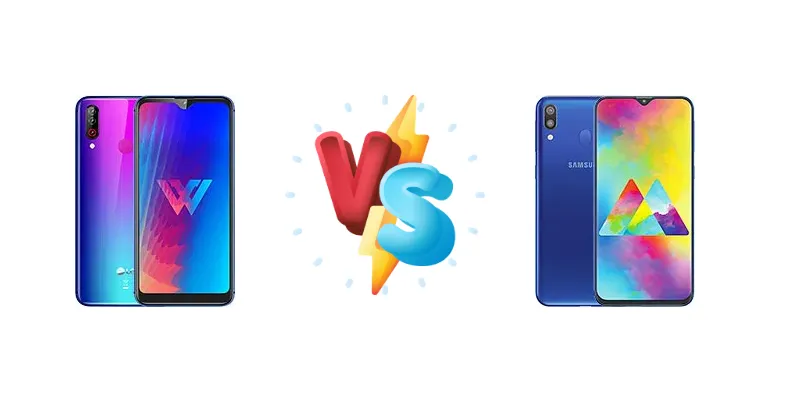
The Samsung Galaxy M20 and LG W30 represent a critical segment of the smartphone market: affordable devices aiming to deliver essential features without breaking the bank. Both phones launched targeting price-sensitive consumers, but they take different approaches to achieving that goal. This comparison dives deep into their specifications to determine which offers the best value.
🏆 Quick Verdict
For most users, the Samsung Galaxy M20 emerges as the stronger choice. Its Exynos 7904 chipset provides a noticeable performance advantage over the LG W30’s Helio P22, making it better suited for multitasking and gaming. While both boast similar battery endurance, the M20’s 15W charging offers a faster top-up.
| Network |
|---|
| 2G bands | GSM 850 / 900 / 1800 / 1900 | GSM 850 / 900 / 1800 / 1900 |
| 3G bands | HSDPA 850 / 900 / 2100 | HSDPA 850 / 900 / 1900 / 2100 |
| 4G bands | 1, 3, 5, 8, 40, 41 | 1, 3, 5, 7, 8, 20, 38, 40, 41 |
| Speed | HSPA, LTE | HSPA 42.2/5.76 Mbps, LTE (2CA) Cat12 600/50 Mbps |
| Technology | GSM / HSPA / LTE | GSM / HSPA / LTE |
| Launch |
|---|
| Announced | 2019, June. Released 2019, July | 2019, January 28. Released 2019, February |
| Status | Discontinued | Discontinued |
| Body |
|---|
| Build | - | Glass front, plastic back, plastic frame |
| Dimensions | 159 x 76.5 x 8.2 mm (6.26 x 3.01 x 0.32 in) | 156.4 x 74.5 x 8.8 mm (6.16 x 2.93 x 0.35 in) |
| SIM | · Nano-SIM· Nano-SIM + Nano-SIM | Nano-SIM + Nano-SIM |
| Weight | 175 g (6.17 oz) | 186 g (6.56 oz) |
| Display |
|---|
| Resolution | 720 x 1520 pixels, 19:9 ratio (~269 ppi density) | 1080 x 2340 pixels, 19.5:9 ratio (~409 ppi density) |
| Size | 6.26 inches, 97.8 cm2 (~80.4% screen-to-body ratio) | 6.3 inches, 97.4 cm2 (~83.6% screen-to-body ratio) |
| Type | IPS LCD | PLS LCD |
| Platform |
|---|
| CPU | Octa-core 2.0 GHz Cortex-A53 | Octa-core (2x1.8 GHz Cortex-A73 & 6x1.6 GHz Cortex-A53) |
| Chipset | Mediatek MT6762 Helio P22 (12 nm) | Exynos 7904 (14 nm) |
| GPU | PowerVR GE8320 | Mali-G71 MP2 |
| OS | Android 9.0 (Pie) | Android 8.1 (Oreo), upgradable to Android 10, One UI 2 |
| Memory |
|---|
| Card slot | microSDXC (uses shared SIM slot) | microSDXC (dedicated slot) |
| Internal | 32GB 3GB RAM, 64GB 4GB RAM | 32GB 3GB RAM, 64GB 4GB RAM |
| | eMMC 5.1 | - |
| Main Camera |
|---|
| Dual | - | 13 MP, f/1.9, 1/3.1", 1.12µm, PDAF
5 MP, f/2.2, 12mm (ultrawide) |
| Features | LED flash, panorama, HDR | LED flash, panorama, HDR |
| Triple | 12 MP, (wide), 1/2.9", 1.25µm, PDAF
13 MP, 18mm (ultrawide)
Auxiliary lens | - |
| Video | 1080p@30fps | 1080p@30fps |
| Selfie camera |
|---|
| Features | - | HDR |
| Single | 16 MP, f/2.2, (wide), 1/3.06", 1.0µm | 8 MP, f/2.0, 25mm (wide) |
| Video | - | 1080p@30fps |
| Sound |
|---|
| 3.5mm jack | Yes | Yes |
| 35mm jack | Yes | Yes |
| Loudspeaker | Yes | Yes |
| Comms |
|---|
| Bluetooth | 4.2, A2DP, LE | 5.0, A2DP, LE |
| NFC | No | Yes (market/region dependent) |
| Positioning | GPS, GLONASS | GPS, GLONASS, BDS |
| Radio | FM radio | FM radio, RDS, recording |
| USB | microUSB 2.0, OTG | USB Type-C 2.0 |
| WLAN | Wi-Fi 802.11 b/g/n, Wi-Fi Direct | Wi-Fi 802.11 b/g/n, Wi-Fi Direct |
| Features |
|---|
| Sensors | Fingerprint (rear-mounted), accelerometer, gyro, proximity | Fingerprint (rear-mounted), accelerometer, gyro, proximity, compass |
| Battery |
|---|
| Charging | - | 15W wired |
| Type | Li-Po 4000 mAh, non-removable | Li-Po 5000 mAh, non-removable |
| Misc |
|---|
| Colors | Thunder Blue, Platinum Grey, Aurora Green | Ocean Blue, Charcoal Black |
| Models | LMX440IM, LM-X440IM, LMX440ZM, LM-X440ZM | SM-M205F, SM-M205FN, SM-M205G, SM-M205M, SM-M205N |
| Price | About 130 EUR | About 400 EUR |
| SAR | 0.82 W/kg (head) 0.32 W/kg (body) | - |
| SAR EU | - | 0.25 W/kg (head) 1.59 W/kg (body) |
| Tests |
|---|
| Audio quality | - |
Noise -90.5dB / Crosstalk -91.7dB |
| Battery life | - | Endurance rating 103h |
| Camera | - |
Photo / Video |
| Display | - |
Contrast ratio: 1333:1 (nominal), 2.960 (sunlight) |
| Loudspeaker | - |
Voice 67dB / Noise 66dB / Ring 68dB |
| Performance |
AnTuTu: 76697 (v7)
GeekBench: 3534 (v4.4)
GFXBench: 4.8fps (ES 3.1 onscreen) |
AnTuTu: 108658 (v7)
GeekBench: 4160 (v4.4)
GFXBench: 4.4fps (ES 3.1 onscreen) |
LG W30
- Potentially simpler software experience
- Similar battery endurance to the M20
- May be available at a slightly lower price point
- Significantly weaker processor performance
- Slower charging speeds (unspecified)
- Likely less refined camera performance
Samsung Galaxy M20
- More powerful Exynos 7904 chipset
- Faster 15W charging
- Potentially better camera image processing
- May be slightly more expensive than the W30
- Similar battery endurance to the W30 despite faster charging
- Software experience can be more feature-rich, potentially leading to bloatware
Display Comparison
Both the LG W30 and Samsung Galaxy M20 share a similar display contrast ratio of 1333:1 (nominal) and 2.960 (sunlight), suggesting comparable visibility in bright conditions. However, detailed panel specifications like peak brightness (in nits) and color gamut coverage are missing. Given Samsung’s history with display technology, it’s reasonable to assume the M20’s panel may offer slightly more accurate color reproduction, but without concrete data, this remains speculative. Bezels are likely similar, typical of phones in this price bracket.
Camera Comparison
Both devices are listed as having 'Photo / Video' capabilities, but specific details are absent. Without sensor size, aperture, or image processing details, a direct comparison is difficult. It’s likely both phones feature a primary camera paired with depth or macro sensors, but the quality will heavily depend on the main sensor’s resolution and the software algorithms employed. Given Samsung’s generally stronger image processing, the M20 likely produces more refined images, but this is an assumption based on brand reputation.
Performance
The core difference lies in the chipsets. The Samsung Galaxy M20’s Exynos 7904, fabricated on a 14nm process, features a heterogeneous core configuration with two Cortex-A73 cores clocked at 1.8 GHz and six Cortex-A53 cores at 1.6 GHz. This architecture provides a substantial performance uplift compared to the LG W30’s MediaTek Helio P22. The Helio P22 utilizes eight Cortex-A53 cores clocked at 2.0 GHz, but the older architecture and 12nm process result in lower single-core and multi-core performance. This translates to snappier app launches, smoother multitasking, and a more enjoyable gaming experience on the M20. The Exynos 7904’s GPU will also handle graphics-intensive tasks more effectively.
Battery Life
Both the LG W30 and Samsung Galaxy M20 achieve an endurance rating of 103 hours, indicating similar battery life under typical usage. However, the Samsung Galaxy M20 supports 15W wired charging, while the LG W30’s charging speed is unspecified. This faster charging capability on the M20 significantly reduces the time required to replenish the battery, offering a more convenient user experience. While both will likely last a full day for average users, the M20’s charging advantage is a key differentiator.
Buying Guide
Buy the LG W30 if you prioritize a simple, straightforward user experience and are primarily focused on basic tasks like calling, texting, and light social media use. Its lower processing power is sufficient for these needs. Buy the Samsung Galaxy M20 if you want a phone capable of handling more demanding applications, enjoy occasional gaming, or appreciate faster charging speeds. The Exynos 7904 offers a significant performance boost for a minimal price increase.
Frequently Asked Questions
❓ Does the Exynos 7904 in the Galaxy M20 get hot during extended gaming sessions?
The Exynos 7904 is a relatively efficient chip, but it can experience thermal throttling during prolonged, demanding gaming. However, the throttling is generally manageable and doesn't lead to complete performance collapse. The 14nm process isn't the most advanced, but it's adequate for the phone's intended use case.
❓ Is the 2MP depth sensor on either phone actually useful for portrait mode photos?
While a dedicated depth sensor can assist in creating a bokeh effect for portrait photos, the quality heavily depends on the software implementation. On these budget devices, the 2MP sensors are often limited in their accuracy and can produce artificial-looking results. Expect passable portrait mode performance, but don't expect DSLR-level quality.
❓ Can the Samsung Galaxy M20 handle popular games like PUBG Mobile at reasonable frame rates?
The Exynos 7904 in the Galaxy M20 can run PUBG Mobile, but you'll likely need to lower the graphics settings to medium or low to achieve consistently smooth frame rates. Expect playable performance around 30-40 FPS. The LG W30’s Helio P22 will struggle to maintain stable frame rates even on the lowest settings.
❓ What type of charging port do both phones use?
Both the Samsung Galaxy M20 and LG W30 utilize a micro-USB port for charging and data transfer. This is common for phones in this price range, but it's slower and less convenient than the USB-C port found on more modern devices.