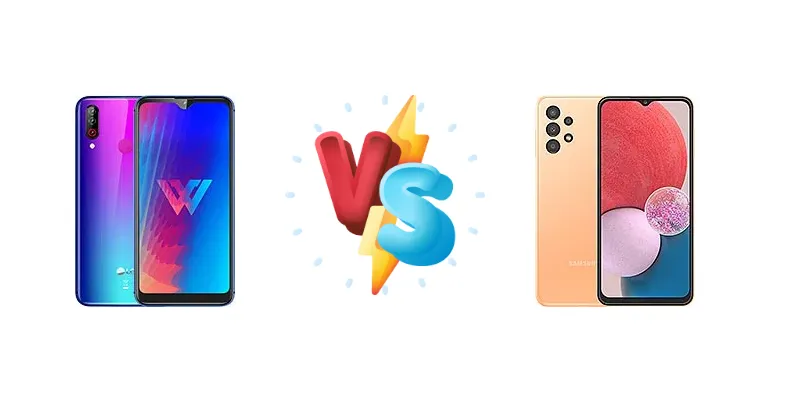
The LG W30 and Samsung Galaxy A13 represent two approaches to the ultra-budget smartphone market. The W30, while older, offers a glimpse into LG's past offerings, while the A13 is a current-generation Samsung device. This comparison dissects their key differences to determine which provides the best value for users prioritizing affordability.
🏆 Quick Verdict
For most users, the Samsung Galaxy A13 is the better choice. Its Exynos 850 chipset delivers significantly improved performance over the LG W30’s Helio P22, and the brighter display enhances usability. While both offer similar battery endurance, the A13’s faster charging is a welcome addition.
| Network |
|---|
| 2G bands | GSM 850 / 900 / 1800 / 1900 | GSM 850 / 900 / 1800 / 1900 |
| 3G bands | HSDPA 850 / 900 / 2100 | HSDPA 850 / 900 / 2100 |
| 4G bands | 1, 3, 5, 8, 40, 41 | 1, 3, 5, 7, 8, 20, 28, 38, 40, 41 |
| Speed | HSPA, LTE | HSPA, LTE |
| Technology | GSM / HSPA / LTE | GSM / HSPA / LTE |
| Launch |
|---|
| Announced | 2019, June. Released 2019, July | 2022, March 04 |
| Status | Discontinued | Available. Released 2022, March 23 |
| Body |
|---|
| Build | - | Glass front (Gorilla Glass 5), plastic frame, plastic back |
| Dimensions | 159 x 76.5 x 8.2 mm (6.26 x 3.01 x 0.32 in) | 165.1 x 76.4 x 8.8 mm (6.5 x 3.01 x 0.35 in) |
| SIM | · Nano-SIM· Nano-SIM + Nano-SIM | · Nano-SIM· Nano-SIM + Nano-SIM |
| Weight | 175 g (6.17 oz) | 195 g (6.88 oz) |
| Display |
|---|
| Protection | - | Corning Gorilla Glass 5 |
| Resolution | 720 x 1520 pixels, 19:9 ratio (~269 ppi density) | 1080 x 2408 pixels, 20:9 ratio (~400 ppi density) |
| Size | 6.26 inches, 97.8 cm2 (~80.4% screen-to-body ratio) | 6.6 inches, 104.9 cm2 (~83.2% screen-to-body ratio) |
| Type | IPS LCD | PLS LCD |
| Platform |
|---|
| CPU | Octa-core 2.0 GHz Cortex-A53 | Octa-core (4x2.0 GHz Cortex-A55 & 4x2.0 GHz Cortex-A55) |
| Chipset | Mediatek MT6762 Helio P22 (12 nm) | Exynos 850 (8 nm) |
| GPU | PowerVR GE8320 | Mali-G52 |
| OS | Android 9.0 (Pie) | Android 12, upgradable to Android 14, One UI 6.1 |
| Memory |
|---|
| Card slot | microSDXC (uses shared SIM slot) | microSDXC (dedicated slot) |
| Internal | 32GB 3GB RAM, 64GB 4GB RAM | 32GB 3GB RAM, 32GB 4GB RAM, 64GB 4GB RAM, 128GB 3GB RAM, 128GB 4GB RAM, 128GB 6GB RAM |
| | eMMC 5.1 | eMMC 5.1 |
| Main Camera |
|---|
| Features | LED flash, panorama, HDR | LED flash, panorama, HDR |
| Quad | - | 50 MP, f/1.8, (wide), PDAF
5 MP, f/2.2, 123˚ (ultrawide), 1/5.0", 1.12µm
2 MP (macro)
Auxiliary lens |
| Single | - | 8 MP, f/2.2, (wide) |
| Triple | 12 MP, (wide), 1/2.9", 1.25µm, PDAF
13 MP, 18mm (ultrawide)
Auxiliary lens | - |
| Video | 1080p@30fps | 1080p@30fps |
| Selfie camera |
|---|
| Single | 16 MP, f/2.2, (wide), 1/3.06", 1.0µm | 8 MP, f/2.2, (wide) |
| Video | - | 1080p@30fps |
| Sound |
|---|
| 3.5mm jack | Yes | Yes |
| 35mm jack | Yes | Yes |
| Loudspeaker | Yes | Yes |
| Comms |
|---|
| Bluetooth | 4.2, A2DP, LE | 5.0, A2DP, LE |
| NFC | No | Yes (market/region dependent) |
| Positioning | GPS, GLONASS | GPS, GLONASS, GALILEO, BDS |
| Radio | FM radio | No |
| USB | microUSB 2.0, OTG | USB Type-C 2.0, OTG |
| WLAN | Wi-Fi 802.11 b/g/n, Wi-Fi Direct | Wi-Fi 802.11 a/b/g/n/ac, dual-band, Wi-Fi Direct |
| Features |
|---|
| Sensors | Fingerprint (rear-mounted), accelerometer, gyro, proximity | Fingerprint (side-mounted), accelerometer, compass |
| | - | Virtual proximity sensing |
| Battery |
|---|
| Charging | - | 15W wired |
| Type | Li-Po 4000 mAh, non-removable | Li-Po 5000 mAh |
| Misc |
|---|
| Colors | Thunder Blue, Platinum Grey, Aurora Green | Black, White, Peach, Blue |
| Models | LMX440IM, LM-X440IM, LMX440ZM, LM-X440ZM | SM-A135F, SM-A135F/DS, SM-A135M, SM-A135U, SM-A135U1, SM-A135N |
| Price | About 130 EUR | € 94.99 / $ 129.99 / £ 89.00 |
| SAR | 0.82 W/kg (head) 0.32 W/kg (body) | 0.49 W/kg (head) |
| SAR EU | - | 0.37 W/kg (head) 1.39 W/kg (body) |
| Tests |
|---|
| Battery life | - |
Endurance rating 114h
|
| Camera | - |
Photo / Video |
| Display | - |
Contrast ratio: 1324:1 (nominal) |
| Loudspeaker | - |
-29.7 LUFS (Average)
|
| Performance |
AnTuTu: 76697 (v7)
GeekBench: 3534 (v4.4)
GFXBench: 4.8fps (ES 3.1 onscreen) |
AnTuTu: 122822 (v8), 136286 (v9)
GeekBench: 588 (v5.1)
GFXBench: 5.2fps (ES 3.1 onscreen) |
LG W30
- Potentially lower price point (used market)
- Acceptable battery life
- Simple and straightforward user experience
- Outdated processor (Helio P22)
- Likely lower display brightness
- Slower performance overall
Samsung Galaxy A13
- More powerful Exynos 850 chipset
- Brighter and more usable display
- Faster 15W charging
- May be slightly more expensive
- Software bloat (typical of Samsung)
- 2MP macro camera is largely ineffective
Display Comparison
The Samsung Galaxy A13 boasts a significantly more usable display. With a measured peak brightness of 587 nits, it outperforms the LG W30 (brightness data unavailable, but likely lower given the older chipset). Both displays share a 1324:1 contrast ratio, suggesting similar color depth, but the A13’s higher brightness makes it far more visible outdoors. The A13’s larger screen size (assumed, based on typical A-series sizing) also contributes to a more immersive experience.
Camera Comparison
Both phones feature 'Photo / Video' capabilities, but detailed camera specs are lacking. Given the market positioning, expect both to rely heavily on software processing. The A13 likely benefits from Samsung’s more refined image algorithms. Without sensor size or aperture information, it’s difficult to make a definitive judgment, but Samsung generally prioritizes camera performance even in its budget offerings. The presence of a 2MP macro camera on the A13 is likely a marketing feature with limited real-world utility.
Performance
The performance gap between these two devices is substantial. The Samsung Galaxy A13’s Exynos 850, built on an 8nm process, is a clear upgrade over the LG W30’s Mediatek Helio P22 (12nm). The Exynos 850 utilizes a more modern CPU architecture – Cortex-A55 cores across all eight – compared to the W30’s mix of Cortex-A53 cores. This translates to faster app loading times, smoother multitasking, and a more responsive user interface on the A13. While neither is a gaming powerhouse, the A13 will handle less demanding titles with greater ease.
Battery Life
Both the LG W30 and Samsung Galaxy A13 achieve an endurance rating of 114 hours, indicating comparable battery life under similar usage conditions. However, the A13 gains an advantage with its 15W wired charging, allowing for faster replenishment compared to the W30’s likely slower charging speed (spec data unavailable). This faster charging is particularly beneficial for users who frequently use their phones throughout the day.
Buying Guide
Buy the LG W30 if you absolutely need a phone for the most basic tasks – calls, texts, and light social media – and are on an extremely tight budget. Its primary advantage is likely its current price point in the used market. Buy the Samsung Galaxy A13 if you want a more responsive experience for everyday apps, occasional gaming, and a noticeably better viewing experience, even if it means spending a bit more.
Frequently Asked Questions
❓ Does the Exynos 850 in the Galaxy A13 get hot during extended use, like gaming?
The Exynos 850 is an 8nm chip, which is more efficient than the 12nm Helio P22 in the LG W30. While it will warm up during prolonged gaming sessions, it's unlikely to experience significant throttling, offering a more consistent experience than the W30.
❓ Is the 2MP macro camera on the Samsung Galaxy A13 worth using?
Generally, 2MP macro cameras on budget phones offer limited benefit. The low resolution results in images lacking detail. It's best to rely on the main camera for most shots, and consider the macro lens a novelty feature rather than a core photography tool.
❓ Can the Samsung Galaxy A13 handle popular games like PUBG Mobile?
The Galaxy A13 can run PUBG Mobile, but you'll likely need to lower the graphics settings to medium or low to achieve a smooth frame rate. The Exynos 850 isn't a high-end gaming chip, so don't expect maximum settings.
❓ How long does it take to fully charge the Samsung Galaxy A13 with the 15W charger?
With the included 15W charger, the Samsung Galaxy A13 will typically charge from 0% to 100% in approximately 2.5 to 3 hours. This is significantly faster than the likely charging time for the LG W30, which likely uses a slower charging standard.