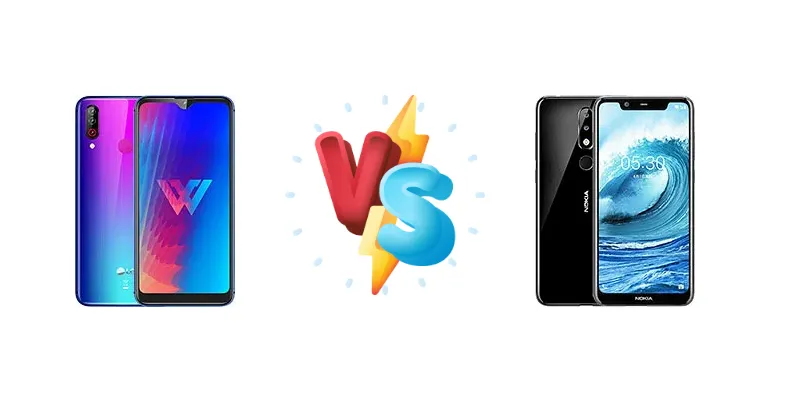
The LG W30 and Nokia 5.1 Plus (also known as the Nokia X5) represent a common battleground in the budget smartphone space. Both devices aim to deliver a functional experience without breaking the bank, but they take different approaches to achieving this. The key differentiator lies in their chipsets: the Mediatek Helio P22 in the LG W30 versus the more powerful Helio P60 in the Nokia 5.1 Plus. This comparison will dissect these differences and determine which phone offers the best value.
🏆 Quick Verdict
For the average user prioritizing responsiveness and multitasking, the Nokia 5.1 Plus (X5) is the clear winner. Its Helio P60 chipset, featuring Cortex-A73 cores, provides a noticeable performance boost over the LG W30’s Helio P22. While the LG W30 may offer slightly better battery life due to its less powerful processor, the Nokia’s overall experience is smoother and more capable.
| Network |
|---|
| 2G bands | GSM 850 / 900 / 1800 / 1900 | GSM 850 / 900 / 1800 / 1900 |
| 3G bands | HSDPA 850 / 900 / 2100 | HSDPA 850 / 900 / 1900 / 2100 |
| 4G bands | 1, 3, 5, 8, 40, 41 | 1, 2, 3, 4, 5, 7, 8, 12, 13, 17, 28, 38, 40, 66 - USA |
| Speed | HSPA, LTE | HSPA 42.2/5.76 Mbps, LTE Cat4 150/50 Mbps |
| Technology | GSM / HSPA / LTE | GSM / CDMA / HSPA / LTE |
| | - | 1, 3, 5, 8, 40, 41 - India |
| Launch |
|---|
| Announced | 2019, June. Released 2019, July | 2018, July 18. Released 2018, December 05 |
| Status | Discontinued | Discontinued |
| Body |
|---|
| Build | - | Glass front, glass back, plastic frame |
| Dimensions | 159 x 76.5 x 8.2 mm (6.26 x 3.01 x 0.32 in) | 149.5 x 72 x 8.1 mm (5.89 x 2.83 x 0.32 in) |
| SIM | · Nano-SIM· Nano-SIM + Nano-SIM | Nano-SIM + Nano-SIM |
| Weight | 175 g (6.17 oz) | 160 g (5.64 oz) |
| Display |
|---|
| Resolution | 720 x 1520 pixels, 19:9 ratio (~269 ppi density) | 720 x 1520 pixels, 19:9 ratio (~287 ppi density) |
| Size | 6.26 inches, 97.8 cm2 (~80.4% screen-to-body ratio) | 5.86 inches, 85.7 cm2 (~79.6% screen-to-body ratio) |
| Type | IPS LCD | IPS LCD |
| Platform |
|---|
| CPU | Octa-core 2.0 GHz Cortex-A53 | Octa-core (4x1.8 GHz Cortex-A73 & 4x1.8 GHz Cortex-A53) - GlobalOcta-core (4x2.0 GHz Cortex-A73 & 4x2.0 GHz Cortex-A53) - China |
| Chipset | Mediatek MT6762 Helio P22 (12 nm) | Mediatek MT6771 Helio P60 (12 nm) |
| GPU | PowerVR GE8320 | Mali-G72 MP3 |
| OS | Android 9.0 (Pie) | Android 8.1 (Oreo), upgradable to Android 10, Android One |
| Memory |
|---|
| Card slot | microSDXC (uses shared SIM slot) | microSDXC (uses shared SIM slot) |
| Internal | 32GB 3GB RAM, 64GB 4GB RAM | 32GB 3GB RAM, 64GB 4GB RAM, 64GB 6GB RAM |
| | eMMC 5.1 | eMMC 5.1 |
| Main Camera |
|---|
| Dual | - | 13 MP, f/2.0, PDAF
Auxiliary lens |
| Features | LED flash, panorama, HDR | LED flash, HDR, panorama |
| Triple | 12 MP, (wide), 1/2.9", 1.25µm, PDAF
13 MP, 18mm (ultrawide)
Auxiliary lens | - |
| Video | 1080p@30fps | 1080p@30fps |
| Selfie camera |
|---|
| Single | 16 MP, f/2.2, (wide), 1/3.06", 1.0µm | 8 MP, f/2.2, 26mm (wide) |
| Video | - | 1080p@30fps |
| Sound |
|---|
| 3.5mm jack | Yes | Yes |
| 35mm jack | Yes | Yes |
| Loudspeaker | Yes | Yes |
| Comms |
|---|
| Bluetooth | 4.2, A2DP, LE | 4.2, A2DP, LE |
| NFC | No | No |
| Positioning | GPS, GLONASS | GPS, GLONASS, BDS, GALILEO |
| Radio | FM radio | FM radio |
| USB | microUSB 2.0, OTG | USB Type-C 2.0, OTG |
| WLAN | Wi-Fi 802.11 b/g/n, Wi-Fi Direct | Wi-Fi 802.11 a/b/g/n/ac, dual-band, Wi-Fi Direct |
| Features |
|---|
| Sensors | Fingerprint (rear-mounted), accelerometer, gyro, proximity | Fingerprint (rear-mounted), accelerometer, gyro, proximity, compass |
| Battery |
|---|
| Type | Li-Po 4000 mAh, non-removable | Li-Ion 3060 mAh, non-removable |
| Misc |
|---|
| Colors | Thunder Blue, Platinum Grey, Aurora Green | Night black, Glacier white, Baltic sea blue |
| Models | LMX440IM, LM-X440IM, LMX440ZM, LM-X440ZM | TA-1120, TA-1105, TA-1102 |
| Price | About 130 EUR | About 190 EUR |
| SAR | 0.82 W/kg (head) 0.32 W/kg (body) | 1.10 W/kg (head) |
| SAR EU | - | 0.78 W/kg (head) 1.89 W/kg (body) |
| Tests |
|---|
| Performance |
AnTuTu: 76697 (v7)
GeekBench: 3534 (v4.4)
GFXBench: 4.8fps (ES 3.1 onscreen) |
AnTuTu: 119428 (v7)
GFXBench: 7.4fps (ES 3.1 onscreen) |
LG W30
- Potentially longer battery life due to less powerful chipset.
- More affordable price point (likely).
- Simple and straightforward user experience.
- Significantly slower performance compared to the Nokia 5.1 Plus.
- Less responsive user interface.
- Limited multitasking capabilities.
Nokia 5.1 Plus (Nokia X5)
- Superior performance thanks to the Helio P60 chipset.
- Smoother multitasking and app loading times.
- Enhanced image processing capabilities.
- More enjoyable gaming experience.
- Potentially shorter battery life compared to the LG W30.
- May be slightly more expensive.
Display Comparison
Neither device boasts a particularly standout display. Both utilize standard LCD panels, and detailed specifications like resolution and brightness are not provided. However, the focus should be on the chipset's ability to drive the display smoothly. The Nokia 5.1 Plus’s more powerful GPU within the Helio P60 will likely result in slightly smoother animations and a more responsive touch experience, even if the panels themselves are comparable.
Camera Comparison
Without detailed sensor information, a direct camera comparison is difficult. However, the Helio P60 in the Nokia 5.1 Plus includes a dedicated image signal processor (ISP) that offers enhanced image processing capabilities compared to the Helio P22. This means the Nokia 5.1 Plus is likely to produce images with better dynamic range, color accuracy, and noise reduction, particularly in challenging lighting conditions. The ISP also supports features like dual-camera bokeh effects and AI scene detection, further enhancing the photographic experience.
Performance
This is where the Nokia 5.1 Plus truly shines. The LG W30’s Mediatek MT6762 Helio P22 features an octa-core configuration of Cortex-A53 cores clocked at 2.0 GHz. In contrast, the Nokia 5.1 Plus (and X5 variant for China) utilizes the Mediatek MT6771 Helio P60, which employs a more sophisticated big.LITTLE architecture with four Cortex-A73 cores clocked at 1.8 GHz (Global) or 2.0 GHz (China) alongside four Cortex-A53 cores. The A73 cores are significantly more powerful than the A53 cores, resulting in a substantial performance uplift in CPU-intensive tasks and gaming. This translates to faster app loading times, smoother multitasking, and a more enjoyable overall user experience on the Nokia 5.1 Plus.
Battery Life
Both devices utilize a 12nm process, which contributes to improved power efficiency. However, the LG W30, with its less demanding Helio P22 chipset, will likely exhibit slightly longer battery life under similar usage scenarios. The Nokia 5.1 Plus’s more powerful processor will consume more power, but the difference is unlikely to be dramatic. Charging wattage is not specified for either device, so a direct comparison of charging speeds is impossible. Real-world battery performance will depend heavily on individual usage patterns.
Buying Guide
Buy the LG W30 if you prioritize absolute simplicity and extended battery life for basic tasks like calls, messaging, and light social media use. You'll appreciate its affordability and straightforward operation. Buy the Nokia 5.1 Plus (Nokia X5) if you value a more responsive user experience, enjoy occasional gaming, or frequently multitask between apps. The Helio P60 chipset delivers a significant performance advantage, making it a better choice for power users on a budget.
Frequently Asked Questions
❓ Will the Nokia 5.1 Plus handle demanding games like PUBG Mobile smoothly?
The Helio P60 in the Nokia 5.1 Plus is capable of running PUBG Mobile, but you'll likely need to use medium graphics settings for a consistently smooth experience. The Cortex-A73 cores provide a significant advantage over the LG W30’s Helio P22, which would struggle with even lower settings.
❓ Is the difference in performance between the Helio P60 and Helio P22 noticeable in everyday tasks?
Yes, the difference is quite noticeable. Simple tasks like browsing the web, checking email, and using social media will feel snappier and more responsive on the Nokia 5.1 Plus. The Helio P60’s more powerful cores and efficient architecture make a significant difference in overall user experience.
❓ Does the Nokia 5.1 Plus (X5) support fast charging?
Unfortunately, neither the provided specifications nor readily available marketing materials detail fast charging support for the Nokia 5.1 Plus (X5). Expect standard 5W or 10W charging speeds.