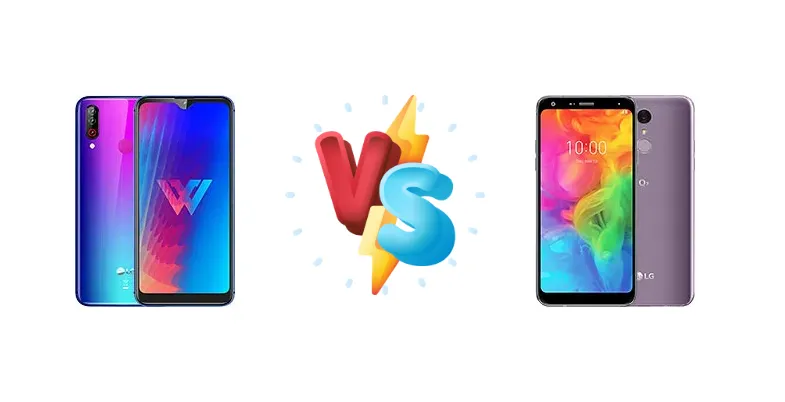
The LG W30 and LG Q7 represent LG's attempts to capture the competitive budget smartphone market. While both aim for affordability, they diverge significantly in their internal hardware, particularly in their chipsets. This comparison dissects these differences to determine which device offers the best balance of performance, efficiency, and value for the price-conscious consumer.
🏆 Quick Verdict
For most users, the LG W30 emerges as the better choice. Its newer Mediatek Helio P22 chipset, built on a 12nm process, offers a more efficient architecture than the older 28nm Mediatek MT6750S found in the LG Q7, translating to better sustained performance and potentially improved battery life.
| Network |
|---|
| 2G bands | GSM 850 / 900 / 1800 / 1900 | GSM 850 / 900 / 1800 / 1900 |
| 3G bands | HSDPA 850 / 900 / 2100 | HSDPA 850 / 900 / 1900 / 2100 |
| 4G bands | 1, 3, 5, 8, 40, 41 | 1, 3, 5, 7, 8, 28, 38, 40, 41 |
| Speed | HSPA, LTE | HSPA 42.2/5.76 Mbps, LTE (2CA) Cat6 300/50 Mbps |
| Technology | GSM / HSPA / LTE | GSM / HSPA / LTE |
| Launch |
|---|
| Announced | 2019, June. Released 2019, July | 2018, May. Released 2018, June |
| Status | Discontinued | Discontinued |
| Body |
|---|
| Dimensions | 159 x 76.5 x 8.2 mm (6.26 x 3.01 x 0.32 in) | 143.8 x 69.3 x 8.4 mm (5.66 x 2.73 x 0.33 in) |
| SIM | · Nano-SIM· Nano-SIM + Nano-SIM | · Nano-SIM· Nano-SIM + Nano-SIM |
| Weight | 175 g (6.17 oz) | 145 g (5.11 oz) |
| | - | IP68 dust/water resistant (up to 1.5m for 30 mins)
MIL-STD-810G compliant*
*does not guarantee ruggedness or use in extreme conditions |
| Display |
|---|
| Resolution | 720 x 1520 pixels, 19:9 ratio (~269 ppi density) | 1080 x 2160 pixels, 18:9 ratio (~442 ppi density) |
| Size | 6.26 inches, 97.8 cm2 (~80.4% screen-to-body ratio) | 5.5 inches, 77.0 cm2 (~77.3% screen-to-body ratio) |
| Type | IPS LCD | IPS LCD |
| Platform |
|---|
| CPU | Octa-core 2.0 GHz Cortex-A53 | Octa-core (4x1.5 GHz Cortex-A53 & 4x1.0 GHz Cortex-A53) - Q7, Q7αOcta-core 1.8 GHz Cortex-A53 - Q7+ |
| Chipset | Mediatek MT6762 Helio P22 (12 nm) | Mediatek MT6750S (28 nm) - Q7, Q7αQualcomm SDM450 Snapdragon 450 (14 nm) - Q7+ |
| GPU | PowerVR GE8320 | Mali-T860MP2 - Q7, Q7αAdreno 506 - Q7+ |
| OS | Android 9.0 (Pie) | Android 8.1 (Oreo), upgradable to Android 9.0 (Pie) |
| Memory |
|---|
| Card slot | microSDXC (uses shared SIM slot) | microSDXC (dedicated slot) |
| Internal | 32GB 3GB RAM, 64GB 4GB RAM | 32GB 3GB RAM, 64GB 4GB RAM |
| | eMMC 5.1 | eMMC 5.1 |
| Main Camera |
|---|
| Features | LED flash, panorama, HDR | LED flash, panorama, HDR |
| Single | - | 13 MP, f/2.2, 1/3.1", 1.12µm, PDAF (Q7, Q7α)
16 MP, PDAF (Q7+) |
| Triple | 12 MP, (wide), 1/2.9", 1.25µm, PDAF
13 MP, 18mm (ultrawide)
Auxiliary lens | - |
| Video | 1080p@30fps | 1080p@30fps (gyro-EIS) |
| Selfie camera |
|---|
| Single | 16 MP, f/2.2, (wide), 1/3.06", 1.0µm | 5 MP (Q7α)
8 MP, f/1.9, 1/4.0", 1.12µm (Q7, Q7+) |
| Video | - | 1080p@30fps |
| Sound |
|---|
| 3.5mm jack | Yes | Yes |
| 35mm jack | Yes | Yes |
| Loudspeaker | Yes | Yes |
| Comms |
|---|
| Bluetooth | 4.2, A2DP, LE | 4.2, A2DP, LE |
| NFC | No | Yes |
| Positioning | GPS, GLONASS | GPS, GLONASS |
| Radio | FM radio | Stereo FM radio with RDS |
| USB | microUSB 2.0, OTG | USB Type-C 2.0, OTG |
| WLAN | Wi-Fi 802.11 b/g/n, Wi-Fi Direct | Wi-Fi 802.11 b/g/n, Wi-Fi Direct, DLNA |
| Features |
|---|
| Sensors | Fingerprint (rear-mounted), accelerometer, gyro, proximity | Fingerprint (rear-mounted), accelerometer, gyro, proximity, compass |
| Battery |
|---|
| Charging | - | 15W wired |
| Type | Li-Po 4000 mAh, non-removable | Li-Po 3000 mAh, non-removable |
| Misc |
|---|
| Colors | Thunder Blue, Platinum Grey, Aurora Green | Aurora Black, Moroccan Blue, Lavender Violet |
| Models | LMX440IM, LM-X440IM, LMX440ZM, LM-X440ZM | LM-Q610, LM-Q610.FG, LM-Q610.FGN, LM-Q610(FGN), LM-Q610.YN, LM-Q725L, LM-Q725K, LM-Q725S |
| Price | About 130 EUR | About 150 EUR |
| SAR | 0.82 W/kg (head) 0.32 W/kg (body) | - |
| Tests |
|---|
| Performance |
AnTuTu: 76697 (v7)
GeekBench: 3534 (v4.4)
GFXBench: 4.8fps (ES 3.1 onscreen) | - |
LG W30
- More efficient chipset (Helio P22, 12nm)
- Potentially better sustained performance
- Likely longer battery life
- Charging speed not explicitly stated
- Limited detailed specifications available
LG Q7
- 15W wired charging
- Potentially lower price point
- Q7+ variant offers a slight performance upgrade with Snapdragon 450
- Less efficient chipset (MT6750S, 28nm)
- More prone to throttling under load
- Potentially shorter battery life
Display Comparison
Neither LG nor available documentation specifies display details beyond size and resolution. Assuming typical LCD panels for this price bracket, color accuracy and peak brightness are likely similar. The absence of higher-end features like LTPO or high refresh rates is expected. The focus here is on the internal hardware, as display quality is unlikely to be a differentiating factor.
Camera Comparison
Detailed camera specifications are unavailable. Given the market segment, both phones likely feature similar basic camera setups. Focusing on the chipset, the W30’s image signal processor (ISP) within the Helio P22 benefits from newer algorithms and potentially faster processing speeds, which could result in slightly improved image quality and faster capture times. However, without detailed sensor information, a definitive comparison is impossible. The presence of a 2MP macro lens on either device is unlikely to significantly impact the overall camera experience.
Performance
The core difference lies in the chipsets. The LG W30’s Mediatek Helio P22 (MT6762) utilizes an octa-core Cortex-A53 configuration at 2.0 GHz, fabricated on a 12nm process. This smaller node size generally leads to improved power efficiency and reduced heat generation compared to the LG Q7’s Mediatek MT6750S (28nm). The Q7’s CPU is an octa-core setup with a heterogeneous configuration – four cores at 1.5 GHz and four at 1.0 GHz. While the Q7+ upgrades to the Qualcomm Snapdragon 450 (14nm), it still lags behind the P22 in overall efficiency. The 12nm process of the Helio P22 allows for sustained performance during longer tasks, while the Q7’s older chipset is more prone to throttling under load. This translates to a smoother experience with the W30 for everyday tasks and light gaming.
Battery Life
Battery capacity isn't specified for either device. However, the LG W30’s Helio P22 chipset, built on a 12nm process, is inherently more power-efficient than the LG Q7’s 28nm MT6750S. This efficiency advantage means the W30 will likely deliver longer battery life on a single charge, even with a similar battery capacity. The LG Q7 does offer 15W wired charging, a feature not explicitly mentioned for the W30, potentially allowing for faster top-ups, but this is offset by the less efficient chipset.
Buying Guide
Buy the LG W30 if you prioritize a more modern chipset for smoother multitasking and app loading, and if you value a potentially longer battery life due to the more efficient manufacturing process. Buy the LG Q7 if you specifically need the 15W wired charging, and if you find a significantly lower price point that outweighs the performance deficit. The Q7+ variant with the Snapdragon 450 offers a slight performance boost over the standard Q7, but still trails the W30.
Frequently Asked Questions
❓ Will the LG Q7 overheat during extended gaming sessions?
The LG Q7’s Mediatek MT6750S, built on a 28nm process, is more susceptible to thermal throttling than the W30’s Helio P22. Expect performance to decrease over time during demanding games, and the phone may become noticeably warm.
❓ Does the Snapdragon 450 in the LG Q7+ close the performance gap with the LG W30?
While the Snapdragon 450 is an improvement over the MT6750S, the LG W30’s Helio P22 still maintains an edge due to its more efficient 12nm manufacturing process. The Snapdragon 450 offers a modest performance boost, but the W30’s sustained performance and battery life remain superior.
❓ Is the 15W charging on the LG Q7 a significant advantage?
The 15W charging is beneficial for quicker top-ups, but the LG W30’s more efficient chipset means you may not need to charge it as frequently, mitigating the advantage of faster charging. The overall user experience will likely favor the W30’s longer battery life.