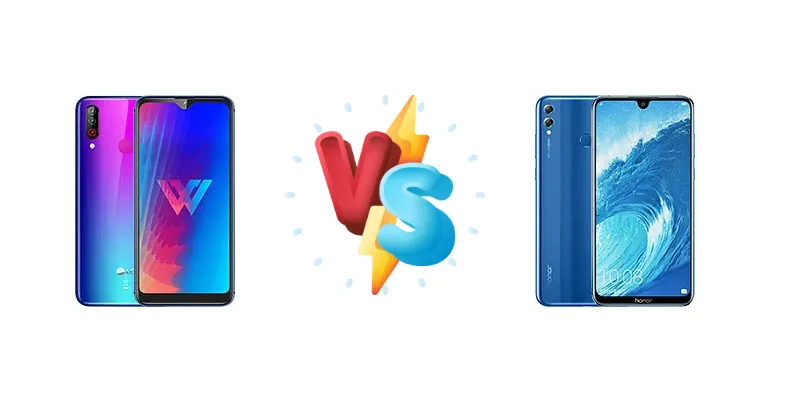
The LG W30 and Honor 8X Max represent a shrinking segment: large-screen, budget-friendly smartphones. Both aimed to deliver a compelling experience without breaking the bank, but they took different approaches to achieving that goal. This comparison dives deep into their specifications to determine which device offers the best balance of performance, features, and value in today's market.
🏆 Quick Verdict
For the average user prioritizing responsiveness and future-proofing, the Honor 8X Max is the clear winner. Its Qualcomm Snapdragon 660 chipset provides a significant performance advantage over the LG W30’s MediaTek Helio P22, making it better suited for multitasking, gaming, and demanding applications. While the W30 may offer slightly better battery life due to its potentially more efficient processor, the 8X Max’s 18W charging mitigates this difference.
| Network |
|---|
| 2G bands | GSM 850 / 900 / 1800 / 1900 | GSM 850 / 900 / 1800 / 1900 |
| 3G bands | HSDPA 850 / 900 / 2100 | HSDPA 850 / 900 / 2100 |
| 4G bands | 1, 3, 5, 8, 40, 41 | 1, 3, 5, 7, 8, 20, 38, 40, 41 - Global |
| Speed | HSPA, LTE | HSPA 42.2/5.76 Mbps, LTE Cat4 150/50 Mbps |
| Technology | GSM / HSPA / LTE | GSM / CDMA / HSPA / LTE |
| | - | 1, 3, 5, 8, 38, 39, 40, 41 - China |
| Launch |
|---|
| Announced | 2019, June. Released 2019, July | 2018, September. Released 2018, September |
| Status | Discontinued | Discontinued |
| Body |
|---|
| Dimensions | 159 x 76.5 x 8.2 mm (6.26 x 3.01 x 0.32 in) | 177.6 x 86.3 x 8.1 mm (6.99 x 3.40 x 0.32 in) |
| SIM | · Nano-SIM· Nano-SIM + Nano-SIM | Nano-SIM + Nano-SIM |
| Weight | 175 g (6.17 oz) | 210 g (7.41 oz) |
| Display |
|---|
| Resolution | 720 x 1520 pixels, 19:9 ratio (~269 ppi density) | 1080 x 2244 pixels, 18.7:9 ratio (~350 ppi density) |
| Size | 6.26 inches, 97.8 cm2 (~80.4% screen-to-body ratio) | 7.12 inches, 127.8 cm2 (~83.4% screen-to-body ratio) |
| Type | IPS LCD | IPS LCD |
| Platform |
|---|
| CPU | Octa-core 2.0 GHz Cortex-A53 | Octa-core (4x1.95 GHz Kryo 260 Gold & 4x1.8 GHz Kryo 260 Silver) |
| Chipset | Mediatek MT6762 Helio P22 (12 nm) | Qualcomm SDM660 Snapdragon 660 (14 nm) |
| GPU | PowerVR GE8320 | Adreno 512 |
| OS | Android 9.0 (Pie) | Android 8.1 (Oreo), upgradable to Android 9 (Pie), EMUI 9 |
| Memory |
|---|
| Card slot | microSDXC (uses shared SIM slot) | microSDXC (dedicated slot) |
| Internal | 32GB 3GB RAM, 64GB 4GB RAM | 64GB 4GB RAM, 64GB 6GB RAM, 128GB 4GB RAM, 128GB 6GB RAM |
| | eMMC 5.1 | eMMC 5.1 |
| Main Camera |
|---|
| Dual | - | 16 MP, f/2.0, PDAF
Auxiliary lens |
| Features | LED flash, panorama, HDR | LED flash, panorama, HDR |
| Triple | 12 MP, (wide), 1/2.9", 1.25µm, PDAF
13 MP, 18mm (ultrawide)
Auxiliary lens | - |
| Video | 1080p@30fps | 1080p@30fps |
| Selfie camera |
|---|
| Features | - | HDR |
| Single | 16 MP, f/2.2, (wide), 1/3.06", 1.0µm | 8 MP, f/2.0 |
| Video | - | 1080p@30fps |
| Sound |
|---|
| 3.5mm jack | Yes | Yes |
| 35mm jack | Yes | Yes |
| Loudspeaker | Yes | Yes, with stereo speakers |
| Comms |
|---|
| Bluetooth | 4.2, A2DP, LE | 4.2, A2DP, LE |
| NFC | No | No |
| Positioning | GPS, GLONASS | GPS, GLONASS, BDS |
| Radio | FM radio | FM radio |
| USB | microUSB 2.0, OTG | microUSB 2.0, OTG |
| WLAN | Wi-Fi 802.11 b/g/n, Wi-Fi Direct | Wi-Fi 802.11 a/b/g/n/ac, Wi-Fi Direct |
| Features |
|---|
| Sensors | Fingerprint (rear-mounted), accelerometer, gyro, proximity | Fingerprint (rear-mounted), accelerometer, gyro, proximity, compass |
| Battery |
|---|
| Charging | - | 18W wired
5W reverse wired |
| Type | Li-Po 4000 mAh, non-removable | Li-Po 5000 mAh, non-removable |
| Misc |
|---|
| Colors | Thunder Blue, Platinum Grey, Aurora Green | Black, Blue, Red |
| Models | LMX440IM, LM-X440IM, LMX440ZM, LM-X440ZM | ARE-AL00, ARE-L22HN, ARE-AL10 |
| Price | About 130 EUR | About 250 EUR |
| SAR | 0.82 W/kg (head) 0.32 W/kg (body) | - |
| Tests |
|---|
| Performance |
AnTuTu: 76697 (v7)
GeekBench: 3534 (v4.4)
GFXBench: 4.8fps (ES 3.1 onscreen) | - |
LG W30
- Potentially slightly better battery efficiency with Helio P22
- May be available at a lower price point
- Simple and straightforward user experience
- Significantly weaker performance compared to Snapdragon 660
- Slower charging speeds
- Less capable ISP for image processing
Honor 8X Max
- Superior performance with Snapdragon 660 chipset
- Faster 18W wired charging
- 5W reverse wired charging capability
- More responsive user experience
- Potentially slightly shorter battery life under heavy use
- May be slightly more expensive than the LG W30
Display Comparison
Neither LG nor Honor provided detailed display specifications in the provided data. However, given the market positioning, both likely feature IPS LCD panels. The key difference lies in the processing power needed to drive them. The Snapdragon 660’s more powerful GPU will likely result in smoother animations and potentially better graphics rendering, even if the panels themselves are similar in resolution and color accuracy. Bezels are likely comparable, typical of phones in this price range.
Camera Comparison
Without detailed camera specifications, a direct comparison is difficult. However, it’s reasonable to assume both phones feature similar camera setups targeting the budget segment. The image signal processor (ISP) within the Snapdragon 660 is more advanced, potentially leading to better image processing, dynamic range, and low-light performance. The Honor 8X Max is likely to produce more detailed and vibrant photos, even with similar sensor resolutions. The LG W30 may rely more heavily on software processing to compensate for the less powerful ISP.
Performance
The core difference between these two devices is the chipset. The Honor 8X Max’s Qualcomm Snapdragon 660 (14nm) is a significantly more capable processor than the LG W30’s MediaTek Helio P22 (12nm). The Snapdragon 660 utilizes a Kryo CPU architecture with a combination of performance (Gold) and efficiency (Silver) cores, clocked at up to 1.95 GHz, offering a more balanced and powerful experience. The Helio P22, with its all Cortex-A53 cores at 2.0 GHz, is geared more towards efficiency than raw performance. This translates to faster app loading times, smoother multitasking, and a more enjoyable gaming experience on the Honor 8X Max. The 14nm process node on the Snapdragon 660, while larger than the Helio P22’s 12nm, doesn’t necessarily equate to worse efficiency; Qualcomm’s architecture is highly optimized.
Battery Life
Battery capacity wasn’t specified for either device. However, the Honor 8X Max’s 18W wired charging is a significant advantage. This allows for much faster charging times compared to the likely 10W or 15W charging on the LG W30. While the W30’s Helio P22 might be slightly more power-efficient under light loads, the Snapdragon 660’s faster charging capabilities and overall better performance make the 8X Max a more convenient option for users who are frequently on the go. The 5W reverse wired charging on the Honor 8X Max is a niche feature, allowing it to act as a power bank for smaller devices.
Buying Guide
Buy the LG W30 if you prioritize a potentially longer battery life and are primarily focused on basic smartphone tasks like calling, texting, and light social media use. Its Helio P22 chipset is sufficient for these everyday activities. Buy the Honor 8X Max if you value smoother performance, faster charging, and a more responsive user experience, especially if you enjoy mobile gaming or frequently use multiple apps simultaneously. The Snapdragon 660 offers a noticeable upgrade in processing power.
Frequently Asked Questions
❓ Will the Honor 8X Max handle demanding games like PUBG Mobile smoothly?
The Snapdragon 660 in the Honor 8X Max is capable of running PUBG Mobile at medium settings with a stable frame rate. While it won't deliver the highest graphical fidelity, it provides a playable and enjoyable gaming experience, unlike the LG W30 which would likely struggle with consistent performance.
❓ Is the difference in performance between the Helio P22 and Snapdragon 660 noticeable in everyday tasks?
Yes, the difference is quite noticeable. Simple tasks like browsing the web and checking email will feel responsive on both phones, but the Honor 8X Max will handle multitasking, app switching, and opening larger applications much faster and more smoothly due to the Snapdragon 660’s superior processing power.
❓ How long does it take to fully charge the Honor 8X Max with the 18W charger?
While a precise time isn't available, the Honor 8X Max with its 18W charging should fully charge from 0% to 100% in approximately 1 hour and 45 minutes to 2 hours, significantly faster than the LG W30 which likely takes over 3 hours.