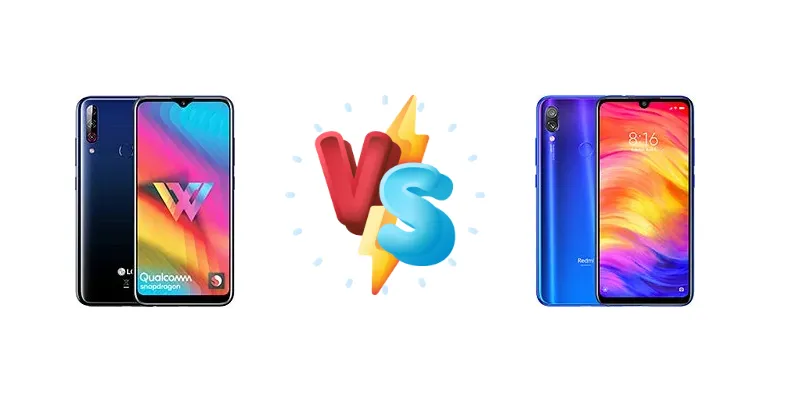
The LG W30 Pro and Xiaomi Redmi Note 7 Pro represent a critical juncture in the mid-range smartphone market – a period where incremental improvements in chipset technology began to deliver tangible benefits to everyday users. Both devices aimed to offer a compelling experience without breaking the bank, but they took different approaches to achieving that goal, primarily through their choice of Qualcomm Snapdragon processors.
🏆 Quick Verdict
For the average user prioritizing performance and future-proofing, the Xiaomi Redmi Note 7 Pro is the clear winner. Its Snapdragon 675, built on a more efficient 11nm process, delivers a noticeable performance uplift over the LG W30 Pro’s Snapdragon 632, coupled with faster 18W Quick Charge 4 support. While the LG W30 Pro remains a capable device, it falls behind in key areas.
| Network |
|---|
| 2G bands | GSM 850 / 900 / 1800 / 1900 | GSM 850 / 900 / 1800 / 1900 |
| 3G bands | HSDPA 850 / 900 / 2100 | HSDPA 850 / 900 / 1900 / 2100 |
| 4G bands | 1, 3, 5, 8, 40, 41 | 1, 3, 5, 7, 8, 40, 41 |
| Speed | HSPA, LTE | HSPA 42.2/5.76 Mbps, LTE (3CA) Cat9 450/50 Mbps |
| Technology | GSM / HSPA / LTE | GSM / HSPA / LTE |
| Launch |
|---|
| Announced | 2019, June. Released 2019, October | 2019, February 28. Released 2019, March 18 |
| Status | Discontinued | Discontinued |
| Body |
|---|
| Build | - | Glass front (Gorilla Glass 5), glass back (Gorilla Glass 5), plastic frame |
| Dimensions | 157.7 x 75.9 x 8.3 mm (6.21 x 2.99 x 0.33 in) | 159.2 x 75.2 x 8.1 mm (6.27 x 2.96 x 0.32 in) |
| SIM | Nano-SIM + Nano-SIM | Nano-SIM + Nano-SIM |
| Weight | 172 g (6.07 oz) | 186 g (6.56 oz) |
| Display |
|---|
| Protection | - | Corning Gorilla Glass 5 |
| Resolution | 720 x 1520 pixels, 19:9 ratio (~270 ppi density) | 1080 x 2340 pixels, 19.5:9 ratio (~409 ppi density) |
| Size | 6.22 inches, 96.6 cm2 (~80.7% screen-to-body ratio) | 6.3 inches, 97.4 cm2 (~81.4% screen-to-body ratio) |
| Type | IPS LCD | IPS LCD |
| Platform |
|---|
| CPU | Octa-core (4x1.8 GHz Kryo 250 Gold & 4x1.8 GHz Kryo 250 Silver) | Octa-core (2x2.0 GHz Kryo 460 Gold & 6x1.7 GHz Kryo 460 Silver) |
| Chipset | Qualcomm SDM632 Snapdragon 632 (14 nm) | Qualcomm SDM675 Snapdragon 675 (11 nm) |
| GPU | Adreno 506 | Adreno 612 |
| OS | Android 9.0 (Pie) | Android 9.0 (Pie), upgradable to Android 10, MIUI 12 |
| Memory |
|---|
| Card slot | microSDXC (dedicated slot) | microSDXC (uses shared SIM slot) |
| Internal | 64GB 4GB RAM | 64GB 4GB RAM, 64GB 6GB RAM, 128GB 6GB RAM |
| | eMMC 5.1 | eMMC 5.1 |
| Main Camera |
|---|
| Dual | - | 48 MP, f/1.8, (wide), 1/2.0", 0.8µm, PDAF
Auxiliary lens |
| Features | LED flash, panorama, HDR | Dual-LED flash, HDR, panorama |
| Triple | 13 MP, PDAF
8 MP, 13mm (ultrawide), 1/4.0", 1.12µm
Auxiliary lens | - |
| Video | 4K@30fps, 1080p@30fps | 4K@30fps, 1080p@30/60/120fps, (gyro-EIS) |
| Selfie camera |
|---|
| Features | - | HDR |
| Single | 16 MP, f/2.2, (wide), 1/3.06", 1.0µm | 13 MP, (wide), 1/3.1", 1.12µm |
| Video | 1080p@30fps | 1080p@30fps |
| Sound |
|---|
| 3.5mm jack | Yes | Yes |
| 35mm jack | Yes | Yes |
| Loudspeaker | Yes | Yes |
| Comms |
|---|
| Bluetooth | 4.2, A2DP, LE | 5.0, A2DP, LE |
| Infrared port | - | Yes |
| NFC | No | No |
| Positioning | GPS, GLONASS | GPS, GLONASS, BDS |
| Radio | FM radio | FM radio, recording |
| USB | USB Type-C 2.0, OTG | USB Type-C 2.0 |
| WLAN | Wi-Fi 802.11 b/g/n, Wi-Fi Direct | Wi-Fi 802.11 a/b/g/n/ac, dual-band, Wi-Fi Direct |
| Features |
|---|
| Sensors | Fingerprint (rear-mounted), accelerometer, gyro, proximity | Fingerprint (rear-mounted), accelerometer, gyro, proximity, compass |
| Battery |
|---|
| Charging | Wired, 50% in 35 min | 18W wired, QC4 |
| Type | Li-Po 4050 mAh, non-removable | Li-Po 4000 mAh, non-removable |
| Misc |
|---|
| Colors | Midnight Blue, Midnight Purple | Nebula Red, Neptune Blue, Space Black, Astro White |
| Models | LMX600IM, LM-X600IM | M1901F7S |
| Price | About 190 EUR | About 260 EUR |
| SAR | - | 0.96 W/kg (head) 0.84 W/kg (body) |
| Tests |
|---|
| Performance | - |
AnTuTu: 180754 (v7), 215308 (v8)
GeekBench: 6620 (v4.4), 1624 (v5.1)
GFXBench: 7.9fps (ES 3.1 onscreen) |
LG W30 Pro
- Potentially lower price point (depending on market)
- Reliable for basic smartphone tasks
- Decent battery life for light usage
- Slower processor compared to the Redmi Note 7 Pro
- Slower charging speeds
- Less efficient chipset (14nm)
Xiaomi Redmi Note 7 Pro
- More powerful Snapdragon 675 processor
- Faster 18W Quick Charge 4 support
- More efficient 11nm process node
- May be slightly more expensive than the LG W30 Pro
- Potentially similar display quality to the LG W30 Pro
- Software experience can vary based on MIUI version
Display Comparison
Neither LG nor Xiaomi specified display details beyond size in their marketing materials. However, given the market segment, both likely utilize IPS LCD panels. The key difference lies under the hood: processing power to drive the display. The Redmi Note 7 Pro’s more powerful chipset can handle more complex graphical tasks, potentially resulting in smoother animations and faster app loading times, even if the panels themselves are similar in terms of resolution and color accuracy.
Camera Comparison
Without detailed sensor information, a direct camera comparison is difficult. However, the Redmi Note 7 Pro’s chipset has a more powerful ISP (Image Signal Processor), enabling faster image processing and potentially better low-light performance. The Snapdragon 675’s superior processing capabilities allow for more sophisticated computational photography techniques, resulting in sharper images and more accurate colors. While both phones likely feature similar primary camera resolutions, the Redmi Note 7 Pro’s image processing pipeline will likely deliver superior results.
Performance
The core distinction between these phones is the chipset. The Xiaomi Redmi Note 7 Pro boasts the Snapdragon 675 (11nm), featuring a Kryo 460 CPU configuration with 2x2.0 GHz Gold cores and 6x1.7 GHz Silver cores. This contrasts with the LG W30 Pro’s Snapdragon 632 (14nm) and its 4x1.8 GHz Kryo 250 Gold and 4x1.8 GHz Kryo 250 Silver setup. The 11nm process node of the 675 is significantly more efficient, leading to better thermal management and sustained performance. The higher clock speeds on the 675’s Gold cores, combined with architectural improvements, translate to a tangible performance advantage in demanding applications and gaming. Users will experience faster app launches and smoother multitasking on the Redmi Note 7 Pro.
Battery Life
While battery capacity isn't specified, the Redmi Note 7 Pro’s 18W Quick Charge 4 support is a significant advantage. The LG W30 Pro only offers standard wired charging, with a reported 50% charge in 35 minutes. The Redmi Note 7 Pro’s faster charging reduces downtime, allowing users to quickly top up their battery when needed. Even if the LG W30 Pro has a slightly larger battery capacity, the Redmi Note 7 Pro’s charging speed will likely result in a more convenient user experience.
Buying Guide
Buy the LG W30 Pro if you are on an extremely tight budget and primarily need a reliable device for basic tasks like calling, texting, and light social media use. Its Snapdragon 632 is sufficient for these workloads. Buy the Xiaomi Redmi Note 7 Pro if you value smoother multitasking, occasional gaming, and faster charging. The Snapdragon 675 provides a more responsive experience and the 18W Quick Charge 4 support significantly reduces charging times, making it ideal for users who are always on the go.
Frequently Asked Questions
❓ Will the Redmi Note 7 Pro overheat during extended gaming sessions?
The Snapdragon 675’s 11nm process node is more efficient than the Snapdragon 632’s 14nm node, resulting in better thermal management. While some throttling may occur during prolonged, demanding gaming, the Redmi Note 7 Pro is less likely to overheat compared to the LG W30 Pro.
❓ Does the Redmi Note 7 Pro support sustained performance for demanding apps?
Yes, the Snapdragon 675’s improved thermal efficiency and CPU architecture allow for more sustained performance under load. The LG W30 Pro’s Snapdragon 632 is more prone to throttling, leading to performance drops during extended use of demanding applications.
❓ Is the difference in charging speed between the two phones noticeable in real-world use?
Absolutely. The Redmi Note 7 Pro’s 18W Quick Charge 4 support significantly reduces charging times compared to the LG W30 Pro’s standard wired charging. Users will experience a much faster top-up, making it ideal for those who need to quickly recharge their device.