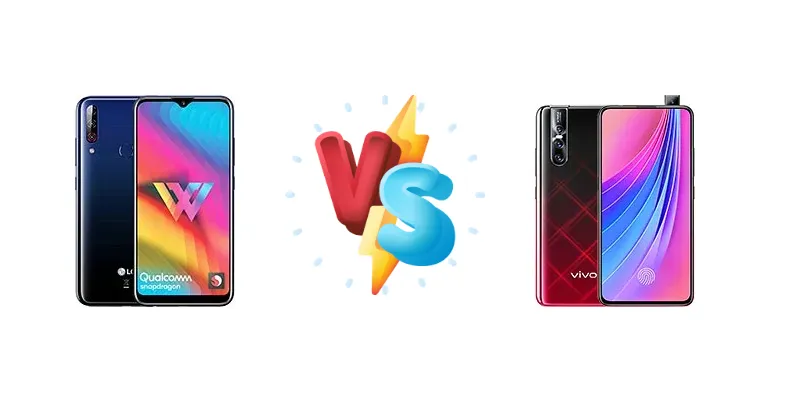
The LG W30 Pro and vivo V15 Pro represent a fascinating intersection of budget-friendly pricing and respectable mid-range specifications. Both devices leverage Qualcomm's Snapdragon 6-series, but with distinct chipset choices – the SDM632 in the LG and the SDM675 in the vivo. This comparison dives deep into the nuances of these two phones, helping you determine which delivers the best experience for your needs.
🏆 Quick Verdict
For most users, the vivo V15 Pro emerges as the stronger contender. Its Snapdragon 675 chipset, built on a more efficient 11nm process, provides a noticeable performance uplift over the LG W30 Pro’s Snapdragon 632. While both boast a 92-hour endurance rating, the V15 Pro’s faster 18W charging offers a more convenient experience.
| Network |
|---|
| 2G bands | GSM 850 / 900 / 1800 / 1900 | GSM 850 / 900 / 1800 / 1900 |
| 3G bands | HSDPA 850 / 900 / 2100 | HSDPA 850 / 900 / 1900 / 2100 |
| 4G bands | 1, 3, 5, 8, 40, 41 | 1, 3, 5, 7, 8, 20 |
| Speed | HSPA, LTE | HSPA 42.2/5.76 Mbps, LTE (2CA) Cat12 600/50 Mbps |
| Technology | GSM / HSPA / LTE | GSM / HSPA / LTE |
| | - | 1, 3, 5, 8, 38, 40, 41 - India |
| Launch |
|---|
| Announced | 2019, June. Released 2019, October | 2019, February. Released 2019, March |
| Status | Discontinued | Discontinued |
| Body |
|---|
| Build | - | Glass front, plastic back, plastic frame |
| Dimensions | 157.7 x 75.9 x 8.3 mm (6.21 x 2.99 x 0.33 in) | 157.3 x 74.7 x 8.2 mm (6.19 x 2.94 x 0.32 in) |
| SIM | Nano-SIM + Nano-SIM | Nano-SIM + Nano-SIM |
| Weight | 172 g (6.07 oz) | 185 g (6.53 oz) |
| Display |
|---|
| Resolution | 720 x 1520 pixels, 19:9 ratio (~270 ppi density) | 1080 x 2340 pixels, 19.5:9 ratio (~404 ppi density) |
| Size | 6.22 inches, 96.6 cm2 (~80.7% screen-to-body ratio) | 6.39 inches, 99.7 cm2 (~84.9% screen-to-body ratio) |
| Type | IPS LCD | Super AMOLED |
| Platform |
|---|
| CPU | Octa-core (4x1.8 GHz Kryo 250 Gold & 4x1.8 GHz Kryo 250 Silver) | Octa-core (2x2.0 GHz Kryo 460 Gold & 6x1.7 GHz Kryo 460 Silver) |
| Chipset | Qualcomm SDM632 Snapdragon 632 (14 nm) | Qualcomm SDM675 Snapdragon 675 (11 nm) |
| GPU | Adreno 506 | Adreno 612 |
| OS | Android 9.0 (Pie) | Android 9.0 (Pie), Funtouch 9 |
| Memory |
|---|
| Card slot | microSDXC (dedicated slot) | microSDXC (dedicated slot) |
| Internal | 64GB 4GB RAM | 128GB 6GB RAM, 128GB 8GB RAM |
| | eMMC 5.1 | eMMC 5.1 |
| Main Camera |
|---|
| Features | LED flash, panorama, HDR | LED flash, HDR, panorama |
| Triple | 13 MP, PDAF
8 MP, 13mm (ultrawide), 1/4.0", 1.12µm
Auxiliary lens | 48 MP, f/1.8, (wide), 1/2.0", 0.8µm, PDAF
8 MP, f/2.2, 13mm (ultrawide)
Auxiliary lens |
| Video | 4K@30fps, 1080p@30fps | 4K@30fps, 1080p@30/60fps |
| Selfie camera |
|---|
| Features | - | HDR |
| Single | 16 MP, f/2.2, (wide), 1/3.06", 1.0µm | Motorized pop-up 32 MP, f/2.0, 26mm (wide), 1/2.8", 0.8µm |
| Video | 1080p@30fps | 1080p@30fps |
| Sound |
|---|
| 3.5mm jack | Yes | Yes |
| 35mm jack | Yes | Yes |
| Loudspeaker | Yes | Yes |
| Comms |
|---|
| Bluetooth | 4.2, A2DP, LE | 5.0, A2DP, LE, EDR, aptX |
| NFC | No | Yes (market dependent) |
| Positioning | GPS, GLONASS | GPS, GLONASS, BDS |
| Radio | FM radio | FM radio |
| USB | USB Type-C 2.0, OTG | microUSB 2.0 |
| WLAN | Wi-Fi 802.11 b/g/n, Wi-Fi Direct | Wi-Fi 802.11 a/b/g/n/ac, dual-band, Wi-Fi Direct |
| Features |
|---|
| Sensors | Fingerprint (rear-mounted), accelerometer, gyro, proximity | Fingerprint (under display, optical), accelerometer, gyro, proximity, compass |
| Battery |
|---|
| Charging | Wired, 50% in 35 min | 18W wired, 24% in 15 min |
| Type | Li-Po 4050 mAh, non-removable | 3700 mAh, non-removable |
| Misc |
|---|
| Colors | Midnight Blue, Midnight Purple | Topaz Blue, Coral Red, Ruby Red |
| Models | LMX600IM, LM-X600IM | 1818, vivo 1818 |
| Price | About 190 EUR | About 360 EUR |
| Tests |
|---|
| Audio quality | - |
Noise -93.4dB / Crosstalk -92.2dB |
| Battery life | - |
Endurance rating 92h
|
| Camera | - |
Photo / Video |
| Display | - |
Contrast ratio: infinite, 3.806 (sunlight) |
| Loudspeaker | - |
Voice 65dB / Noise 74dB / Ring 83dB
|
| Performance | - |
AnTuTu: 180774 (v7)
GeekBench: 6527 (v4.4)
GFXBench: 7.1fps (ES 3.1 onscreen) |
LG W30 Pro
- Potentially lower price point
- Reliable Qualcomm Snapdragon 632 chipset
- Decent battery endurance (92h)
- Slower Snapdragon 632 processor
- Slower charging speed (50% in 35 min)
- Less efficient 14nm process
vivo V15 Pro
- Faster Snapdragon 675 processor
- Faster 18W charging (24% in 15 min)
- More efficient 11nm process
- Potentially higher price point
- Camera specs are unknown
- May not offer significantly better battery life in real-world use
Display Comparison
Both the LG W30 Pro and vivo V15 Pro share an 'infinite' contrast ratio and a sunlight readability score of 3.806, suggesting similar display quality in outdoor conditions. However, the context data lacks specifics on panel type (IPS, AMOLED) or resolution. Given the market positioning, both likely employ IPS LCDs. The absence of refresh rate information suggests standard 60Hz panels on both devices. Without further data, it’s difficult to definitively declare a display winner, but the shared sunlight readability suggests a comparable viewing experience.
Camera Comparison
Both phones are listed as having 'Photo / Video' capabilities, but lack specific details regarding sensor size, aperture, or features like Optical Image Stabilization (OIS). Given the era of these phones, it’s reasonable to assume both feature multi-camera setups, but the quality will heavily depend on the primary sensor. Without more data, it’s impossible to assess camera performance accurately. The presence of a 2MP macro lens on either device is likely a marketing gimmick, offering limited real-world benefit.
Performance
The vivo V15 Pro’s Snapdragon 675 represents a significant step up from the LG W30 Pro’s Snapdragon 632. The 675, fabricated on an 11nm process versus the 632’s 14nm, offers improved power efficiency and thermal performance. The CPU configuration further highlights this difference: the V15 Pro features 2x 2.0 GHz Kryo 460 Gold cores and 6x 1.7 GHz Kryo 460 Silver cores, while the W30 Pro has 4x 1.8 GHz Kryo 250 Gold and 4x 1.8 GHz Kryo 250 Silver. This translates to faster app loading times and smoother multitasking on the V15 Pro, particularly noticeable when running demanding applications. Gamers will also benefit from the 675’s more capable Adreno 615 GPU.
Battery Life
Both the LG W30 Pro and vivo V15 Pro achieve an endurance rating of 92 hours, indicating comparable battery life under similar usage conditions. However, the V15 Pro boasts 18W wired charging, capable of delivering 24% charge in 15 minutes, while the W30 Pro only manages 50% in 35 minutes. This faster charging speed provides a significant convenience advantage for the V15 Pro, allowing users to quickly top up their battery when needed. The similar endurance ratings suggest that the more efficient Snapdragon 675 in the V15 Pro effectively mitigates any potential battery drain from its increased performance.
Buying Guide
Buy the LG W30 Pro if you prioritize a simple, reliable experience and are on an extremely tight budget. It’s a solid choice for basic tasks like calling, texting, and light social media use. Buy the vivo V15 Pro if you value smoother multitasking, occasional gaming, and faster charging speeds. The V15 Pro is better suited for users who demand a bit more from their smartphone without breaking the bank.
Frequently Asked Questions
❓ Is the Snapdragon 675 in the vivo V15 Pro powerful enough for modern mobile games?
The Snapdragon 675 is capable of running many popular mobile games at medium to high settings. While it won't deliver the same performance as flagship chipsets, it provides a smooth gaming experience for titles like PUBG Mobile and Call of Duty: Mobile, especially when paired with sufficient RAM.
❓ How does the 11nm process of the Snapdragon 675 impact real-world battery life compared to the 14nm Snapdragon 632?
The 11nm process is more efficient than 14nm, meaning the Snapdragon 675 consumes less power for the same level of performance. This translates to slightly improved battery life and reduced heat generation, allowing the V15 Pro to maintain performance for longer periods during demanding tasks.
❓ Does the vivo V15 Pro support fast charging protocols beyond its 18W wired charging?
Information on specific fast charging protocol support (like Quick Charge or Power Delivery) is not available in the provided context. However, given vivo's history, it's likely the V15 Pro supports at least Quick Charge 2.0 or 3.0 for compatibility with a wider range of chargers.