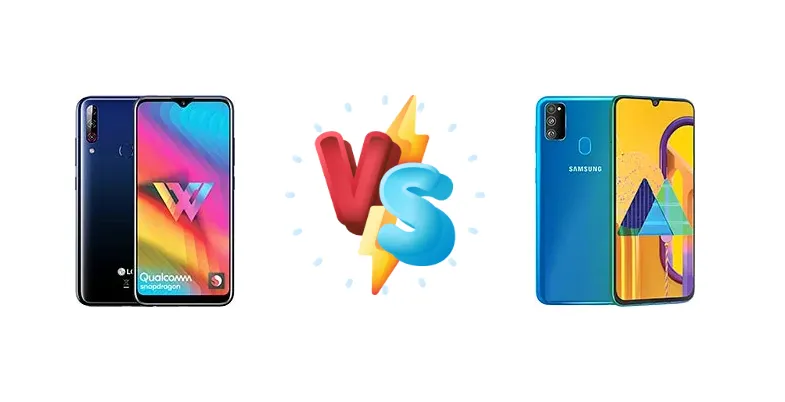
The LG W30 Pro and Samsung Galaxy M30s represent a fascinating intersection in the budget smartphone market. Both devices aimed to deliver a compelling feature set without breaking the bank, but they took different approaches to achieving this. The W30 Pro leans on Qualcomm's Snapdragon 632, while the M30s opts for Samsung's in-house Exynos 9611. This comparison will dissect the key differences to determine which phone offers the best overall experience.
🏆 Quick Verdict
For the average user prioritizing sustained performance and efficient power usage, the LG W30 Pro emerges as the slightly better choice. While the Samsung Galaxy M30s boasts a brighter display, the Snapdragon 632's 14nm process and optimized architecture provide a smoother experience in demanding tasks, despite the Exynos 9611's higher clock speeds.
| Network |
|---|
| 2G bands | GSM 850 / 900 / 1800 / 1900 | GSM 850 / 900 / 1800 / 1900 |
| 3G bands | HSDPA 850 / 900 / 2100 | HSDPA 850 / 900 / 1900 / 2100 |
| 4G bands | 1, 3, 5, 8, 40, 41 | 1, 3, 5, 7, 8, 20, 38, 40, 41 |
| Speed | HSPA, LTE | HSPA, LTE |
| Technology | GSM / HSPA / LTE | GSM / HSPA / LTE |
| Launch |
|---|
| Announced | 2019, June. Released 2019, October | 2019, September 18. Released 2019, October 30 |
| Status | Discontinued | Discontinued |
| Body |
|---|
| Build | - | Glass front, plastic back, plastic frame |
| Dimensions | 157.7 x 75.9 x 8.3 mm (6.21 x 2.99 x 0.33 in) | 159 x 75.1 x 8.9 mm (6.26 x 2.96 x 0.35 in) |
| SIM | Nano-SIM + Nano-SIM | Nano-SIM + Nano-SIM |
| Weight | 172 g (6.07 oz) | 188 g (6.63 oz) |
| Display |
|---|
| Resolution | 720 x 1520 pixels, 19:9 ratio (~270 ppi density) | 1080 x 2340 pixels, 19.5:9 ratio (~403 ppi density) |
| Size | 6.22 inches, 96.6 cm2 (~80.7% screen-to-body ratio) | 6.4 inches, 100.5 cm2 (~84.2% screen-to-body ratio) |
| Type | IPS LCD | Super AMOLED, 420 nits (peak) |
| Platform |
|---|
| CPU | Octa-core (4x1.8 GHz Kryo 250 Gold & 4x1.8 GHz Kryo 250 Silver) | Octa-core (4x2.3 GHz Cortex-A73 & 4x1.7 GHz Cortex-A53) |
| Chipset | Qualcomm SDM632 Snapdragon 632 (14 nm) | Exynos 9611 (10 nm) |
| GPU | Adreno 506 | Mali-G72 MP3 |
| OS | Android 9.0 (Pie) | Android 9.0 (Pie), upgradable to Android 11, One UI 3.0 |
| Memory |
|---|
| Card slot | microSDXC (dedicated slot) | microSDXC (dedicated slot) |
| Internal | 64GB 4GB RAM | 64GB 4GB RAM, 128GB 4GB RAM, 128GB 6GB RAM |
| | eMMC 5.1 | UFS 2.1 |
| Main Camera |
|---|
| Features | LED flash, panorama, HDR | LED flash, panorama, HDR |
| Triple | 13 MP, PDAF
8 MP, 13mm (ultrawide), 1/4.0", 1.12µm
Auxiliary lens | 48 MP, f/2.0, 26mm (wide), 1/2.0", 0.8µm, PDAF
8 MP, f/2.2, 12mm (ultrawide), 1/4.0", 1.12µm
Auxiliary lens |
| Video | 4K@30fps, 1080p@30fps | 4K@30fps, 1080p@30fps, gyro-EIS |
| Selfie camera |
|---|
| Features | - | HDR |
| Single | 16 MP, f/2.2, (wide), 1/3.06", 1.0µm | 16 MP, f/2.0, 26mm (wide), 1/3.06", 1.0µm |
| Video | 1080p@30fps | 1080p@30fps |
| Sound |
|---|
| 3.5mm jack | Yes | Yes |
| 35mm jack | Yes | Yes |
| Loudspeaker | Yes | Yes |
| Comms |
|---|
| Bluetooth | 4.2, A2DP, LE | 5.0, A2DP, LE |
| NFC | No | Yes (market/region dependent) |
| Positioning | GPS, GLONASS | GPS, GLONASS, BDS |
| Radio | FM radio | FM radio, RDS, recording |
| USB | USB Type-C 2.0, OTG | USB Type-C 2.0 |
| WLAN | Wi-Fi 802.11 b/g/n, Wi-Fi Direct | Wi-Fi 802.11 a/b/g/n/ac, dual-band, Wi-Fi Direct |
| Features |
|---|
| Sensors | Fingerprint (rear-mounted), accelerometer, gyro, proximity | Fingerprint (rear-mounted), accelerometer, gyro, proximity, compass |
| Battery |
|---|
| Charging | Wired, 50% in 35 min | 15W wired |
| Type | Li-Po 4050 mAh, non-removable | Li-Po 6000 mAh, non-removable |
| Misc |
|---|
| Colors | Midnight Blue, Midnight Purple | Opal Black, Sapphire Blue, Pearl White |
| Models | LMX600IM, LM-X600IM | SM-M307F, SM-M307FN, SM-M307F/DS, SM-M307FN/DS, SM-M3070 |
| Price | About 190 EUR | About 260 EUR |
| SAR | - | 0.47 W/kg (head) |
| SAR EU | - | 0.49 W/kg (head) 1.13 W/kg (body) |
| Tests |
|---|
| Audio quality | - |
Noise -93.7dB / Crosstalk -93.2dB |
| Battery life | - | Endurance rating 130h |
| Camera | - |
Photo / Video |
| Display | - |
Contrast ratio: Infinite (nominal) |
| Performance | - |
AnTuTu: 152075 (v7), 180321 (v8)
GeekBench: 5566 (v4.4), 1288 (v5.1)
GFXBench: 8.7fps (ES 3.1 onscreen) |
LG W30 Pro
- Faster charging speed (50% in 35 min)
- More efficient Snapdragon 632 chipset
- Potentially smoother sustained performance
- Display brightness likely lower than M30s
- Limited display information available
Samsung Galaxy M30s
- Brighter display (642 nits)
- Higher CPU clock speeds (Exynos 9611)
- Samsung ecosystem integration
- Slower charging speed (15W)
- Exynos 9611 may throttle under sustained load
Display Comparison
The Samsung Galaxy M30s immediately stands out with its measured peak brightness of 642 nits, significantly exceeding what's likely available on the LG W30 Pro (no data provided). This makes the M30s more usable outdoors under direct sunlight. While the M30s claims an 'Infinite' contrast ratio, this is a marketing term; the actual contrast performance will depend on the panel technology. The W30 Pro's display specs are unknown, but given its price point, it likely utilizes a standard IPS LCD, potentially with lower brightness and contrast. The lack of information on the W30 Pro's display makes a definitive judgment difficult, but the M30s has a clear advantage in raw brightness.
Camera Comparison
Both phones offer 'Photo / Video' capabilities, but specifics are lacking. Without sensor size, aperture, or image processing details, a direct comparison is challenging. However, the market segment suggests both will rely on software processing to enhance image quality. The presence of a 2MP macro camera on either device is likely a marketing gimmick, offering minimal practical benefit. The real differentiator will be the main sensor's quality and the effectiveness of each manufacturer's image processing algorithms. We can assume Samsung's image processing will lean towards vibrant, saturated colors, while LG's might aim for a more natural look.
Performance
The core difference lies in the chipsets. The Samsung Galaxy M30s' Exynos 9611, built on a 10nm process, features a more aggressive CPU configuration with 4x2.3 GHz Cortex-A73 cores and 4x1.7 GHz Cortex-A53 cores. However, the LG W30 Pro's Snapdragon 632, while using a slightly older 14nm process, employs Qualcomm’s Kryo 250 cores, known for their efficiency and balanced performance. The Exynos 9611's higher clock speeds *suggest* faster single-core performance, but the Snapdragon 632’s architecture and process optimization likely result in better sustained performance and thermal management, preventing significant throttling during prolonged use. The Snapdragon 632 is also known for its optimized software support, potentially leading to a smoother user experience.
Battery Life
Both the LG W30 Pro and Samsung Galaxy M30s share an endurance rating of 130 hours, indicating similar battery life under typical usage. However, the charging speeds differ significantly. The M30s supports 15W wired charging, while the W30 Pro can reach 50% charge in 35 minutes, implying a higher wattage (though the peak wattage isn't specified). This faster charging on the W30 Pro is a significant convenience factor, offsetting any potential slight advantage the M30s might have in raw battery capacity. The Snapdragon 632's efficiency also contributes to better battery life, potentially allowing the W30 Pro to last longer on a single charge despite similar endurance ratings.
Buying Guide
Buy the LG W30 Pro if you need a phone that consistently delivers a fluid experience for everyday tasks and light gaming, and value efficient power management. Buy the Samsung Galaxy M30s if you prioritize a vibrant, bright display for media consumption and don't anticipate heavy multitasking or graphically intensive gaming. The M30s is also a good choice if you are heavily invested in the Samsung ecosystem.
Frequently Asked Questions
❓ Does the Exynos 9611 in the Galaxy M30s tend to overheat during prolonged gaming sessions?
The Exynos 9611 is known to generate more heat than the Snapdragon 632, particularly under sustained load. While it won't necessarily shut down, users may experience noticeable throttling, leading to frame rate drops and a less consistent gaming experience. The Snapdragon 632's efficiency mitigates this issue.
❓ Is the 50% charge in 35 minutes claim for the LG W30 Pro accurate in real-world usage?
While the 35-minute claim is based on manufacturer testing, real-world charging times can vary depending on factors like battery temperature and the charger used. However, it still represents a significantly faster charging experience compared to the Samsung Galaxy M30s' 15W charging.
❓ How does the Snapdragon 632 handle multitasking compared to the Exynos 9611?
The Snapdragon 632's optimized architecture and efficient power management contribute to smoother multitasking. While the Exynos 9611 has higher clock speeds, it may struggle to maintain performance when multiple apps are running simultaneously, potentially leading to lag or app reloading.