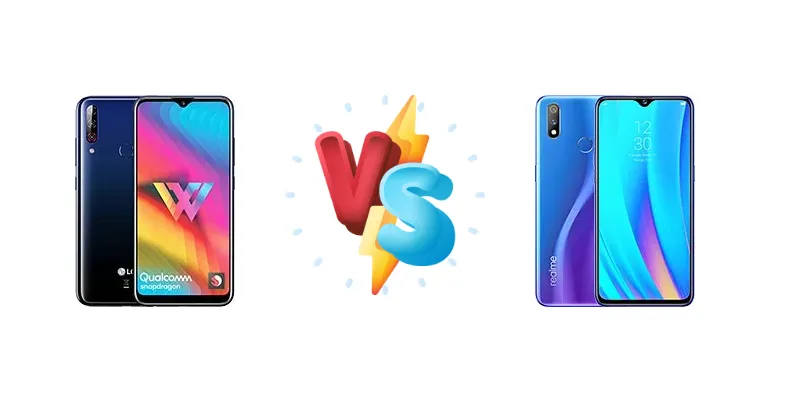
The LG W30 Pro and Realme 3 Pro represent a fascinating intersection in the budget smartphone market. Both devices, while now older models, offer compelling features for their price point, but diverge significantly in their core processing power. This comparison dissects the differences between the Snapdragon 632 and 710 chipsets, alongside battery performance and other key features, to determine which phone delivers the best overall experience.
🏆 Quick Verdict
For the average user prioritizing responsiveness and future-proofing, the Realme 3 Pro is the clear winner. Its Snapdragon 710 chipset provides a noticeable performance uplift over the LG W30 Pro’s Snapdragon 632, making it better suited for multitasking and gaming. While both offer similar battery endurance, the Realme 3 Pro’s faster charging is a welcome addition.
| Network |
|---|
| 2G bands | GSM 850 / 900 / 1800 / 1900 | GSM 850 / 900 / 1800 / 1900 |
| 3G bands | HSDPA 850 / 900 / 2100 | HSDPA 850 / 900 / 2100 - India |
| 4G bands | 1, 3, 5, 8, 40, 41 | 1, 3, 5, 8, 38, 40, 41 - India |
| Speed | HSPA, LTE | HSPA 42.2/11.5 Mbps, LTE (2CA) Cat6 300/75 Mbps |
| Technology | GSM / HSPA / LTE | GSM / HSPA / LTE |
| | - | 1, 2, 3, 4, 5, 7, 8, 20, 28, 38, 39, 40, 41 - EMEA |
| Launch |
|---|
| Announced | 2019, June. Released 2019, October | 2019, April 22. Released 2019, May |
| Status | Discontinued | Discontinued |
| Body |
|---|
| Build | - | Glass front (Gorilla Glass 5), plastic back, plastic frame |
| Dimensions | 157.7 x 75.9 x 8.3 mm (6.21 x 2.99 x 0.33 in) | 156.8 x 74.2 x 8.3 mm (6.17 x 2.92 x 0.33 in) |
| SIM | Nano-SIM + Nano-SIM | Nano-SIM + Nano-SIM |
| Weight | 172 g (6.07 oz) | 172 g (6.07 oz) |
| Display |
|---|
| Protection | - | Corning Gorilla Glass 5 |
| Resolution | 720 x 1520 pixels, 19:9 ratio (~270 ppi density) | 1080 x 2340 pixels, 19.5:9 ratio (~409 ppi density) |
| Size | 6.22 inches, 96.6 cm2 (~80.7% screen-to-body ratio) | 6.3 inches, 97.4 cm2 (~83.7% screen-to-body ratio) |
| Type | IPS LCD | IPS LCD |
| Platform |
|---|
| CPU | Octa-core (4x1.8 GHz Kryo 250 Gold & 4x1.8 GHz Kryo 250 Silver) | Octa-core (2x2.2 GHz Kryo 360 Gold & 6x1.7 GHz Kryo 360 Silver) |
| Chipset | Qualcomm SDM632 Snapdragon 632 (14 nm) | Qualcomm SDM710 Snapdragon 710 (10 nm) |
| GPU | Adreno 506 | Adreno 616 |
| OS | Android 9.0 (Pie) | Android 9.0 (Pie), planned upgrade to Android 10, ColorOS 6 |
| Memory |
|---|
| Card slot | microSDXC (dedicated slot) | microSDXC (dedicated slot) |
| Internal | 64GB 4GB RAM | 64GB 4GB RAM, 64GB 6GB RAM, 128GB 6GB RAM |
| | eMMC 5.1 | eMMC 5.1 |
| Main Camera |
|---|
| Dual | - | 16 MP, f/1.7, 1/2.6", 1.22µm, dual pixel PDAF
Auxiliary lens |
| Features | LED flash, panorama, HDR | LED flash, HDR |
| Triple | 13 MP, PDAF
8 MP, 13mm (ultrawide), 1/4.0", 1.12µm
Auxiliary lens | - |
| Video | 4K@30fps, 1080p@30fps | 4K@30fps, 1080p@30/120fps, 720p@960fps, gyro-EIS |
| Selfie camera |
|---|
| Features | - | HDR |
| Single | 16 MP, f/2.2, (wide), 1/3.06", 1.0µm | 25 MP, f/2.0, 1/2.8", 0.8µm |
| Video | 1080p@30fps | 1080p@30fps |
| Sound |
|---|
| 3.5mm jack | Yes | Yes |
| 35mm jack | Yes | Yes |
| Loudspeaker | Yes | Yes |
| Comms |
|---|
| Bluetooth | 4.2, A2DP, LE | 5.0, A2DP, LE |
| NFC | No | No |
| Positioning | GPS, GLONASS | GPS, GLONASS |
| Radio | FM radio | FM radio |
| USB | USB Type-C 2.0, OTG | microUSB 2.0, OTG |
| WLAN | Wi-Fi 802.11 b/g/n, Wi-Fi Direct | Wi-Fi 802.11 a/b/g/n/ac, dual-band, Wi-Fi Direct |
| Features |
|---|
| Sensors | Fingerprint (rear-mounted), accelerometer, gyro, proximity | Fingerprint (rear-mounted), accelerometer, gyro, proximity, compass |
| Battery |
|---|
| Charging | Wired, 50% in 35 min | 20W wired, 50% in 30 min |
| Music play | - | Up to 126 h |
| Stand-by | - | Up to 383 h (3G) |
| Talk time | - | Up to 32 h (3G) |
| Type | Li-Po 4050 mAh, non-removable | 4045 mAh, non-removable |
| Misc |
|---|
| Colors | Midnight Blue, Midnight Purple | Carbon Gray, Nitro Blue, Lightning Purple |
| Models | LMX600IM, LM-X600IM | RMX1851 |
| Price | About 190 EUR | About 270 EUR |
| Tests |
|---|
| Audio quality | - |
Noise -92.9dB / Crosstalk -91.1dB |
| Battery life | - |
Endurance rating 91h
|
| Camera | - |
Photo / Video |
| Display | - |
Contrast ratio: 1782:1 (nominal) |
| Loudspeaker | - |
Voice 67dB / Noise 73dB / Ring 90dB
|
| Performance | - |
AnTuTu: 155647 (v7)
GeekBench: 5881 (v4.4)
GFXBench: 11fps (ES 3.1 onscreen) |
LG W30 Pro
- Potentially lower price point (given age)
- Decent battery endurance
- Functional for basic tasks
- Significantly weaker performance compared to the Realme 3 Pro
- Less efficient chipset (14nm)
- Slower charging speed
Realme 3 Pro
- Faster and more efficient Snapdragon 710 chipset
- Faster 20W charging
- Better suited for gaming and multitasking
- May be slightly more expensive
- Battery life is comparable, not superior, to the W30 Pro
- Older model, software updates may be limited
Display Comparison
Both the LG W30 Pro and Realme 3 Pro share a nominal contrast ratio of 1782:1, suggesting similar visual pop. However, detailed display specifications like peak brightness, color gamut coverage, and panel type are missing. Given Realme’s focus on display quality in later models, it’s reasonable to assume the 3 Pro may have a slightly more vibrant panel, but without concrete data, this remains speculative. Bezels are likely comparable, typical of phones in this price bracket.
Camera Comparison
Both devices are listed as having Photo/Video capabilities, but specific details are absent. Without sensor size, aperture information, or image processing details, a direct comparison is difficult. However, Realme generally emphasizes camera performance in its marketing, suggesting the 3 Pro may offer more refined image processing and potentially better low-light performance. The presence of a dedicated Night Mode or HDR capabilities on the 3 Pro is plausible, while the W30 Pro may rely on more basic algorithms. It's important to note that the inclusion of a 2MP macro lens on either device is unlikely to significantly impact image quality.
Performance
The core difference lies in the chipsets. The Realme 3 Pro’s Snapdragon 710, built on a more efficient 10nm process, significantly outperforms the LG W30 Pro’s 14nm Snapdragon 632. The 710’s Kryo 360 CPU configuration (2x2.2 GHz Gold & 6x1.7 GHz Silver) offers a faster peak clock speed and a more sophisticated core arrangement compared to the 632’s (4x1.8 GHz Gold & 4x1.8 GHz Silver). This translates to smoother multitasking, quicker app loading times, and a more enjoyable gaming experience. The 710’s Adreno 616 GPU also provides a substantial graphics boost. While both phones likely feature similar RAM configurations, the 710’s superior processing power will maximize its effectiveness.
Battery Life
Interestingly, both phones achieve an endurance rating of 91 hours, indicating comparable real-world battery life despite the Snapdragon 710’s potentially higher power consumption. This suggests efficient software optimization on the Realme 3 Pro. However, the Realme 3 Pro boasts 20W wired charging, achieving 50% charge in 30 minutes, while the LG W30 Pro takes 35 minutes. This faster charging speed is a significant convenience factor, allowing users to quickly top up their battery when needed.
Buying Guide
Buy the LG W30 Pro if you prioritize a simple, reliable experience and are on an extremely tight budget. It’s a functional device for basic tasks like calling, texting, and light social media use. Buy the Realme 3 Pro if you value performance, enjoy mobile gaming, or anticipate using demanding applications. The Snapdragon 710 offers a significant step up in processing power, making it a more versatile and future-proof choice.
Frequently Asked Questions
❓ Will the Snapdragon 710 in the Realme 3 Pro handle demanding games like PUBG Mobile smoothly?
Yes, the Snapdragon 710 is capable of running PUBG Mobile at medium to high settings with stable frame rates. While it won't deliver the same experience as a flagship chipset, it provides a significantly better gaming experience than the Snapdragon 632 in the LG W30 Pro.
❓ How much of a difference will the faster charging make in daily use on the Realme 3 Pro?
The 20W charging on the Realme 3 Pro is a noticeable improvement. Being able to gain 50% charge in 30 minutes is significantly faster than the LG W30 Pro’s 35-minute timeframe, making it ideal for users who need a quick power boost before heading out.
❓ Are software updates still available for either the LG W30 Pro or the Realme 3 Pro?
Given the age of both devices, major Android version updates are unlikely. However, Realme generally provides more consistent security updates than LG, so the 3 Pro is more likely to receive ongoing security patches.