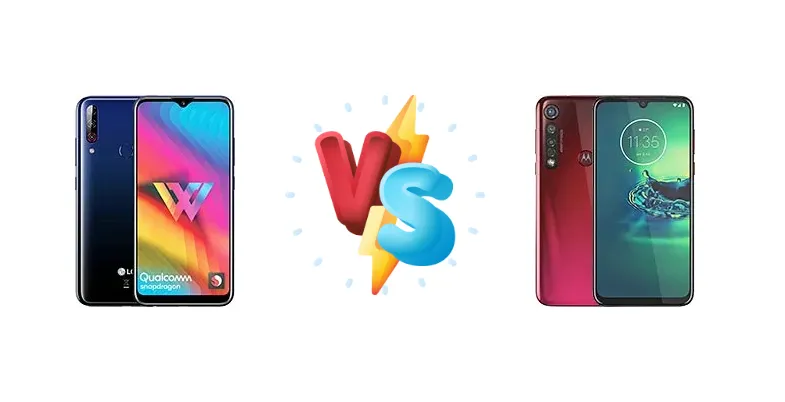
The LG W30 Pro and Motorola Moto G8 Plus represent a sweet spot in the smartphone market – affordable devices aiming to deliver a solid experience without breaking the bank. Both leverage Qualcomm's Snapdragon 6-series, but subtle differences in chipset, display technology, and battery optimization create distinct user experiences. This comparison dives deep into those nuances to determine which phone offers the best value.
🏆 Quick Verdict
For most users, the Motorola Moto G8 Plus emerges as the slightly better choice. Its Snapdragon 665, built on an 11nm process, offers a modest performance advantage and improved efficiency, coupled with a brighter, more visible display. While the LG W30 Pro charges slightly faster, the G8 Plus’s overall package is more compelling.
| Network |
|---|
| 2G bands | GSM 850 / 900 / 1800 / 1900 | GSM 850 / 900 / 1800 / 1900 |
| 3G bands | HSDPA 850 / 900 / 2100 | HSDPA 850 / 900 / 1700(AWS) / 1900 / 2100 |
| 4G bands | 1, 3, 5, 8, 40, 41 | 1, 2, 3, 4, 5, 7, 8, 18, 19, 20, 26, 28, 38, 40, 41 |
| Speed | HSPA, LTE | HSPA 42.2/5.76 Mbps, LTE (2CA) Cat13 600/100 Mbps |
| Technology | GSM / HSPA / LTE | GSM / HSPA / LTE |
| | - | 1, 2, 3, 4, 5, 7, 8, 12, 17, 28, 66 - LATAM |
| Launch |
|---|
| Announced | 2019, June. Released 2019, October | 2019, October 24. Released 2019, October 28 |
| Status | Discontinued | Discontinued |
| Body |
|---|
| Build | - | Glass front, plastic back, plastic frame |
| Dimensions | 157.7 x 75.9 x 8.3 mm (6.21 x 2.99 x 0.33 in) | 158.4 x 75.8 x 9.1 mm (6.24 x 2.98 x 0.36 in) |
| SIM | Nano-SIM + Nano-SIM | · Nano-SIM· Nano-SIM + Nano-SIM |
| Weight | 172 g (6.07 oz) | 188 g (6.63 oz) |
| | - | Water-repellent coating |
| Display |
|---|
| Resolution | 720 x 1520 pixels, 19:9 ratio (~270 ppi density) | 1080 x 2280 pixels, 19:9 ratio (~400 ppi density) |
| Size | 6.22 inches, 96.6 cm2 (~80.7% screen-to-body ratio) | 6.3 inches, 99.1 cm2 (~82.5% screen-to-body ratio) |
| Type | IPS LCD | IPS LCD |
| Platform |
|---|
| CPU | Octa-core (4x1.8 GHz Kryo 250 Gold & 4x1.8 GHz Kryo 250 Silver) | Octa-core (4x2.0 GHz Kryo 260 Gold & 4x1.8 GHz Kryo 260 Silver) |
| Chipset | Qualcomm SDM632 Snapdragon 632 (14 nm) | Qualcomm SDM665 Snapdragon 665 (11 nm) |
| GPU | Adreno 506 | Adreno 610 |
| OS | Android 9.0 (Pie) | Android 9.0 (Pie), upgradable to Android 10 |
| Memory |
|---|
| Card slot | microSDXC (dedicated slot) | microSDXC (uses shared SIM slot) |
| Internal | 64GB 4GB RAM | 64GB 4GB RAM |
| | eMMC 5.1 | eMMC 5.1 |
| Main Camera |
|---|
| Features | LED flash, panorama, HDR | Laser AF, LED flash, HDR, panorama |
| Triple | 13 MP, PDAF
8 MP, 13mm (ultrawide), 1/4.0", 1.12µm
Auxiliary lens | 48 MP, f/1.7, 26mm (wide), 1/2.0", 0.8µm, PDAF
16 MP, f/2.2, 14mm (ultrawide), dedicated video camera (1080p)
Auxiliary lens |
| Video | 4K@30fps, 1080p@30fps | 4K@30fps, 1080p@30/60/120fps, 1080p@30fps (gyro-EIS) |
| Selfie camera |
|---|
| Features | - | HDR |
| Single | 16 MP, f/2.2, (wide), 1/3.06", 1.0µm | 25 MP, f/2.0, 0.9µm |
| Video | 1080p@30fps | 1080p@30/120fps |
| Sound |
|---|
| 3.5mm jack | Yes | Yes |
| 35mm jack | Yes | Yes |
| Loudspeaker | Yes | Yes, with stereo speakers |
| Comms |
|---|
| Bluetooth | 4.2, A2DP, LE | 5.0, A2DP, LE, aptX |
| NFC | No | Yes (market dependent) |
| Positioning | GPS, GLONASS | GPS, GLONASS, BDS, GALILEO |
| Radio | FM radio | FM radio |
| USB | USB Type-C 2.0, OTG | USB Type-C 2.0, OTG |
| WLAN | Wi-Fi 802.11 b/g/n, Wi-Fi Direct | Wi-Fi 802.11 a/b/g/n/ac, dual-band, Wi-Fi Direct |
| Features |
|---|
| Sensors | Fingerprint (rear-mounted), accelerometer, gyro, proximity | Fingerprint (rear-mounted), accelerometer, gyro, proximity, compass |
| Battery |
|---|
| Charging | Wired, 50% in 35 min | 15W wired |
| Type | Li-Po 4050 mAh, non-removable | Li-Po 4000 mAh, non-removable |
| Misc |
|---|
| Colors | Midnight Blue, Midnight Purple | Dark Blue, Dark Red |
| Models | LMX600IM, LM-X600IM | XT2019, XT2019-2 |
| Price | About 190 EUR | About 270 EUR |
| SAR | - | 0.59 W/kg (head) 1.58 W/kg (body) |
| SAR EU | - | 0.59 W/kg (head) 0.88 W/kg (body) |
| Tests |
|---|
| Audio quality | - |
Noise -93.2dB / Crosstalk -94.2dB |
| Battery life | - | Endurance rating 87h |
| Camera | - |
Photo |
| Display | - |
Contrast ratio: 1505:1 (nominal) |
| Loudspeaker | - |
Voice 79dB / Noise 74dB / Ring 80dB |
| Performance | - |
AnTuTu: 168699 (v8)
GeekBench: 5641 (v4.4), 1385 (v5.1)
GFXBench: 6.5fps (ES 3.1 onscreen) |
LG W30 Pro
- Faster charging speed (50% in 35 mins)
- Potentially more efficient power delivery in short bursts
- LG's typically clean software experience
- Older 14nm Snapdragon 632 chipset
- Likely lower peak display brightness
- Limited information on camera capabilities
Motorola Moto G8 Plus
- More efficient 11nm Snapdragon 665 chipset
- Brighter display (581 nits)
- Better overall performance for multitasking
- Slower 15W charging
- Motorola's software can include bloatware
- Camera performance relies heavily on software optimization
Display Comparison
The Motorola Moto G8 Plus boasts a significantly more usable display, achieving a measured peak brightness of 581 nits. This is crucial for outdoor visibility, a common pain point for budget phones. While both displays share a 1505:1 contrast ratio, the higher brightness of the Moto G8 Plus translates to a more vibrant and punchy image. The LG W30 Pro’s display specifications are not provided, making a direct comparison difficult, but it’s reasonable to assume it falls short of the G8 Plus in peak brightness given the market positioning.
Camera Comparison
Both phones are listed as having a 'Photo' camera, which is unhelpful. Without specific sensor details, it’s difficult to make a meaningful comparison. However, given the market segment, it’s likely both rely on similar budget image sensors. The aperture and sensor size will be the key differentiators, but this information is unavailable. We can assume image processing will be a key area of divergence, with Motorola often favoring a more saturated look, while LG tends towards more natural colors. The lack of detail regarding OIS or advanced features suggests both cameras will struggle in low-light conditions.
Performance
The core difference lies in the chipsets: the LG W30 Pro utilizes the Snapdragon 632 (14nm), while the Moto G8 Plus features the Snapdragon 665 (11nm). The 665’s smaller 11nm fabrication process offers improved power efficiency, meaning less heat generation and potentially less performance throttling under sustained load. The CPU configuration is similar – both are octa-core with a mix of Kryo Gold and Silver cores – but the 665’s Gold cores clock slightly higher at 2.0 GHz versus 1.8 GHz on the 632. This translates to a noticeable, though not dramatic, performance boost for the Moto G8 Plus in everyday tasks and light gaming.
Battery Life
Both the LG W30 Pro and Motorola Moto G8 Plus achieve an endurance rating of 87 hours, suggesting comparable real-world battery life. However, the charging speeds differ significantly. The LG W30 Pro claims a 50% charge in 35 minutes, implying a faster charging wattage. The Moto G8 Plus offers 15W wired charging, which is slower. This means the W30 Pro is better suited for users who need a quick power boost, while the G8 Plus relies on a more gradual charging process. The 11nm process of the Snapdragon 665 in the G8 Plus contributes to better power efficiency, potentially offsetting the slower charging speed in some usage scenarios.
Buying Guide
Buy the LG W30 Pro if you prioritize the fastest possible charging speeds and are frequently in situations where a quick top-up is essential. Buy the Motorola Moto G8 Plus if you value a brighter, more easily viewable display, slightly better overall performance for multitasking and light gaming, and a longer-lasting battery experience despite similar endurance ratings.
Frequently Asked Questions
❓ Does the Snapdragon 665 in the Moto G8 Plus handle demanding games like PUBG Mobile smoothly?
The Snapdragon 665 is capable of running PUBG Mobile, but you'll likely need to stick to medium graphics settings and moderate frame rates for a consistently smooth experience. The 665's Adreno 610 GPU is a step up from the 632's Adreno 509, providing a slight performance advantage.
❓ Is the 15W charging on the Moto G8 Plus significantly slower than the LG W30 Pro's faster charging?
While the LG W30 Pro charges faster initially, the difference in overall charging time from 0-100% isn't massive. The Moto G8 Plus's 15W charging is still adequate for overnight charging, and the more efficient Snapdragon 665 chipset helps to minimize the need for frequent top-ups.
❓ How does Motorola's software experience compare to LG's on these devices?
LG typically offers a cleaner, more stock-Android-like experience, while Motorola's software often includes pre-installed bloatware and some custom features. However, Motorola has improved its software in recent years, and the bloatware can often be uninstalled.