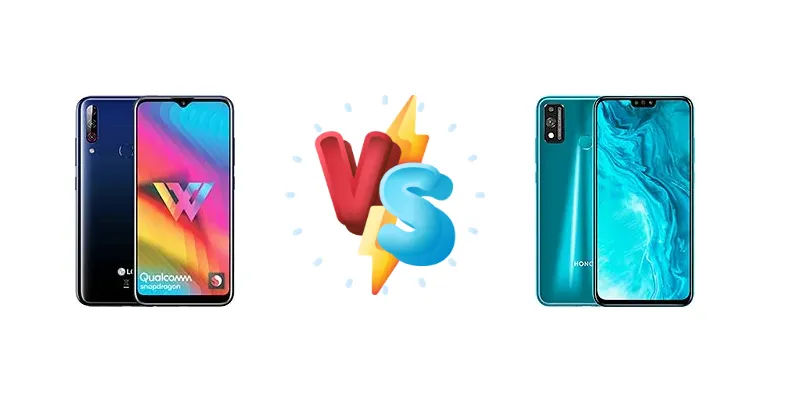
The LG W30 Pro and Honor 9X Lite represent compelling options in the crowded budget smartphone market. While both aim to deliver essential features at an accessible price point, they diverge significantly in their core hardware. This comparison dissects the differences between the Qualcomm Snapdragon 632 and Kirin 710F chipsets, evaluating their impact on performance, battery efficiency, and overall user experience.
🏆 Quick Verdict
For the average user prioritizing consistent performance and faster charging, the LG W30 Pro emerges as the better choice. While the Honor 9X Lite boasts a more modern 12nm process, the Snapdragon 632’s optimized architecture and quicker charging capabilities provide a smoother, more convenient daily experience.
| Network |
|---|
| 2G bands | GSM 850 / 900 / 1800 / 1900 | GSM 850 / 900 / 1800 / 1900 |
| 3G bands | HSDPA 850 / 900 / 2100 | HSDPA 850 / 900 / 1900 / 2100 |
| 4G bands | 1, 3, 5, 8, 40, 41 | 1, 3, 7, 8, 20 |
| Speed | HSPA, LTE | HSPA 42.2/5.76 Mbps, LTE (2CA) Cat6 300/50 Mbps |
| Technology | GSM / HSPA / LTE | GSM / HSPA / LTE |
| Launch |
|---|
| Announced | 2019, June. Released 2019, October | 2020, April 17. Released 2020, May 14 |
| Status | Discontinued | Discontinued |
| Body |
|---|
| Dimensions | 157.7 x 75.9 x 8.3 mm (6.21 x 2.99 x 0.33 in) | 160.4 x 76.6 x 7.8 mm (6.31 x 3.02 x 0.31 in) |
| SIM | Nano-SIM + Nano-SIM | Nano-SIM + Nano-SIM |
| Weight | 172 g (6.07 oz) | 188 g (6.63 oz) |
| Display |
|---|
| Resolution | 720 x 1520 pixels, 19:9 ratio (~270 ppi density) | 1080 x 2340 pixels, 19.5:9 ratio (~397 ppi density) |
| Size | 6.22 inches, 96.6 cm2 (~80.7% screen-to-body ratio) | 6.5 inches, 103.2 cm2 (~84.0% screen-to-body ratio) |
| Type | IPS LCD | IPS LCD |
| Platform |
|---|
| CPU | Octa-core (4x1.8 GHz Kryo 250 Gold & 4x1.8 GHz Kryo 250 Silver) | Octa-core (4x2.2 GHz Cortex-A73 & 4x1.7 GHz Cortex-A53) |
| Chipset | Qualcomm SDM632 Snapdragon 632 (14 nm) | Kirin 710F (12 nm) |
| GPU | Adreno 506 | Mali-G51 MP4 |
| OS | Android 9.0 (Pie) | Android 9.0 (Pie), EMUI 9.1, Google Play Services |
| Memory |
|---|
| Card slot | microSDXC (dedicated slot) | microSDXC (dedicated slot) |
| Internal | 64GB 4GB RAM | 128GB 4GB RAM |
| | eMMC 5.1 | - |
| Main Camera |
|---|
| Dual | - | 48 MP, f/1.8, (wide), 1/2.0", 0.8µm, PDAF
Auxiliary lens |
| Features | LED flash, panorama, HDR | LED flash, HDR, panorama |
| Triple | 13 MP, PDAF
8 MP, 13mm (ultrawide), 1/4.0", 1.12µm
Auxiliary lens | - |
| Video | 4K@30fps, 1080p@30fps | 1080p@30fps |
| Selfie camera |
|---|
| Single | 16 MP, f/2.2, (wide), 1/3.06", 1.0µm | 8 MP, f/2.0, (wide) |
| Video | 1080p@30fps | 1080p@30fps |
| Sound |
|---|
| 3.5mm jack | Yes | Yes |
| 35mm jack | Yes | Yes |
| Loudspeaker | Yes | Yes |
| Comms |
|---|
| Bluetooth | 4.2, A2DP, LE | 4.2, A2DP, LE |
| NFC | No | Yes (market/region dependent) |
| Positioning | GPS, GLONASS | GPS, GLONASS, BDS |
| Radio | FM radio | FM radio |
| USB | USB Type-C 2.0, OTG | microUSB 2.0 |
| WLAN | Wi-Fi 802.11 b/g/n, Wi-Fi Direct | Wi-Fi 802.11 a/b/g/n/ac, dual-band, Wi-Fi Direct |
| Features |
|---|
| Sensors | Fingerprint (rear-mounted), accelerometer, gyro, proximity | Fingerprint (rear-mounted), accelerometer, proximity, compass |
| Battery |
|---|
| Charging | Wired, 50% in 35 min | 10W wired |
| Type | Li-Po 4050 mAh, non-removable | Li-Po 3750 mAh |
| Misc |
|---|
| Colors | Midnight Blue, Midnight Purple | Emerald Green, Midnight Black |
| Models | LMX600IM, LM-X600IM | JSN-L21, JSN-L22, JSN-L23 |
| Price | About 190 EUR | About 220 EUR |
LG W30 Pro
- Faster charging (50% in 35 min)
- Optimized Snapdragon 632 architecture
- Potentially smoother multitasking
- 14nm process may run slightly warmer
- Display specs unknown, potentially lower quality
Honor 9X Lite
- 12nm Kirin 710F process (potentially better efficiency)
- Potentially cooler operating temperatures
- Slightly newer chipset
- Slower 10W charging
- Older Cortex-A73 cores
- Potentially less consistent performance
Display Comparison
Display specifications are not provided in the context data. However, given the price bracket, both devices likely feature LCD panels with 720p+ resolution. The Honor 9X Lite, being a slightly newer device, *may* benefit from slightly improved color accuracy or viewing angles, but this is speculative. Bezels are likely comparable, reflecting the cost-conscious design of both phones.
Camera Comparison
Camera details are limited. Both phones likely feature a multi-camera setup, but the quality will heavily depend on sensor size and image processing. Without specific sensor information, it’s difficult to declare a clear winner. The presence of a 2MP macro lens on either device is unlikely to significantly impact image quality; these are often included for marketing purposes rather than practical benefit. Image processing algorithms will be a key differentiator, and brand reputation suggests LG may have a slight edge in color science.
Performance
The core difference lies in the chipsets. The Honor 9X Lite’s Kirin 710F, fabricated on a 12nm process, theoretically offers better power efficiency than the LG W30 Pro’s 14nm Snapdragon 632. However, the Kirin 710F’s Cortex-A73 cores, while clocked higher at 2.2 GHz, are older architecture compared to the Snapdragon 632’s Kryo 250 Gold cores (1.8 GHz). The Snapdragon 632’s architecture is optimized for sustained performance, potentially leading to smoother multitasking and gaming. The Snapdragon 632’s GPU is also likely to provide a more consistent frame rate in graphically intensive games. Users prioritizing responsiveness will likely find the Snapdragon 632 more satisfying.
Battery Life
Battery capacity is not specified. However, the LG W30 Pro’s 50% charge in 35 minutes represents a significant advantage over the Honor 9X Lite’s 10W wired charging. This faster charging speed translates to less downtime and greater convenience for users. Even with a comparable battery capacity, the LG W30 Pro’s charging speed makes it the more practical choice for users who need to quickly top up their phone throughout the day. The 12nm process of the Kirin 710F *could* lead to slightly better battery life under light usage, but the faster charging of the LG W30 Pro likely negates this benefit for most users.
Buying Guide
Buy the LG W30 Pro if you need a phone that feels responsive during everyday tasks and benefits from significantly faster charging speeds. This is ideal for users who frequently use their phone on the go and dislike long charging waits. Buy the Honor 9X Lite if you prioritize a potentially slightly cooler operating temperature due to the 12nm process and are willing to accept slower charging and potentially less consistent performance in demanding applications.
Frequently Asked Questions
❓ Will the Kirin 710F overheat during prolonged gaming sessions?
While the 12nm process of the Kirin 710F is more efficient, the Snapdragon 632’s architecture is optimized for sustained performance. Overheating is unlikely to be a major issue on either device, but the Snapdragon 632 may maintain higher frame rates for longer periods without significant throttling.
❓ How much faster is the LG W30 Pro's charging compared to the Honor 9X Lite?
The LG W30 Pro charges to 50% in 35 minutes, while the Honor 9X Lite uses a standard 10W charger. This means the LG W30 Pro can add a substantial amount of charge in the time it takes the Honor 9X Lite to reach a minimal usable level, offering a significant convenience advantage.
❓ Is the difference in CPU architecture between the Snapdragon 632 and Kirin 710F noticeable in everyday use?
Yes, the Snapdragon 632’s Kryo 250 Gold cores are based on a newer architecture than the Kirin 710F’s Cortex-A73 cores. This translates to smoother app launches, faster multitasking, and a more responsive user interface, particularly when switching between applications.