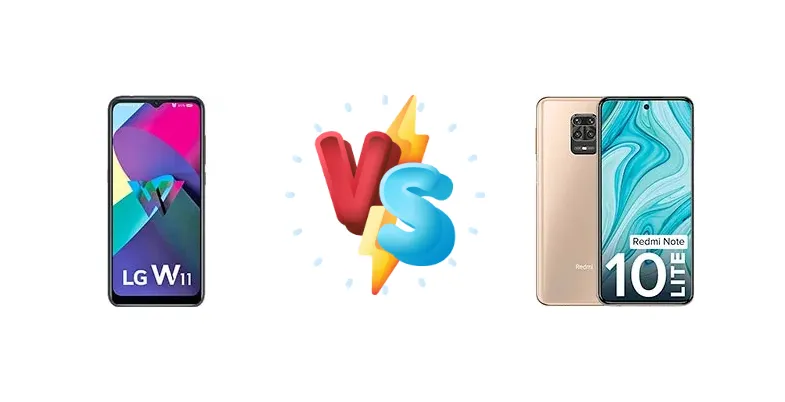
Both the LG W11 and the Xiaomi Redmi Note 10 Lite target the budget-conscious smartphone user, but they approach this segment with vastly different hardware. The LG W11 relies on the older Mediatek Helio P22, while the Redmi Note 10 Lite boasts the more modern Qualcomm Snapdragon 720G. This comparison dissects these differences to determine which device delivers the best experience for your money.
🏆 Quick Verdict
For the vast majority of users, the Xiaomi Redmi Note 10 Lite is the clear winner. Its Snapdragon 720G chipset provides a substantial performance uplift over the LG W11’s Helio P22, coupled with faster 18W charging. While the LG W11 may be slightly more affordable in some markets, the Redmi Note 10 Lite’s superior processing power and efficiency justify the price difference.
| Network |
|---|
| 2G bands | GSM 850 / 900 / 1800 / 1900 | GSM 850 / 900 / 1800 / 1900 |
| 3G bands | HSDPA 850 / 900 / 2100 | HSDPA 850 / 900 / 1700(AWS) / 1900 / 2100 |
| 4G bands | 1, 3, 5, 8, 40, 41 | 1, 2, 3, 4, 5, 7, 8, 20, 28, 38, 40, 41 |
| Speed | HSPA, LTE | HSPA, LTE |
| Technology | GSM / HSPA / LTE | GSM / HSPA / LTE |
| Launch |
|---|
| Announced | 2020, November 06 | 2021, October 01 |
| Status | Cancelled | Available. Released 2021, October 02 |
| Body |
|---|
| Build | - | Glass front (Gorilla Glass 5), glass back (Gorilla Glass 5), plastic frame |
| Dimensions | 166.2 x 76.3 x 8.4 mm (6.54 x 3.00 x 0.33 in) | 165.8 x 76.7 x 8.8 mm (6.53 x 3.02 x 0.35 in) |
| SIM | Nano-SIM + Nano-SIM | Nano-SIM + Nano-SIM |
| Weight | - | 209 g (7.37 oz) |
| | - | Water-repellent coating |
| Display |
|---|
| Protection | - | Corning Gorilla Glass 5 |
| Resolution | 720 x 1600 pixels, 20:9 ratio (~269 ppi density) | 1080 x 2400 pixels, 20:9 ratio (~395 ppi density) |
| Size | 6.52 inches, 102.6 cm2 (~80.9% screen-to-body ratio) | 6.67 inches, 107.4 cm2 (~84.5% screen-to-body ratio) |
| Type | IPS LCD | IPS LCD |
| Platform |
|---|
| CPU | Octa-core 2.0 GHz Cortex-A53 | Octa-core (2x2.3 GHz Kryo 465 Gold & 6x1.8 GHz Kryo 465 Silver) |
| Chipset | Mediatek MT6762 Helio P22 (12 nm) | Qualcomm SM7125 Snapdragon 720G (8 nm) |
| GPU | PowerVR GE8320 | Adreno 618 |
| OS | Android 10 | Android 10, MIUI 11 |
| Memory |
|---|
| Card slot | microSDXC (dedicated slot) | microSDXC (dedicated slot) |
| Internal | 32GB 3GB RAM | 64GB 4GB RAM, 64GB 6GB RAM, 128GB 4GB RAM, 128GB 6GB RAM |
| | eMMC 5.1 | - |
| Main Camera |
|---|
| Dual | 13 MP, (wide), PDAF
Auxiliary lens | - |
| Features | LED flash, panorama, HDR | LED flash, HDR, panorama |
| Quad | - | 48 MP, f/1.9, 26mm (wide), 0.8µm, PDAF
8 MP, f/2.2, 119˚ (ultrawide), 1/4.0", 1.12µm
5 MP (macro), AF
Auxiliary lens |
| Single | - | 16 MP, f/2.5, (wide), 1/3.06", 1.0µm |
| Video | 1080p@30fps | 4K@30fps, 1080p@30/60/120fps, 720p@960fps, gyro-EIS |
| Selfie camera |
|---|
| Features | - | HDR, panorama |
| Single | 8 MP, (wide) | 16 MP, f/2.5, (wide), 1/3.06", 1.0µm |
| Video | 1080p@30fps | 1080p@30fps |
| Sound |
|---|
| 3.5mm jack | Yes | Yes |
| 35mm jack | Yes | Yes |
| Loudspeaker | Yes | Yes |
| Comms |
|---|
| Bluetooth | 4.2, A2DP, LE | 5.0, A2DP, LE |
| Infrared port | - | Yes |
| NFC | No | Yes |
| Positioning | GPS, GLONASS | GPS, GLONASS, GALILEO, BDS, NavIC |
| Radio | FM radio | FM radio, recording |
| USB | USB Type-C 2.0, OTG | USB Type-C 2.0 |
| WLAN | Wi-Fi 802.11 b/g/n, Wi-Fi Direct | Wi-Fi 802.11 a/b/g/n/ac, dual-band, Wi-Fi Direct |
| Features |
|---|
| Sensors | Accelerometer | Fingerprint (side-mounted), accelerometer, gyro, proximity, compass |
| Battery |
|---|
| Charging | - | 18W wired |
| Type | Li-Po 4000 mAh | Li-Po 5020 mAh |
| Misc |
|---|
| Colors | Midnight Blue | Aurora Blue, Glacier White, Interstellar Black, Champagne Gold |
| Models | LM-K310IM | M2002F4LG |
| Price | About 110 EUR | About 200 EUR |
| SAR | - | 1.17 W/kg (head) 0.86 W/kg (body) |
| SAR EU | - | 1.01 W/kg (head) 1.39 W/kg (body) |
LG W11
- Potentially lower price point
- Simple and straightforward user experience
- May be more readily available in certain regions
- Significantly weaker performance
- Slower charging speeds
- Less efficient processor
Xiaomi Redmi Note 10 Lite
- Superior performance with Snapdragon 720G
- Faster 18W charging
- More efficient processor for longer battery life
- May be slightly more expensive
- Software experience (MIUI) can be polarizing
- Potentially more bloatware
Display Comparison
Neither device is known for a standout display. Both likely feature LCD panels, typical for this price bracket. However, the comparison centers on the underlying processing power impacting UI smoothness. Display specs beyond panel type are unavailable, so we can only infer that the Redmi Note 10 Lite’s more powerful GPU will contribute to a more responsive visual experience, especially during scrolling and animations.
Camera Comparison
Without detailed camera specifications, a direct comparison is difficult. However, the Redmi Note 10 Lite’s more powerful ISP (Image Signal Processor) within the Snapdragon 720G will likely result in better image processing, particularly in challenging lighting conditions. While both phones likely feature a primary camera, the Redmi Note 10 Lite’s chipset allows for more sophisticated computational photography features. The LG W11’s Helio P22 is less capable in this regard, potentially leading to softer images and less dynamic range.
Performance
The core difference lies in the chipsets. The Xiaomi Redmi Note 10 Lite’s Qualcomm Snapdragon 720G, built on an 8nm process, is a significant leap forward from the LG W11’s Mediatek Helio P22 (12nm). The Snapdragon 720G’s octa-core configuration (2x2.3 GHz Kryo 465 Gold & 6x1.8 GHz Kryo 465 Silver) offers substantially higher clock speeds and a more efficient architecture than the Helio P22’s 2.0 GHz Cortex-A53 cores. This translates to faster app launches, smoother multitasking, and a more enjoyable gaming experience on the Redmi Note 10 Lite. The 8nm process also contributes to better thermal management, reducing the likelihood of performance throttling under sustained load.
Battery Life
Battery capacity is not specified for either device. However, the Redmi Note 10 Lite’s 18W wired charging is a clear advantage over the LG W11, which likely supports slower charging speeds. The Snapdragon 720G’s improved power efficiency also contributes to better battery life, meaning the Redmi Note 10 Lite will likely last longer on a single charge, even with similar battery capacities. The faster charging also minimizes downtime, getting you back up and running quicker.
Buying Guide
Buy the LG W11 if your primary need is a very basic smartphone for essential tasks like calls, texts, and light social media, and you are operating on an extremely tight budget. Buy the Xiaomi Redmi Note 10 Lite if you prioritize smoother multitasking, occasional gaming, faster app loading times, and quicker charging – all without breaking the bank. The Redmi Note 10 Lite is the better choice for anyone who wants a phone that can handle more than just the basics.
Frequently Asked Questions
❓ Will the Redmi Note 10 Lite handle demanding games like PUBG Mobile smoothly?
The Snapdragon 720G in the Redmi Note 10 Lite is capable of running PUBG Mobile at medium to high settings with reasonable frame rates. While it won't deliver a flagship-level gaming experience, it's a significant improvement over the Helio P22 in the LG W11, which would struggle with consistent performance.
❓ Is the difference in performance between the Helio P22 and Snapdragon 720G noticeable in everyday tasks?
Absolutely. The Snapdragon 720G offers a much snappier experience when opening apps, switching between tasks, and browsing the web. The LG W11’s Helio P22 can feel sluggish in comparison, especially with multiple apps open. The difference is most apparent during multitasking.
❓ Does the Redmi Note 10 Lite support fast charging protocols beyond 18W?
While the Redmi Note 10 Lite officially supports 18W charging, it is compatible with Qualcomm’s Quick Charge 3.0. Using a compatible charger may result in slightly faster charging speeds, though the difference will likely be marginal.
❓ How does the software experience differ between the LG W11 and the Redmi Note 10 Lite?
The LG W11 likely runs a relatively stock version of Android, offering a cleaner and simpler user interface. The Redmi Note 10 Lite runs Xiaomi’s MIUI, which is heavily customized and includes numerous features, but can also come with pre-installed bloatware. User preference will dictate which experience is better.