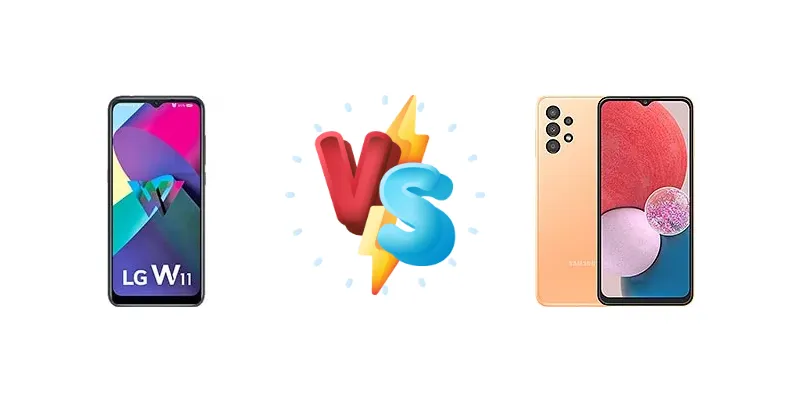
The LG W11 and Samsung Galaxy A13 represent two approaches to the ultra-budget smartphone market. The W11, an older model, focuses on providing basic functionality at a low price point. The A13, while still affordable, aims to deliver a more modern experience with a more powerful chipset and improved display technology. This comparison dissects the key differences to help you determine which device best suits your needs.
🏆 Quick Verdict
For most users, the Samsung Galaxy A13 is the superior choice. Its Exynos 850 chipset provides a significant performance boost over the LG W11’s Helio P22, resulting in smoother multitasking and a more responsive user experience. While both phones offer similar battery endurance, the A13’s brighter display and more modern features justify the slight price premium.
| Network |
|---|
| 2G bands | GSM 850 / 900 / 1800 / 1900 | GSM 850 / 900 / 1800 / 1900 |
| 3G bands | HSDPA 850 / 900 / 2100 | HSDPA 850 / 900 / 2100 |
| 4G bands | 1, 3, 5, 8, 40, 41 | 1, 3, 5, 7, 8, 20, 28, 38, 40, 41 |
| Speed | HSPA, LTE | HSPA, LTE |
| Technology | GSM / HSPA / LTE | GSM / HSPA / LTE |
| Launch |
|---|
| Announced | 2020, November 06 | 2022, March 04 |
| Status | Cancelled | Available. Released 2022, March 23 |
| Body |
|---|
| Build | - | Glass front (Gorilla Glass 5), plastic frame, plastic back |
| Dimensions | 166.2 x 76.3 x 8.4 mm (6.54 x 3.00 x 0.33 in) | 165.1 x 76.4 x 8.8 mm (6.5 x 3.01 x 0.35 in) |
| SIM | Nano-SIM + Nano-SIM | · Nano-SIM· Nano-SIM + Nano-SIM |
| Weight | - | 195 g (6.88 oz) |
| Display |
|---|
| Protection | - | Corning Gorilla Glass 5 |
| Resolution | 720 x 1600 pixels, 20:9 ratio (~269 ppi density) | 1080 x 2408 pixels, 20:9 ratio (~400 ppi density) |
| Size | 6.52 inches, 102.6 cm2 (~80.9% screen-to-body ratio) | 6.6 inches, 104.9 cm2 (~83.2% screen-to-body ratio) |
| Type | IPS LCD | PLS LCD |
| Platform |
|---|
| CPU | Octa-core 2.0 GHz Cortex-A53 | Octa-core (4x2.0 GHz Cortex-A55 & 4x2.0 GHz Cortex-A55) |
| Chipset | Mediatek MT6762 Helio P22 (12 nm) | Exynos 850 (8 nm) |
| GPU | PowerVR GE8320 | Mali-G52 |
| OS | Android 10 | Android 12, upgradable to Android 14, One UI 6.1 |
| Memory |
|---|
| Card slot | microSDXC (dedicated slot) | microSDXC (dedicated slot) |
| Internal | 32GB 3GB RAM | 32GB 3GB RAM, 32GB 4GB RAM, 64GB 4GB RAM, 128GB 3GB RAM, 128GB 4GB RAM, 128GB 6GB RAM |
| | eMMC 5.1 | eMMC 5.1 |
| Main Camera |
|---|
| Dual | 13 MP, (wide), PDAF
Auxiliary lens | - |
| Features | LED flash, panorama, HDR | LED flash, panorama, HDR |
| Quad | - | 50 MP, f/1.8, (wide), PDAF
5 MP, f/2.2, 123˚ (ultrawide), 1/5.0", 1.12µm
2 MP (macro)
Auxiliary lens |
| Single | - | 8 MP, f/2.2, (wide) |
| Video | 1080p@30fps | 1080p@30fps |
| Selfie camera |
|---|
| Single | 8 MP, (wide) | 8 MP, f/2.2, (wide) |
| Video | 1080p@30fps | 1080p@30fps |
| Sound |
|---|
| 3.5mm jack | Yes | Yes |
| 35mm jack | Yes | Yes |
| Loudspeaker | Yes | Yes |
| Comms |
|---|
| Bluetooth | 4.2, A2DP, LE | 5.0, A2DP, LE |
| NFC | No | Yes (market/region dependent) |
| Positioning | GPS, GLONASS | GPS, GLONASS, GALILEO, BDS |
| Radio | FM radio | No |
| USB | USB Type-C 2.0, OTG | USB Type-C 2.0, OTG |
| WLAN | Wi-Fi 802.11 b/g/n, Wi-Fi Direct | Wi-Fi 802.11 a/b/g/n/ac, dual-band, Wi-Fi Direct |
| Features |
|---|
| Sensors | Accelerometer | Fingerprint (side-mounted), accelerometer, compass |
| | - | Virtual proximity sensing |
| Battery |
|---|
| Charging | - | 15W wired |
| Type | Li-Po 4000 mAh | Li-Po 5000 mAh |
| Misc |
|---|
| Colors | Midnight Blue | Black, White, Peach, Blue |
| Models | LM-K310IM | SM-A135F, SM-A135F/DS, SM-A135M, SM-A135U, SM-A135U1, SM-A135N |
| Price | About 110 EUR | € 94.99 / $ 129.99 / £ 89.00 |
| SAR | - | 0.49 W/kg (head) |
| SAR EU | - | 0.37 W/kg (head) 1.39 W/kg (body) |
| Tests |
|---|
| Battery life | - |
Endurance rating 114h
|
| Camera | - |
Photo / Video |
| Display | - |
Contrast ratio: 1324:1 (nominal) |
| Loudspeaker | - |
-29.7 LUFS (Average)
|
| Performance | - |
AnTuTu: 122822 (v8), 136286 (v9)
GeekBench: 588 (v5.1)
GFXBench: 5.2fps (ES 3.1 onscreen) |
LG W11
- Lowest possible price point
- Functional for basic tasks
- Decent battery endurance
- Outdated processor
- Dim and less vibrant display
- Limited performance for demanding apps
Samsung Galaxy A13
- Significantly faster processor
- Brighter and more vibrant display
- Faster charging
- More modern features
- Slightly higher price
- 2MP macro camera is largely ineffective
- Still a budget device with limitations
Display Comparison
The Samsung Galaxy A13 boasts a significantly more appealing display experience. While both screens share a 1324:1 contrast ratio, the A13’s measured peak brightness of 587 nits is considerably higher than what’s expected from the W11’s panel. This translates to better visibility outdoors and a more vibrant image. The W11’s display, while functional, will likely appear dimmer and less saturated in comparison. The A13’s larger screen size (not specified in data, but typical for the A series) also contributes to a more immersive viewing experience.
Camera Comparison
Both devices feature 'Photo / Video' capabilities, but the specifics are unknown. Given the market positioning, it’s safe to assume both cameras prioritize affordability over image quality. Without sensor size or aperture data, it’s difficult to make a definitive judgment. However, Samsung’s image processing algorithms generally offer more refined results than LG’s, potentially giving the A13 an edge in image quality. The inclusion of a 2MP macro camera on the A13 is unlikely to be a significant benefit, as these sensors typically lack the detail and clarity needed for compelling macro photography.
Performance
The performance gap between these two devices is substantial. The Samsung Galaxy A13’s Exynos 850, built on an 8nm process, is a clear upgrade over the LG W11’s 12nm Mediatek Helio P22. The Exynos 850 utilizes a more efficient architecture with Cortex-A55 cores across all eight cores, whereas the Helio P22 uses older Cortex-A53 cores. This results in faster app loading times, smoother multitasking, and improved overall responsiveness on the A13. While both CPUs are clocked at 2.0 GHz, the architectural improvements of the Exynos chip provide a tangible performance advantage.
Battery Life
Both the LG W11 and Samsung Galaxy A13 achieve an endurance rating of 114 hours, suggesting comparable battery life under similar usage conditions. However, the A13’s 15W wired charging is faster than what the W11 likely offers (based on its market segment), allowing for quicker top-ups. While the battery capacity isn’t specified for either device, the more efficient Exynos 850 in the A13 may contribute to slightly longer real-world battery life, even with a similar capacity.
Buying Guide
Buy the LG W11 if you absolutely need the lowest possible price and only require a phone for basic tasks like calls, texts, and light web browsing. It’s a functional device for those with minimal smartphone needs. Buy the Samsung Galaxy A13 if you prioritize performance, a better viewing experience, and a more future-proof device. The A13 is ideal for users who enjoy social media, streaming videos, or playing casual games.
Frequently Asked Questions
❓ Does the Exynos 850 in the Galaxy A13 get hot during extended gaming sessions?
The Exynos 850 is a relatively efficient chip. While it will warm up during prolonged gaming, it’s unlikely to experience significant thermal throttling, providing a consistently playable experience for most mobile games. The 8nm process node contributes to better heat dissipation compared to the LG W11’s Helio P22.
❓ Is the LG W11 a good choice for elderly users who primarily make calls and send texts?
Yes, the LG W11 is a suitable option for users with basic needs. Its simplicity and low price make it an accessible choice for those who primarily use a phone for communication. However, the smaller screen and slower performance may be frustrating for some.
❓ How much storage does the Samsung Galaxy A13 typically come with, and is it expandable?
While not specified in the provided data, the Samsung Galaxy A13 typically comes with 32GB or 64GB of internal storage and supports microSD card expansion, allowing you to add up to 1TB of additional storage for photos, videos, and other files.
❓ Will the LG W11 receive future software updates?
Given its age and market positioning, it's unlikely the LG W11 will receive significant software updates beyond security patches. The Samsung Galaxy A13 is more likely to receive at least one major Android version update, offering a longer software support lifespan.