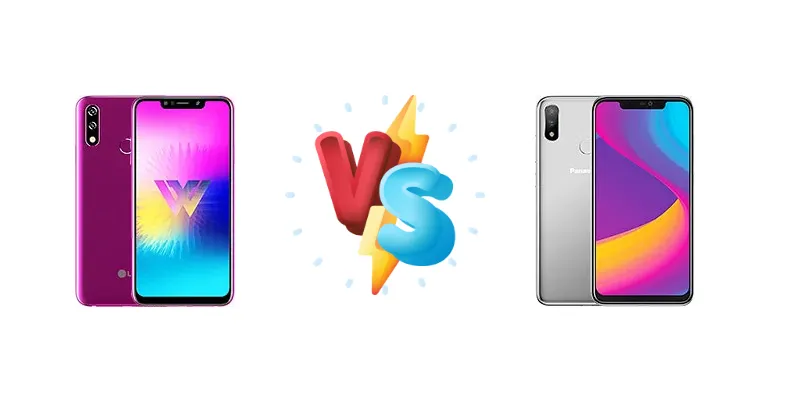
The LG W10 and Panasonic Eluga X1 Pro represent a segment of the market focused on affordability. While both devices aim to deliver a smartphone experience without breaking the bank, they differ significantly in their core processing power. This comparison dissects the key differences between the Mediatek Helio P22 in the W10 and the Helio P60 in the Eluga X1 Pro, helping you determine which device best suits your needs.
🏆 Quick Verdict
For the average user prioritizing responsiveness and multitasking, the Panasonic Eluga X1 Pro is the clear winner. Its Helio P60 chipset, featuring Cortex-A73 cores, offers a substantial performance uplift over the LG W10’s Helio P22. While the W10 may suffice for basic tasks, the X1 Pro provides a smoother, more capable experience.
| Network |
|---|
| 2G bands | GSM 850 / 900 / 1800 / 1900 | GSM 850 / 900 / 1800 / 1900 |
| 3G bands | HSDPA 850 / 900 / 1900 / 2100 | HSDPA 850 / 900 / 1900 / 2100 |
| 4G bands | 1, 3, 5, 8, 40, 41 | 1, 2, 3, 5, 7, 8, 20, 38, 39, 40, 41 |
| Speed | HSPA, LTE | HSPA 42.2/5.76 Mbps, LTE (2CA) Cat13 600/50 Mbps |
| Technology | GSM / HSPA / LTE | GSM / HSPA / LTE |
| Launch |
|---|
| Announced | 2019, June. Released 2019, July | 2018, October. Released 2018, October |
| Status | Discontinued | Discontinued |
| Body |
|---|
| Build | - | Glass front (Gorilla Glass 3), glass back, stainless steel frame |
| Dimensions | 156 x 76.2 x 8.5 mm (6.14 x 3.00 x 0.33 in) | 155 x 75.5 x 7.9 mm (6.10 x 2.97 x 0.31 in) |
| SIM | · Nano-SIM· Nano-SIM + Nano-SIM | Nano-SIM + Micro-SIM |
| Weight | 164 g (5.78 oz) | 195 g (6.88 oz) |
| Display |
|---|
| Protection | - | Corning Gorilla Glass 3 |
| Resolution | 720 x 1512 pixels, 19:9 ratio (~271 ppi density) | 1080 x 2246 pixels, 18.7:9 ratio (~403 ppi density) |
| Size | 6.19 inches, 96.0 cm2 (~80.7% screen-to-body ratio) | 6.18 inches, 96.2 cm2 (~82.2% screen-to-body ratio) |
| Type | IPS LCD | IPS LCD |
| Platform |
|---|
| CPU | Octa-core 2.0 GHz Cortex-A53 | Octa-core (4x2.0 GHz Cortex-A73 & 4x2.0 GHz Cortex-A53) |
| Chipset | Mediatek MT6762 Helio P22 (12 nm) | Mediatek MT6771 Helio P60 (12 nm) |
| GPU | PowerVR GE8320 | Mali-G72 MP3 |
| OS | Android 9.0 (Pie) | Android 8.1 (Oreo) |
| Memory |
|---|
| Card slot | microSDXC (dedicated slot) | microSDXC (uses shared SIM slot) |
| Internal | 32GB 3GB RAM | 64GB 4GB RAM, 128GB 6GB RAM |
| | eMMC 5.1 | eMMC 5.1 |
| Main Camera |
|---|
| Dual | 13 MP, PDAF
Auxiliary lens | 16 MP, PDAF
Auxiliary lens |
| Features | LED flash, panorama, HDR | LED flash, panorama |
| Video | 1080p@30fps | 1080p@30fps |
| Selfie camera |
|---|
| Features | LED flash | 1080p@30fps |
| Single | 8 MP | 16 MP, f/2.2, 1/3.06", 1.0µm |
| Video | 1080p@30fps | - |
| Sound |
|---|
| 3.5mm jack | Yes | No |
| 35mm jack | Yes | No |
| Loudspeaker | Yes | Yes |
| Comms |
|---|
| Bluetooth | 4.2, A2DP, LE | 4.2, A2DP, LE |
| Infrared port | - | Yes |
| NFC | No | No |
| Positioning | GPS, GLONASS | GPS |
| Radio | FM radio | FM radio |
| USB | microUSB 2.0, OTG | USB Type-C 2.0, OTG |
| WLAN | Wi-Fi 802.11 b/g/n, Wi-Fi Direct | Wi-Fi 802.11 а/b/g/n, dual-band, Wi-Fi Direct |
| Features |
|---|
| Sensors | Fingerprint (rear-mounted), accelerometer, gyro, proximity | Infrared Face ID, fingerprint (rear-mounted), accelerometer, gyro, proximity, compass |
| Battery |
|---|
| Charging | - | 10W wired
Wireless |
| Type | Li-Po 4000 mAh, non-removable | Li-Ion 3000 mAh, non-removable |
| Misc |
|---|
| Colors | Tulip Purple, Smokey Grey | Dark Grey, Silver |
| Models | LMX130IM | - |
| Price | About 110 EUR | About 350 EUR |
LG W10
- Likely more affordable price point.
- Potentially longer battery life due to less powerful chipset (dependent on battery capacity).
- Simple and straightforward user experience.
- Significantly slower performance compared to the Eluga X1 Pro.
- Less capable for multitasking and demanding applications.
- Limited camera performance due to less advanced ISP.
Panasonic Eluga X1 Pro
- Superior performance thanks to the Helio P60 chipset.
- Faster app launch speeds and smoother multitasking.
- Wireless charging capability for added convenience.
- Potentially higher price compared to the LG W10.
- May experience slightly faster battery drain under heavy use.
- 10W charging is relatively slow compared to modern standards.
Display Comparison
Neither device’s display specifications are provided, so a direct comparison is limited. However, given their market positioning, it’s reasonable to assume both utilize IPS LCD panels. The lack of information regarding resolution, brightness, and color gamut makes it difficult to assess visual quality. Users should expect a standard viewing experience typical of budget smartphones.
Camera Comparison
Without detailed camera specifications, a precise comparison is impossible. However, the chipset difference indirectly impacts camera performance. The Helio P60’s image signal processor (ISP) is more advanced, enabling faster image processing and potentially better low-light performance. While both phones likely feature similar sensor resolutions in their primary cameras, the Eluga X1 Pro’s ISP will likely deliver superior image quality and faster capture speeds. The presence of wireless charging on the Eluga X1 Pro suggests a slightly more feature-rich overall package, potentially extending to camera features.
Performance
The core difference lies in the chipsets. The LG W10’s Mediatek Helio P22 (12nm) utilizes eight Cortex-A53 cores clocked at 2.0 GHz. This is a power-efficient but relatively slow architecture. Conversely, the Panasonic Eluga X1 Pro boasts the Mediatek Helio P60 (12nm), featuring a more sophisticated configuration: four Cortex-A73 cores at 2.0 GHz paired with four Cortex-A53 cores. The Cortex-A73 cores represent a significant architectural improvement, offering substantially higher single-core performance, crucial for app launch speeds and general responsiveness. This translates to a noticeably snappier experience on the Eluga X1 Pro, particularly when switching between applications or running demanding tasks. The P60 also benefits from a more powerful Mali-G72 MP3 GPU, offering better graphics performance than the P22’s Mali-T860 MP2.
Battery Life
Battery capacity isn’t specified for either device. However, the Helio P60 in the Eluga X1 Pro, despite being more powerful, is also a relatively efficient chip. The Eluga X1 Pro supports 10W wired and wireless charging, offering greater convenience and flexibility. The LG W10 likely only supports wired charging, and potentially at a slower rate. While a larger battery capacity on the W10 could offset the P60’s power draw, the X1 Pro’s charging options provide a tangible advantage for users who value convenience.
Buying Guide
Buy the LG W10 if you need a very basic smartphone for essential communication – calls, texts, and light social media – and prioritize a minimal financial investment. Buy the Panasonic Eluga X1 Pro if you prefer a more responsive device capable of handling moderate multitasking, occasional gaming, and a smoother overall user experience, even if it means a slightly higher price point.
Frequently Asked Questions
❓ Will the Panasonic Eluga X1 Pro handle popular games like PUBG Mobile smoothly?
The Helio P60 is capable of running PUBG Mobile, but likely at medium settings to maintain a stable frame rate. The Mali-G72 MP3 GPU isn't a high-end gaming chip, so don't expect maximum graphical fidelity. The LG W10’s Helio P22 would struggle significantly with PUBG Mobile, offering a less enjoyable experience.
❓ Is the difference in performance between the Helio P60 and P22 noticeable in everyday tasks like browsing and social media?
Yes, the difference is quite noticeable. The Helio P60’s Cortex-A73 cores provide a significant boost in responsiveness, resulting in faster app loading times, smoother scrolling, and a more fluid overall experience when browsing the web or using social media apps. The LG W10’s Helio P22 will feel comparatively sluggish.
❓ Does the Panasonic Eluga X1 Pro's wireless charging significantly impact charging speed?
No, 10W wireless charging is relatively slow. While convenient, it will take considerably longer to charge the Eluga X1 Pro wirelessly compared to using a wired charger. Expect a full charge to take several hours via wireless charging.