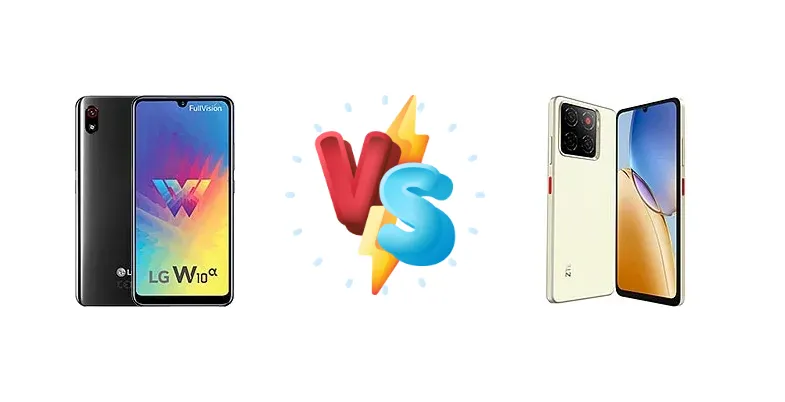
The LG W10 Alpha and ZTE Blade A56 represent the ultra-budget end of the Android spectrum. Both rely on Unisoc chipsets to deliver a smartphone experience at a minimal cost. However, significant differences in chipset architecture and battery endurance create a clear distinction between these two devices, impacting performance and usability for different types of users.
🏆 Quick Verdict
For most users, the ZTE Blade A56 emerges as the better choice. Its newer Unisoc T7200 chipset, built on a more efficient 12nm process, coupled with impressive 56-hour battery endurance, provides a smoother and longer-lasting experience than the LG W10 Alpha's older, less efficient platform.
| Network |
|---|
| 2G bands | GSM 850 / 900 / 1800 / 1900 | GSM 850 / 900 / 1800 / 1900 |
| 3G bands | HSDPA 850 / 900 / 2100 | HSDPA 850 / 900 / 1900 / 2100 |
| 4G bands | 1, 3, 5, 8, 40, 41 | 1, 3, 5, 7, 8, 20, 28, 38, 40, 41 |
| Speed | HSPA 42.2/5.76 Mbps, LTE (2CA) Cat13 600/150 Mbps | HSPA, LTE |
| Technology | GSM / HSPA / LTE | GSM / HSPA / LTE |
| Launch |
|---|
| Announced | 2020, February 19. Released 2020, February 19 | 2025, June 11 |
| Status | Discontinued | Available. Released 2025, July |
| Body |
|---|
| Dimensions | 147.3 x 71 x 8.9 mm (5.80 x 2.80 x 0.35 in) | 167.6 x 77.4 x 8.3 mm (6.60 x 3.05 x 0.33 in) |
| SIM | Nano-SIM + Nano-SIM | Nano-SIM + Nano-SIM |
| Weight | 170 g (6.00 oz) | 193 g (6.81 oz) |
| Display |
|---|
| Protection | - | Mohs level 4 |
| Resolution | 720 x 1512 pixels, 19:9 ratio (~293 ppi density) | 720 x 1600 pixels, 20:9 ratio (~260 ppi density) |
| Size | 5.71 inches, 81.7 cm2 (~78.1% screen-to-body ratio) | 6.75 inches, 110.0 cm2 (~84.8% screen-to-body ratio) |
| Type | IPS LCD | IPS LCD, 90Hz |
| Platform |
|---|
| CPU | Octa-core (4x1.6 GHz Cortex-A55 & 4x1.2 GHz Cortex-A55) | Octa-core (2x1.6 GHz Cortex-A75 & 6x1.6 GHz Cortex-A55) |
| Chipset | Unisoc SC9863A (28 nm) | Unisoc T7200 (12 nm) |
| GPU | IMG8322 | Mali-G57 MP1 |
| OS | Android 9.0 (Pie) | Android 15 |
| Memory |
|---|
| Card slot | microSDXC (dedicated slot) | microSDXC (dedicated slot) |
| Internal | 32GB 3GB RAM | 64GB 4GB RAM, 128GB 4GB RAM |
| | eMMC 5.1 | - |
| Main Camera |
|---|
| Features | LED flash, panorama, HDR | LED flash |
| Single | 8 MP, AF | 13 MP, AF
Auxiliary lenses |
| Video | 1080p@30fps | 1080p@30fps |
| Selfie camera |
|---|
| Single | 8 MP | 8 MP |
| Video | 720p@30fps | Yes |
| Sound |
|---|
| 3.5mm jack | Yes | - |
| 35mm jack | Yes | Yes |
| Loudspeaker | Yes | Yes |
| Comms |
|---|
| Bluetooth | 4.1, A2DP, LE | 5.2, A2DP, LE |
| NFC | No | No |
| Positioning | GPS | GPS, GALILEO, GLONASS |
| Radio | FM radio | FM radio |
| USB | microUSB 2.0, OTG | USB Type-C 2.0, OTG |
| WLAN | Wi-Fi 802.11 b/g/n, Wi-Fi Direct | Wi-Fi 802.11 b/g/n |
| Features |
|---|
| Sensors | Accelerometer, proximity | Fingerprint (side-mounted), accelerometer |
| Battery |
|---|
| Charging | - | 10W wired |
| Type | Li-Po 3450 mAh | Li-Po 5000 mAh |
| Misc |
|---|
| Colors | Black, Blue | Black, Yellow |
| Models | LMX210, LMX210LMW, LM-X210LMW | Z2473 |
| Price | About 130 EUR | € 69.00 / $ 87.12 / £ 66.75 |
| EU LABEL |
|---|
| Battery | - | 56:03h endurance, 800 cycles |
| Energy | - | Class A |
| Free fall | - | Class D (80 falls) |
| Repairability | - | Class B |
LG W10 Alpha
- Potentially lower initial purchase price.
- Simple and straightforward user experience.
- Compact form factor (likely).
- Older, less efficient Unisoc SC9863A chipset.
- Likely shorter battery life.
- Limited performance for multitasking.
ZTE Blade A56
- More powerful and efficient Unisoc T7200 chipset.
- Exceptional battery life (56:03h endurance).
- 800 charge cycles indicate long-term battery health.
- 10W charging is relatively slow.
- May be slightly more expensive than the LG W10 Alpha.
- Basic camera performance expected.
Display Comparison
Neither LG nor ZTE provide display specifications beyond the basic screen size. Given the price point, both likely utilize IPS LCD panels with 720p+ resolution. The lack of detailed specs makes a direct comparison impossible, but it's safe to assume both displays prioritize affordability over color accuracy or brightness. Expect noticeable limitations in outdoor visibility.
Camera Comparison
Detailed camera specifications are unavailable for either device. However, given their market segment, it’s reasonable to expect basic camera setups focused on affordability. The absence of information suggests neither phone will excel in image quality, particularly in low-light conditions. Any included 'macro' lenses are likely to be low-resolution and offer minimal benefit. Image processing will likely be basic, prioritizing speed over detail.
Performance
The ZTE Blade A56’s Unisoc T7200 represents a significant architectural leap over the LG W10 Alpha’s Unisoc SC9863A. The T7200 features a combination of 2x Cortex-A75 cores and 6x Cortex-A55 cores, offering a substantial performance boost in CPU-intensive tasks compared to the Alpha’s all Cortex-A55 configuration. The 12nm fabrication process of the T7200 also contributes to improved power efficiency. While both are entry-level chips, the A75 cores in the Blade A56 will provide a more responsive experience when switching between apps or loading heavier websites. The SC9863A, built on a 28nm process, will likely struggle with more demanding applications.
Battery Life
The ZTE Blade A56 boasts a remarkable 56:03h endurance rating and 800 charge cycles, a clear advantage over the LG W10 Alpha (battery capacity unspecified). This translates to significantly longer usage between charges, making the Blade A56 ideal for users who are frequently away from a power source. The 10W wired charging on the Blade A56 is relatively slow, but the exceptional battery life mitigates this limitation. The LG W10 Alpha, lacking comparable battery endurance data, will likely require more frequent charging.
Buying Guide
Buy the LG W10 Alpha if you prioritize a potentially lower upfront cost and are comfortable with a more basic user experience. It's suitable for users who primarily need a phone for calls, texts, and very light app usage. Buy the ZTE Blade A56 if you value longer battery life, slightly improved performance for multitasking, and a more modern chipset architecture, making it a better fit for users who stream videos, browse the web, or use social media regularly.
Frequently Asked Questions
❓ Is the Unisoc T7200 in the ZTE Blade A56 capable of running popular social media apps smoothly?
Yes, the Unisoc T7200, with its Cortex-A75 cores, is sufficiently powerful to run popular social media apps like Facebook, Instagram, and TikTok without significant lag. While it won't offer a flagship-level experience, it provides a noticeably smoother experience than the LG W10 Alpha's SC9863A, especially when multitasking.
❓ How does the 12nm process of the Unisoc T7200 impact the ZTE Blade A56's battery life compared to the LG W10 Alpha?
The 12nm fabrication process of the Unisoc T7200 is significantly more efficient than the 28nm process used in the LG W10 Alpha’s SC9863A. This means the T7200 consumes less power for the same level of performance, directly contributing to the ZTE Blade A56’s impressive 56:03h battery endurance. Users can expect considerably longer usage times between charges with the Blade A56.
❓ Will the ZTE Blade A56 receive software updates and security patches?
Given the budget nature of both devices, long-term software support is unlikely. However, ZTE generally provides at least some level of security updates for its budget phones. It's advisable to check ZTE's official website for the latest update information for the Blade A56. The LG W10 Alpha's update prospects are even more uncertain given LG's exit from the smartphone market.